
As Air Force Tanker Bids Come Due, Focus Turns to U.S. Jobs Tied to Mobile Project
As Boeing and EADS submitted final bids for the Air Force's KC-X tanker contract, the debate centered on U.S. jobs and a proposed Mobile assembly plant.
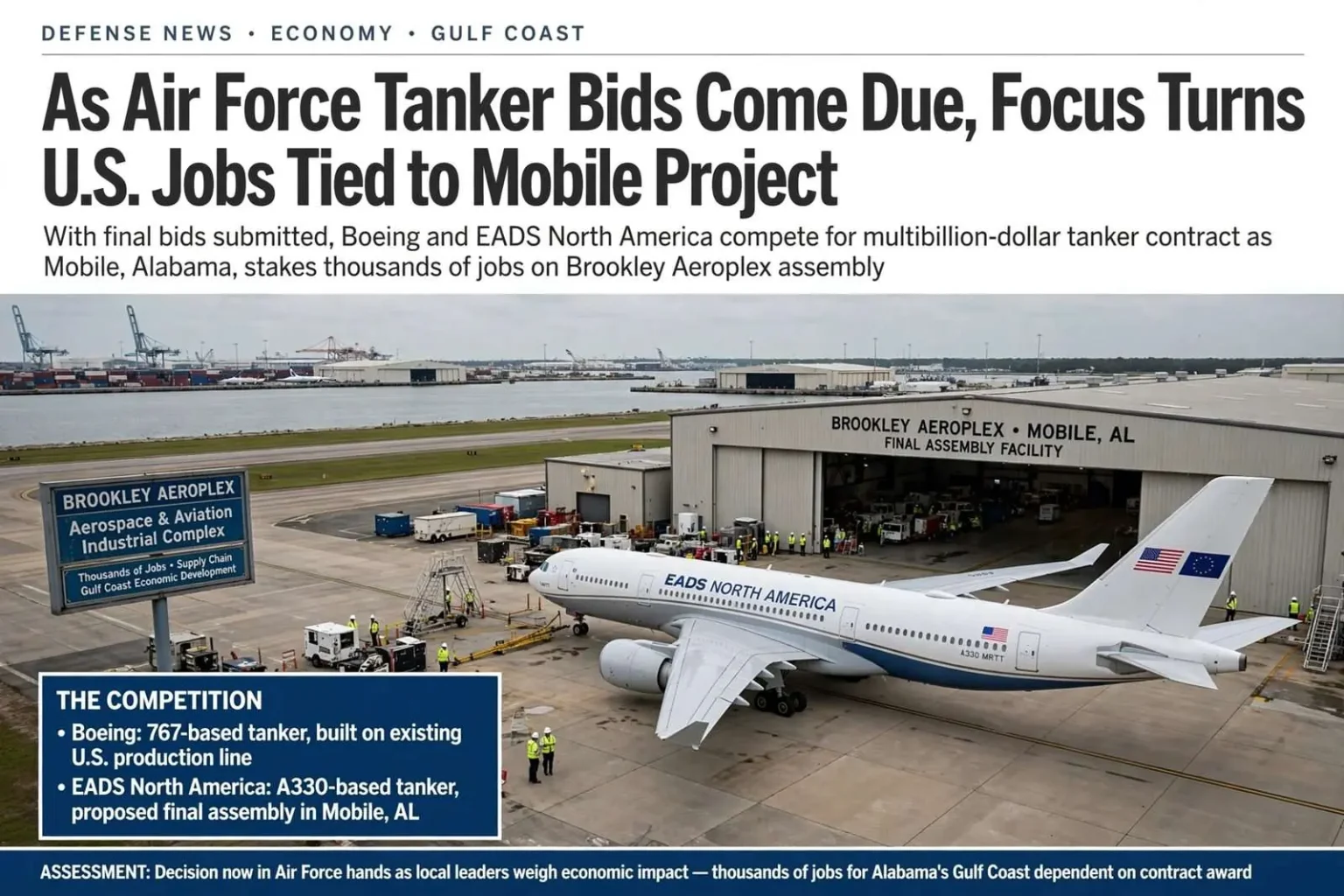
With the deadline for final bids on the Air Force’s multibillion-dollar aerial refueling tanker contract arriving, much of the public debate around the competition has centered on a familiar question for the two rival teams: how many American jobs would actually come from each side’s plan, and where would they land. The contest pits Boeing, offering a tanker based on its 767 airliner, against EADS North America, the U.S. arm of European aerospace group EADS, offering a larger tanker based on the Airbus A330. EADS has proposed final assembly of its tanker at the Brookley Aeroplex in Mobile, a plan that has made the outcome of the bidding a closely watched local economic story rather than a distant Washington procurement fight.
The stakes for Mobile are difficult to overstate. Final assembly of military aircraft at Brookley would make the city one of a handful of places in the country where large military airframes are built, bringing the engineers, machinists, and supplier plants that follow such work. Civic leaders along the Gulf Coast have spent years courting aerospace employers as the region works to diversify an economy long anchored by shipbuilding, the port, and tourism, and the tanker bid represents the largest single opportunity the region has pursued in that effort.
Competing Claims on U.S. Supply Chains
Both companies have leaned heavily on claims about domestic content and supplier networks as the bid deadline approached. Boeing has argued that its tanker, built on an existing U.S. production line, would rely on a long-established American supply chain and preserve jobs already in place. EADS and its backers have countered that a Mobile assembly operation would create jobs in a region that does not currently have a large-scale commercial aircraft manufacturing presence, rather than simply shifting existing work from one location to another.
Supporters of the Mobile-based option have also pointed to Boeing’s own extensive use of outsourced, internationally sourced components on its newer 787 Dreamliner program as evidence that neither company can claim a purely domestic supply chain. The Dreamliner program drew wings from Japan, fuselage sections from Italy, and parts from suppliers across Europe and Asia — a sourcing model Boeing pioneered as it globalized production. Boeing has disputed that comparison, noting differences between commercial airliner programs and a military tanker built for the Air Force, where mission requirements, security rules, and the defense industrial base shape sourcing decisions differently than they do in the commercial market.
The jobs debate has been amplified by the political weight both camps have brought to it. Members of Congress from Washington State, where Boeing’s existing production lines anchor thousands of jobs, and from Alabama and the Gulf Coast, where EADS would build, have pressed the Air Force and each other over which bid truly represents American manufacturing. EADS has emphasized that its U.S. operation would be American in substance, with American workers and American suppliers, while Boeing’s allies argue that profits, engineering depth, and corporate decision-making remain on American soil only in Boeing’s case.
What’s at Stake Locally
For Mobile and the surrounding region, the tanker competition has been framed as a chance to land a marquee aerospace manufacturing project and the supplier activity that could follow it, at a moment when the local economy was also absorbing the effects of a punishing national recession. The Brookley Aeroplex — the sprawling former Brookley Field that the Air Force closed in the late 1960s and the city has spent decades converting into an industrial and aviation complex — sits on Mobile Bay just south of downtown, with deep-water access, runway infrastructure, and room for the large hangar buildings that final assembly would require.
EADS is not starting from a standing stop in Mobile. The company has operated tanker-related work at Brookley for years, maintaining and supporting aerial refueling aircraft flown by other customers, and the experience gave the city a track record to point to when the new competition opened. Those operations demonstrated that a European airframer could run a disciplined industrial operation on the Gulf Coast and that local workers could perform the specialized maintenance and modification work military tankers demand — a proof of concept that underpins the final-assembly bid.
A Competition Measured in Decades
The tanker contract is not an ordinary procurement. Aerial refueling tankers are the aircraft that extend the reach of nearly every American air combat mission, allowing fighters and bombers to stay aloft longer and travel farther without landing. The Air Force’s existing fleet of refueling planes is built around airframes that are, in many cases, older than the pilots flying them, and the service has described replacing the fleet as one of its most urgent recapitalization priorities. Whichever company wins the current competition will hold a production program expected to run for years and to define the military’s refueling capability for decades, which is why both sides have fought the contest so hard through multiple rounds.
The bidding itself has a tangled history that Mobile residents have followed closely. An earlier round of the competition ended in protest, appeal, and a revised solicitation, and the team lineup shifted along the way before settling into the current head-to-head between Boeing and EADS North America. Each twist in the process has been dissected locally, because each one changes the odds that the prize — final assembly at Brookley — actually lands in Mobile. The arrival of the final bid deadline brings the contest to the point where paperwork becomes reality, or does not.
What a Win Would Mean for the Gulf Coast
Economists who study aerospace clusters describe final assembly plants as anchor institutions: the assembly line itself employs a core workforce, but the supplier contracts, engineering support, and training pipelines around it multiply the effect. Mobile’s bid is built on that multiplier logic. The city offers the Brookley complex, port access for shipping large components, a growing aviation maintenance sector, and workforce training programs that Alabama has used to recruit manufacturers to the state. Supporters argue that a tanker assembly line would validate Mobile as an aerospace city and attract the next generation of aviation employers to the Gulf Coast.
The counterfactual matters, too. If Boeing wins, the work goes to its existing production lines in Washington State, and Mobile’s role in the program would be negligible. That outcome would not erase the aerospace momentum the region has built — Brookley’s existing tenants, maintenance operations, and aviation employers would continue — but it would leave the city’s largest recruitment pursuit unrealized, and local officials have been candid that the competition’s outcome will shape the region’s industrial ambitions for a generation either way.
For now, the bids are in and the decision moves behind closed doors at the Air Force, where acquisition officials will evaluate the two proposals on cost, capability, and the lengthy technical requirements the service has written into the contract. The public argument over American jobs will continue until an award is announced, and both Mobile and the communities that depend on Boeing’s existing lines will be watching the same announcement with opposite hopes. Whichever way the decision falls, the bidding war has already secured one thing for Mobile: the defense industry now knows the city’s name, its airfield, and its workforce — assets that remain valuable no matter which tanker eventually flies.
The Politics of the Award
Tanker procurements have rarely stayed contained within the Pentagon. The program has drawn presidential-level attention, hearings on Capitol Hill, and fierce lobbying from the congressional delegations of every state touched by the outcome. Lawmakers from the Pacific Northwest have warned about the risk to an existing workforce and industrial base, while Gulf Coast delegations have pressed the Air Force to give full weight to the new capacity and competition a Mobile line would introduce. The World Trade Organization has also been pulled into the dispute in various forms, as the two governments behind the rival airframers — the United States and European Union — accuse each other of subsidizing their aircraft industries, an argument each side’s supporters have used to color the tanker debate.
For the Air Force, the task is to make the award on the merits written into the request for proposals: the aircraft’s capability, its lifecycle cost, the strength of each bidder’s plan to deliver on schedule, and the industrial commitments each has made. Acquisition officials have learned from the program’s turbulent history that a decision perceived as flawed invites another protest and another delay, so the evaluation that follows the bid deadline is expected to be exhaustive. The service has promised a disciplined process, and both bidders have said they will respect the outcome of a fair competition — while preparing, as ever, to challenge one that is not.
Mobile’s Long Game
Local officials in Mobile have been careful to frame the tanker bid as part of a longer strategy rather than a single bet. The Brookley Aeroplex already hosts aviation maintenance, modification, and manufacturing employers, and the city has invested in the infrastructure — roads, utilities, hangar space, and deepwater access — that aerospace work of any scale requires. Every round of the tanker competition, win or lose, has forced the city to sharpen its pitch, strengthen its workforce partnerships, and deepen its relationships with the airframers and their suppliers, assets that endure after any single procurement is decided.
The region’s economic development community points out that the Gulf Coast’s advantages are structural rather than sentimental: an ice-free port capable of handling oversized cargo, land available at a fraction of the cost of established aerospace hubs, a temperate climate that allows year-round construction and flight operations, and a labor pool that has grown up around shipbuilding, aviation maintenance, and heavy industry. Those fundamentals are why the city remains in contention for work of this scale, and why aerospace recruiters continue to list Mobile among the locations they watch closely.
As the evaluation proceeds, the practical question for Mobile residents is straightforward: whether the next large airframes to roll out of a Gulf Coast hangar will be built here by local hands, or whether the region will have to wait for the next opportunity to prove it can do the work. The bids are in, the arguments are made, and the decision that follows will be remembered in Mobile for what it says about the city’s place in American aerospace.


