At Least Two Hurt in Two-Vehicle Crash on Dr. MLK Jr. Avenue in Prichard
At least two people were injured when a pickup truck and a sedan collided near Dr. Martin Luther King Jr. Avenue and West Turner Road in Prichard.
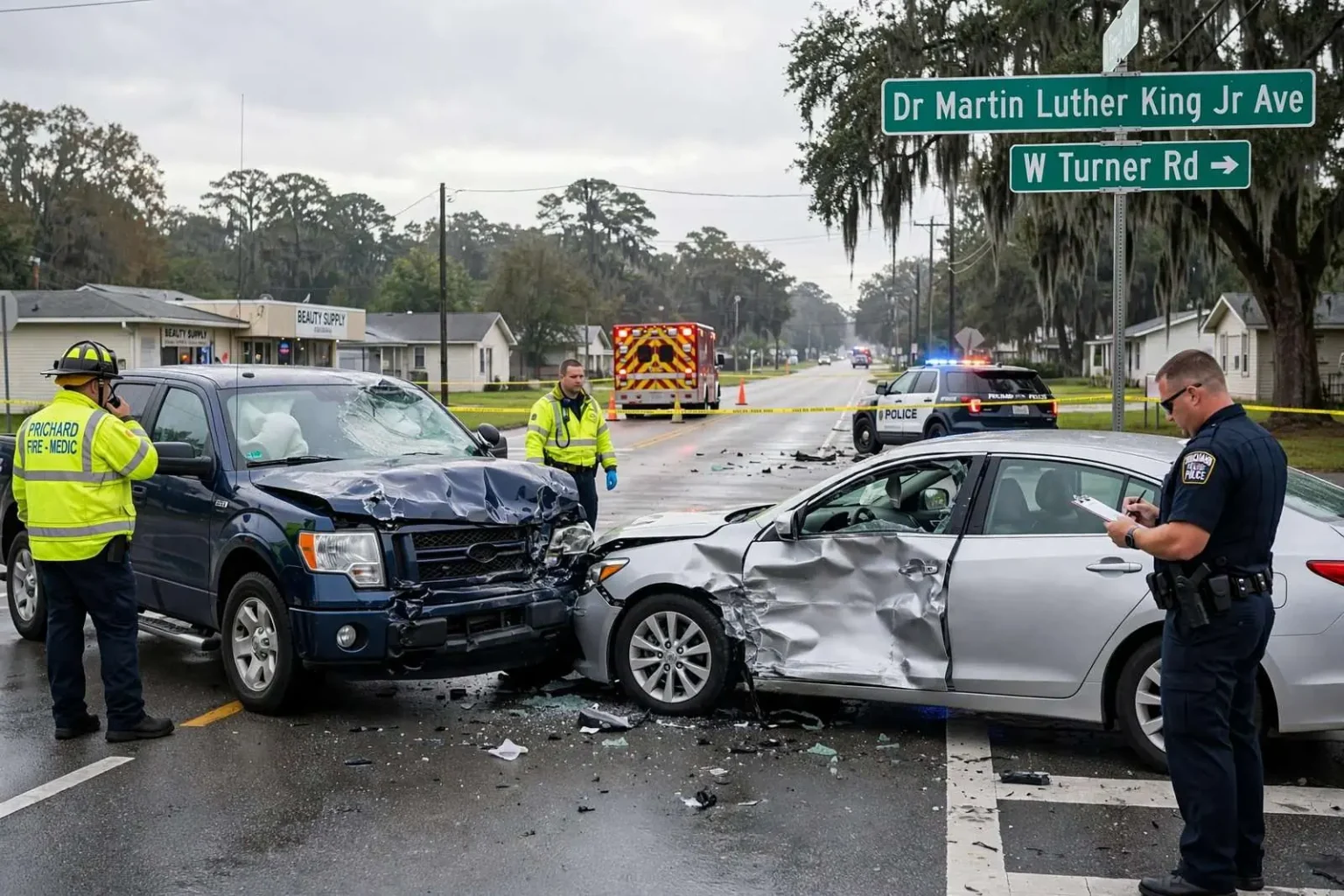
At least two people were injured Wednesday morning when a pickup truck and a sedan collided near the intersection of Dr. Martin Luther King Jr. Avenue and West Turner Road in Prichard. The crash was reported before 7 a.m. on July 17, 2019, at the start of the morning commute in one of the city’s busiest corridors. First responders who arrived at the scene said at least two people were hurt, though their injuries were not believed to be life-threatening. Authorities did not immediately say what led to the collision or whether any citations would be issued.
The timing of the wreck placed it squarely within the window when Prichard’s streets carry their heaviest traffic, as residents head toward jobs in Mobile, Chickasaw and other nearby communities. Morning crashes at signalized and unsignalized intersections alike are among the most common calls for service that fire and law enforcement agencies along the Gulf Coast handle, and the first hour after a wreck is often devoted to securing the scene, treating the injured and getting traffic moving again.
No further details about the conditions of those involved were released at the time. Officials also did not identify those hurt, which is common in the early stages of an injury crash investigation while families are still being notified and the extent of injuries is being evaluated.
A Corridor That Carries the City
Dr. Martin Luther King Jr. Avenue is one of the principal north-south thoroughfares in Prichard, a city of roughly 20,000 residents in northern Mobile County that borders Mobile and Chickasaw. The avenue runs through a dense mix of residential neighborhoods, churches, schools and small businesses, and it serves as a daily artery for commuters moving between the northern suburbs and the Port City. Its intersections with cross streets such as West Turner Road concentrate much of that movement into a small number of conflict points, where turning vehicles, pedestrians and through traffic all share the same pavement.
The stretch around West Turner Road sits in a busy residential and commercial corridor, with homes fronting the avenue and neighborhood streets feeding into it from both sides. During the morning hours, Dr. Martin Luther King Jr. Avenue carries steady commuter traffic, and drivers exiting side streets must often wait for gaps in a near-continuous flow of vehicles. Intersections like this one are familiar landmarks to Prichard residents, who navigate them on the way to work, school and errands every day.
Prichard’s street grid developed over decades as the city grew around the industrial and railroad corridors that shaped northern Mobile County. Many of its roads were laid out long before modern traffic volumes, which is one reason older intersections can become focal points for collisions as the population and traffic counts around them change. Cities across Mobile County have worked in recent years to improve signaling, striping and lighting at known trouble spots, but the fundamental geometry of older crossings remains a factor in how crashes happen there.
How Injury Crashes Are Handled
When a wreck with injuries is reported inside Prichard’s city limits, the response typically involves the Prichard Fire Department for medical care and fire suppression, ambulance transport for the injured, and police officers to investigate, document the scene and direct traffic. First responders triage everyone involved at the scene, and those with injuries that are not life-threatening are often evaluated and transported for further care as a precaution. The term itself covers a wide range of outcomes, from cuts and bruises to fractures and other injuries that require hospital treatment but are not expected to be fatal.
Once patients are cared for, attention turns to the roadway itself. Wrecked vehicles must be removed, debris cleared and, where necessary, fluid spills contained before traffic can return to normal. On a corridor like Dr. Martin Luther King Jr. Avenue, even a short closure can ripple outward, as drivers detour onto parallel residential streets that were never designed for heavy volumes. Officers generally work to reopen the road as quickly as safety allows.
Investigating the Cause
Authorities did not immediately say what led to the collision, and determining fault in a two-vehicle crash rarely happens in the first hours. Investigators typically interview drivers and witnesses, measure and photograph the scene, examine damage patterns on both vehicles and gather any available camera footage from nearby homes or businesses. From that material they reconstruct how the vehicles came together and whether speed, right-of-way, distraction, impairment or a mechanical problem played a role.
Whether citations are issued is often a separate decision made after the initial investigation, sometimes days later. In Alabama, municipal police have authority to charge traffic offenses arising from crashes on city streets, and serious-injury cases are sometimes reviewed with prosecutors before charges are filed. Until that review is complete, agencies frequently decline to assign fault publicly, which is why early reports of crashes like this one list the cause as under review rather than stating a conclusion.
Crash reports generated from such investigations also feed statewide and federal databases used to identify dangerous intersections and set safety priorities. That data collection is part of why every injury wreck matters beyond the people directly involved: patterns in the numbers can justify signal timing changes, added signage, lighting upgrades or enforcement campaigns at specific corners.
Intersection Safety in the Mobile Area
Mobile County consistently ranks among Alabama’s busiest counties for traffic volume, and intersection collisions are among the most frequent crash types reported across the region. Common contributing factors include failure to yield when turning across traffic, following too closely in stop-and-go commuter conditions, and drivers entering major roads from side streets without adequate gaps. Morning rush hours amplify all of these, because more vehicles are on the road at once and many drivers are pressed for time.
Local safety officials routinely urge drivers to approach busy intersections with extra caution: reduce speed well before the crossing, scan for vehicles and pedestrians on side streets, avoid distractions and leave following room that allows for sudden stops. Pedestrians in corridors like Dr. Martin Luther King Jr. Avenue are advised to use marked crossings where they exist and to be especially visible during early-morning hours when light is still low.
For residents of the neighborhoods around West Turner Road, the crash was a familiar reminder of how quickly routine trips can change. Emergency agencies across the Gulf Coast repeat the same guidance after wrecks like this one: move over or slow down for emergency vehicles, give first responders room to work, and report dangerous driving before it results in a collision.
What Comes Next
The two people reported hurt in the wreck were expected to recover, based on the initial assessments that their injuries were not life-threatening. Recovery timelines vary widely depending on the nature of the injuries, and some people hurt in crashes continue treatment for weeks after the initial hospital visit. Those involved, like anyone injured on Alabama roadways, may also face insurance claims and other practical matters while the official investigation remains open.
For the wider community, the more immediate lesson is about the road itself. Prichard’s main avenues will carry the same commuter load tomorrow morning as they did on the day of this crash, and the drivers on them will face the same split-second decisions at every cross street. Caution at the intersection of Dr. Martin Luther King Jr. Avenue and West Turner Road — and at crossings like it throughout Mobile County — remains the most effective tool available for keeping the next crash from happening at all.
Anyone who witnessed the collision or has information that could assist investigators is generally encouraged to contact the investigating agency directly. Additional details, including the official cause determination and any citations, had not been released as of the time of this report.
Emergency Response on Gulf Coast Roads
The speed and coordination of the first response plays a large role in how injury crashes end. Dispatchers sending help to a wreck like the one on Dr. Martin Luther King Jr. Avenue must quickly determine how many vehicles and patients are involved, whether anyone is trapped and whether hazards such as leaking fuel are present. Fire crews handle extrication and hazard control, paramedics focus on the injured, and law enforcement secures the scene so that rescue work can proceed safely alongside live traffic.
Agencies across Mobile County train together on multi-vehicle scenes for precisely this reason, and mutual aid agreements allow departments to call on neighboring crews when a scene demands more resources than one department can supply. A pickup truck and sedan colliding at commuter speed can produce significant vehicle damage, and responders must be prepared for anything from minor injuries to serious entrapment until they can assess the scene in person.
Residents who encounter a crash scene are reminded to follow the directions of officers on the ground and to avoid stopping to look, which slows the response and creates additional hazards. Alabama’s move-over law requires drivers approaching stopped emergency vehicles to change lanes or slow down, a rule designed to protect both the injured and the people helping them.
Prichard’s Road Network and Daily Life
Prichard occupies a distinctive place in Mobile County’s geography, stretching across the northern edge of the Mobile metropolitan area with a mix of older neighborhoods, commercial strips and wooded tracts. Because the city lies directly between growing suburbs and Mobile’s employment core, a large share of its residents commute through or out of the city every workday. That puts sustained pressure on avenues like Dr. Martin Luther King Jr. Avenue, which function simultaneously as neighborhood streets and commuter routes.
The dual role of these roads shapes daily life in ways residents know well. School zones activate in the morning, delivery trucks make stops along commercial stretches, and pedestrians walk to bus stops and churches along the same lanes that carry commuter traffic. Every intersection where a side street meets a main avenue — West Turner Road among them — becomes a point where those competing uses meet, and where a moment’s inattention can have consequences for an entire neighborhood’s morning.
City leaders and neighborhood associations in Prichard have long discussed traffic calming, improved lighting and better crosswalk visibility as ways to make corridors safer without rebuilding them. While the outcome of this week’s investigation remains pending, the crash near West Turner Road joins the ongoing conversation about how the city’s oldest streets can safely serve its present-day traffic.
As of the latest information available, the investigation into the collision remained active, and no citations had been announced. Further updates would come from the investigating agency as the review of the scene and the vehicles involved moves forward.