Atlanta Duo Brings Improvised Theremin-and-Lap-Steel Sound to Downtown Mobile’s Blind Mule
Atlanta improvisational duo Duet for Theremin and Lap Steel brought its genre-blurring, no-two-shows-alike sound to downtown Mobile's Blind Mule, pairing an instrument played without touch with a Southern slide-guitar tradition.
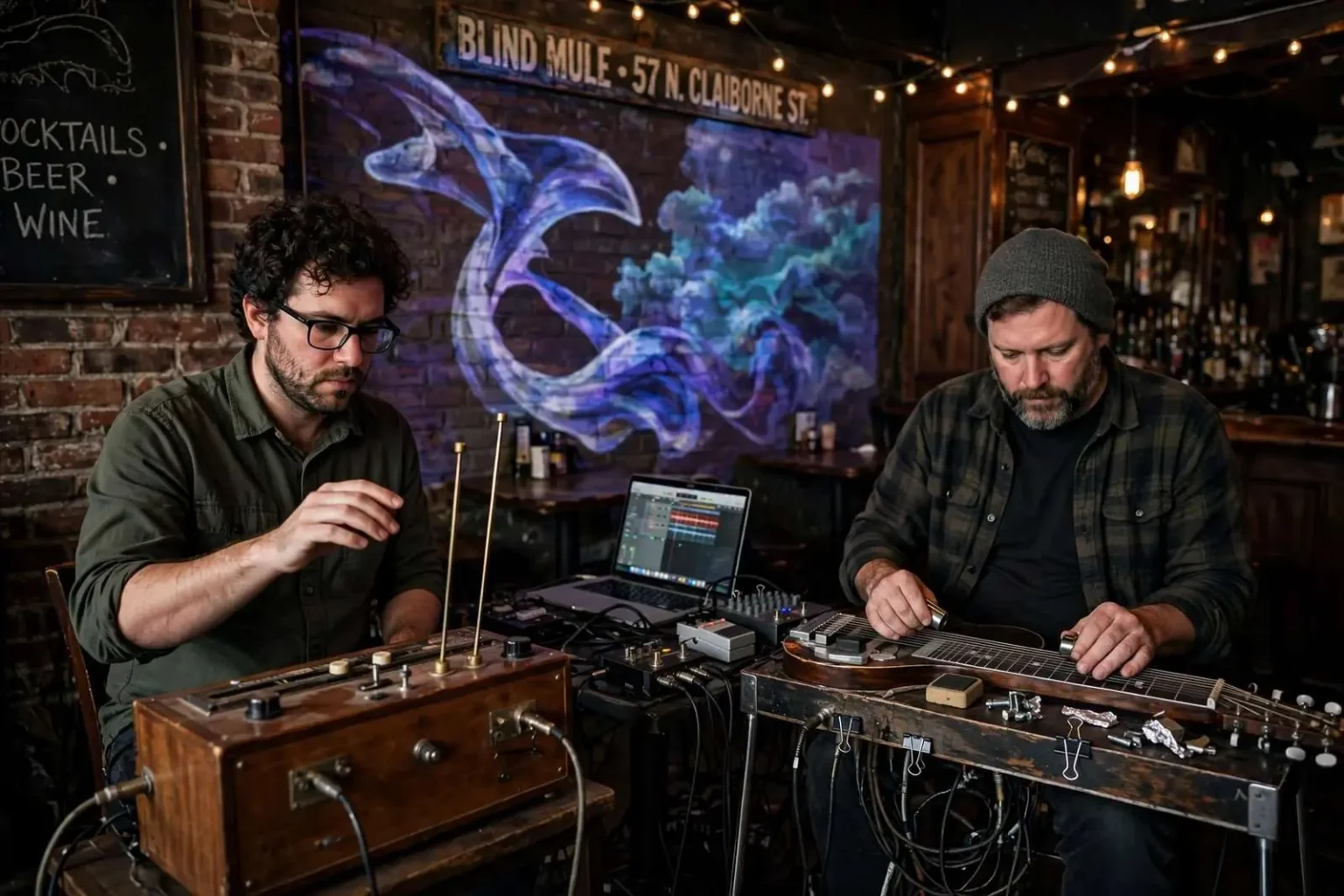
An Atlanta experimental music project built around two unlikely partners — the theremin, an instrument played without ever being touched, and the lap steel guitar, a Southern staple more often heard in country and blues — was set to bring its improvised sound to downtown Mobile. Duet for Theremin and Lap Steel was booked to perform with local artist Adam Taylor at 10 p.m. Saturday, May 15, at the Blind Mule, 57 North Claiborne Street, a longtime gathering spot in Mobile’s historic downtown district.
The duo, made up of musicians who go by Frank and Scott, does not play from sheet music or work within a fixed setlist. Instead, each performance is built in real time, drawing on electronic tones, laptop processing and prepared stringed instruments to create what the group has described as an environment of rich textures, swirling collages and hypnotic pulses that deliberately avoid conventional song structure. In an interview ahead of the Mobile show, the pair said their sets typically run 30 to 45 minutes without a break, unfolding as a single continuous piece rather than a string of individual songs.
An Improvised Listening Experience
According to the musicians, no two performances of Duet for Theremin and Lap Steel sound alike, since the material is generated live rather than rehearsed and repeated. On the tour that brought them through the Gulf Coast, the duo said they incorporated visual projections created by Atlanta filmmaker Robbie Land, adding a layer of moving imagery to accompany the improvised soundscape. The goal, the pair explained, is to give audiences something they have not encountered before — a listening experience shaped by mood and texture rather than melody or lyrics in any traditional sense.
Frank and Scott said the project’s roots trace back to an open improvisational music series hosted at the Contemporary, an Atlanta art gallery, organized by Robert Cheatham. It was there that Scott, playing theremin, and Frank, playing a prepared lap steel guitar, first crossed paths as performers, though they did not initially play together. The two later decided the pairing of instruments was worth pursuing as its own project. What began as a planned one-off performance turned into an ongoing collaboration that, by the time of the Mobile show, had continued for several years.
Asked what they hope listeners take away from a live set, the musicians said they aim for audiences to leave with the sense of having experienced something genuinely new — a sound and atmosphere unlike anything they had encountered before, and one that carries them, if only briefly, somewhere unfamiliar.
What Is a Theremin?
For audiences unfamiliar with the instrument at the center of the duo’s sound, the theremin remains one of the more unusual devices in the history of electronic music. Invented in the early 1920s by Russian physicist Léon Theremin, it is played without any physical contact: a performer moves their hands in the air near two metal antennas, and the instrument’s electromagnetic fields translate hand position into changes in pitch and volume. The result is a continuous, wavering tone that can range from eerie and ghostly to smooth and vocal-like, depending on the player’s control.
The theremin found early fame in classical and novelty music in the mid-20th century and later became closely associated with science-fiction film scores of the 1950s, giving it a reputation as the sound of the otherworldly and unknown. In the decades since, it has been adopted by experimental and avant-garde musicians precisely because of that unpredictable, non-fixed-pitch quality — there are no frets, keys or strings to guide the player, only careful, practiced control of hand movement in open space. That same open-endedness is part of what has made it a natural fit for improvisational projects like Duet for Theremin and Lap Steel.
The Lap Steel’s Southern Roots
The lap steel guitar occupies a very different place in music history, with origins tracing back to late 19th- and early 20th-century Hawaii, where musicians developed the technique of sliding a metal or glass bar along guitar strings held horizontally across the lap. The style spread to the American mainland in the early 1900s and became a foundational sound in country, blues and early rock and roll, eventually giving rise to the pedal steel guitar heard throughout Nashville recordings. In its more traditional form, the instrument is closely tied to twang, swoop and sustain — sounds long associated with rural and Southern music traditions.
By using a “prepared” lap steel — altering the instrument’s strings or adding objects to change its natural resonance, a technique with roots in 20th-century experimental composition — Frank’s side of the duo pushes the instrument away from its familiar country and blues associations and toward something closer to ambient drone or noise music. Paired with the theremin’s wavering electronic tone, the combination results in a sound that draws on Southern musical heritage while deliberately subverting it, landing somewhere between folk tradition and avant-garde electronic composition.
A Tradition of “Prepared” Instruments
The idea of altering an instrument’s natural sound through preparation did not originate with Duet for Theremin and Lap Steel. The best-known example in 20th-century music is the prepared piano, a technique pioneered by American composer John Cage in the 1930s and 1940s, in which objects such as screws, bolts, rubber erasers or strips of felt are placed between or on top of piano strings to transform its tone into something closer to a percussion ensemble than a conventional keyboard instrument. Cage’s prepared piano works helped establish a broader lineage in experimental composition built around modifying familiar instruments to produce unfamiliar sounds, rather than inventing wholly new instruments from scratch.
That same impulse runs through a prepared lap steel guitar: rather than building an electronic instrument to achieve an unconventional tone, the performer intervenes directly on a traditional acoustic or electric instrument, using its familiar form to produce sounds well outside its familiar repertoire. Combined with a theremin, an instrument that was electronic and unconventional from its very invention, the pairing reflects two different paths toward the same goal — music that resists easy categorization by drawing on, and then departing from, established instrumental traditions.
Atlanta’s Experimental and Improvised Music Scene
Duet for Theremin and Lap Steel’s origin story is itself tied to a broader tradition of improvisational and experimental music that has long had a foothold in Atlanta’s gallery and arts spaces. Open improvisation series, of the kind the duo described taking part in, have historically served as informal laboratories where visual artists, composers and musicians cross paths and experiment with combinations of instruments and sounds that would rarely appear together on a conventional bill. These series are typically low-key, low-cost events held in gallery or studio spaces rather than traditional concert venues, and they often serve as the incubator for projects, like this one, that later go on to tour more broadly.
That kind of small-venue, DIY circuit is also how many experimental acts based outside major metro areas end up reaching audiences in mid-sized cities like Mobile. Rather than playing large concert halls, touring experimental and improvisational musicians frequently rely on independent bars, restaurants with back rooms or attached music spaces, and small listening rooms that are willing to book acts outside the mainstream. For audiences, that means genuinely unconventional live music is often more accessible in an intimate bar setting than in a formal concert hall.
This circuit of galleries, small bars and independent venues has long functioned as a proving ground for musicians working outside commercial genres, giving them a way to build an audience gradually, city by city, without depending on radio play or major festival slots. For a duo built entirely on improvisation, that kind of low-pressure, listening-focused setting is often better suited to the material than a large room designed for dancing or singing along — a quiet bar crowd willing to sit with a 30-to-45-minute continuous piece is, in many ways, the ideal audience for the kind of show Duet for Theremin and Lap Steel set out to deliver in Mobile.
The Blind Mule and Downtown Mobile’s Music Scene
The Blind Mule, located at 57 North Claiborne Street, has long operated as one of downtown Mobile’s neighborhood restaurant-and-bar gathering spots, situated in the heart of the city’s historic district a short distance from Dauphin Street and the LoDa (Lower Dauphin Street) entertainment corridor. Like many similar establishments in Mobile’s downtown core, the venue has functioned not just as a place to eat and drink but as a small stage for local and touring musicians, part of a broader network of bars, restaurants and clubs that have helped sustain a live-music culture in the city’s historic center for decades.
Downtown Mobile’s entertainment district has weathered significant change over the years, shaped by shifting tastes, the rise and fall of individual venues, and periodic waves of investment in the area’s historic buildings. Small rooms like the one hosting Duet for Theremin and Lap Steel have often played an outsized role in that ecosystem, giving local and regional audiences access to touring acts — from blues and rock bands to more experimental fare — that might otherwise bypass the Gulf Coast entirely. Bringing a project like Duet for Theremin and Lap Steel to a bar stage, rather than a formal concert setting, reflects that same longstanding pattern of Mobile’s smaller venues serving as an entry point for music that falls outside the regional mainstream.
A Night of Improvisation on Claiborne Street
For Mobile audiences accustomed to more traditional live-music bills, Duet for Theremin and Lap Steel’s stop at the Blind Mule offered a different kind of evening — one built not around familiar songs but around a single sustained, improvised piece shaped by two instruments rarely heard together, augmented by projected visuals and shared alongside a set from local performer Adam Taylor. Whether or not it was a style of music Mobile crowds had encountered before, it was, by the musicians’ own description, exactly the kind of unfamiliar territory they hoped to lead their listeners into for one night on North Claiborne Street.