Atmore business owner charged with reckless murder after child dies in hot car
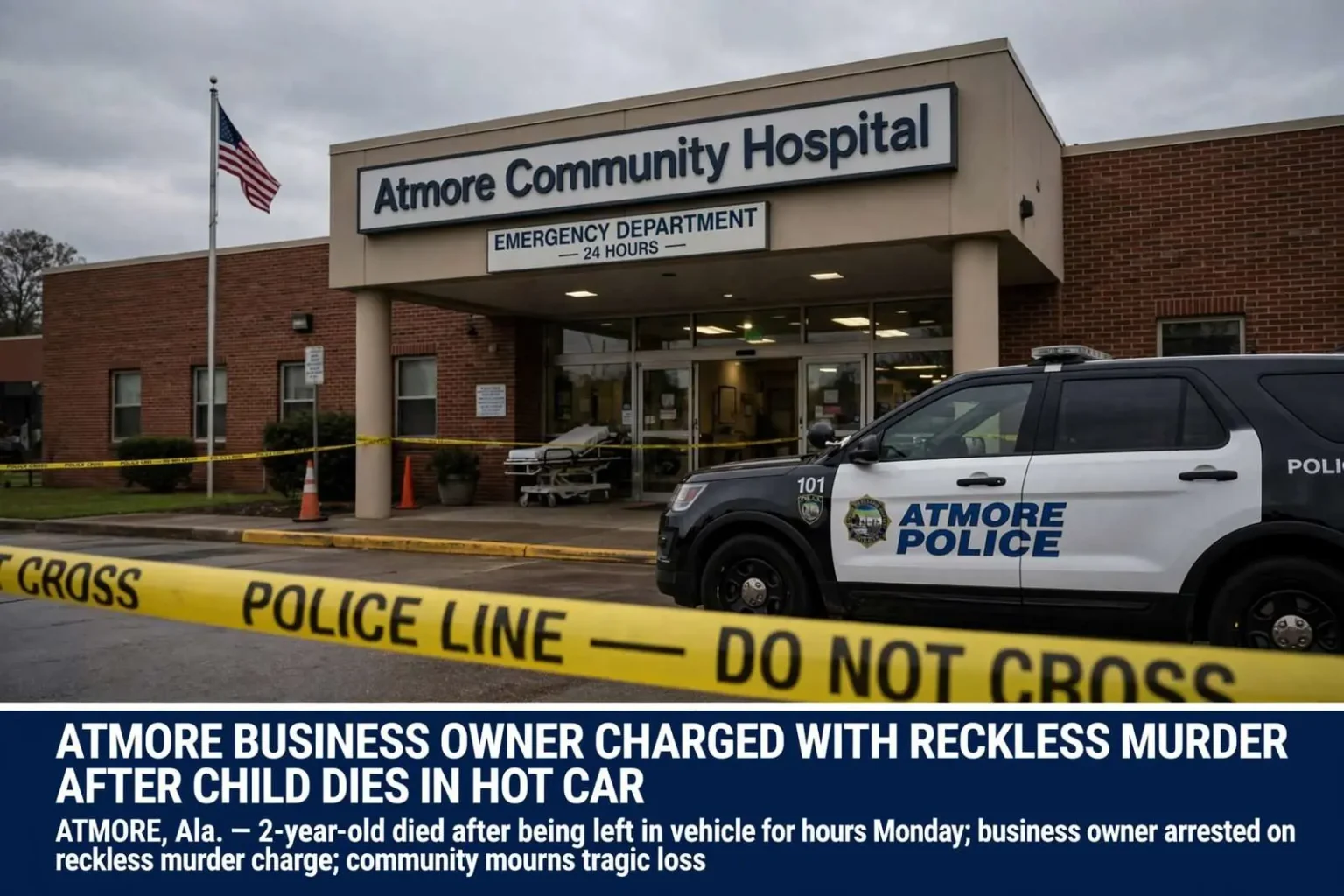
An Atmore business owner has been charged with reckless murder after a 2-year-old child died following hours inside a vehicle, the Atmore Police Department.
ATMORE, Ala. — An Atmore business owner has been arrested and charged with reckless murder after a young child in his care died following an hours-long period inside a vehicle, according to the Atmore Police Department. The case has stunned the small Escambia County community and brought renewed attention to the dangers of hot-car deaths, which claim the lives of dozens of children across the United States every year.
Officers were called to Atmore Community Hospital around 4:30 p.m. Monday after the child was brought in having been left in a car for several hours, police said. The child, who was 2 years old, was later pronounced dead at the hospital. What began as a medical emergency quickly became a criminal investigation as officers and detectives worked to establish how the child had spent the day.
How the Day Unfolded
Investigators said the child was supposed to have been dropped off at daycare that morning but never arrived. The detail proved central to the case: because no daycare worker was expecting the child, no one raised an alarm during the hours the child remained inside the vehicle, a pattern that recurs in hot-car deaths across the country when a routine break in a parent or caregiver’s schedule removes the checkpoint that would normally catch the mistake.
The father, Shawn Rounsavall, went to the daycare that afternoon to pick the child up and was told the child had not been dropped off. According to police, he then found the child in the backseat of his car and rushed to the hospital. Despite the efforts of hospital staff, the child could not be saved.
The sequence, from a missed daycare drop-off to an afternoon discovery, compressed a tragedy into a matter of hours. By the time emergency crews were involved, the window in which an intervention could have saved the child had long since closed, and the investigation turned from rescue to accountability.
The Arrest and Charge
Rounsavall was arrested and charged with reckless murder and was taken to the Escambia County (Ala.) Detention Center, authorities said. The charge, one of the most serious available to prosecutors in a case of this kind, reflects the state’s legal framework for deaths caused by conduct showing an extreme indifference to human life, and it signals that investigators concluded the circumstances went beyond a momentary lapse.
Reckless murder under Alabama law does not require an intent to kill. Instead, prosecutors can pursue the charge when a death results from conduct committed under circumstances manifesting extreme indifference to human life, a standard that hot-car cases can meet when a child is left for an extended period in dangerous heat. The charge carries the weight of a homicide prosecution, and the case will move through the Escambia County court system in the weeks and months ahead as prosecutors present evidence to a grand jury and the defense prepares its response.
Authorities have not detailed all of the evidence gathered in the investigation, and the case remains an active matter for the Atmore Police Department. As with any criminal charge, the accusation is not a conviction, and the legal process will determine what responsibility, if any, is ultimately established in court.
The Community and the Hospital
The response at Atmore Community Hospital placed a small-town medical facility at the center of a heartbreaking scene. Hospital staff who receive a child in that condition face a race against injuries that are often already catastrophic, and the pronouncement of death hours after the 4:30 p.m. arrival marked the end of attempts to reverse the effects of prolonged heat exposure.
News of the arrest spread quickly through Atmore, a city of a few thousand residents on the northern edge of Escambia County near the Florida line, where the childcare schedule of a single family is the kind of thing neighbors notice. The case became the subject of intense local conversation within a day, and police urged the public to allow the investigation to run its course rather than speculate about details that had not been confirmed.
Hot-Car Deaths: A Recurring Tragedy
The circumstances of the Atmore case mirror a pattern that safety experts have documented for decades. Pediatric vehicular heatstroke occurs when a child’s body temperature rises faster than an adult’s and the enclosed interior of a parked vehicle pushes temperatures far above the outdoor reading. Even on a mild day, the interior of a car can climb to lethal levels in a short time, and the effects on a small child begin within minutes.
Safety organizations that track these deaths describe a consistent set of scenarios: a caregiver who forgets a child in the backseat, a child who climbs into an unlocked vehicle to play and cannot get out, and a caregiver who knowingly leaves a child for what is intended to be a brief period. The first scenario is the most common, and researchers studying it have found that memory failures of the kind involved in forgotten-child cases can happen to caregivers of any background, particularly when routines are disrupted.
That research has driven a national push for technological safeguards. Childcare check-in procedures, backseat reminder systems built into newer vehicles, aftermarket sensors, and occupant-detection requirements under recent federal safety legislation all aim to break the chain of events that ends in a hot-car death. Advocates note that the single most reliable safeguard remains an external checkpoint, such as a daycare that contacts a parent when a child does not arrive, a safeguard that in the Atmore case existed in reverse: because the child was expected at daycare and never arrived, no one on the receiving end knew to call.
The irony highlighted by advocates is that the alert came only hours later, when a parent arrived to pick up a child who had never been dropped off. In cases where daycare staff notice a no-show earlier in the morning and reach a parent immediately, deaths have been prevented. The timing of that call is often the difference between a near-miss and a fatality, which is why childcare providers across Alabama and the Gulf Coast have made morning confirmation calls a standard practice.
What Charges Mean in Cases Like This
Prosecutors across the country have handled hot-car deaths with a wide range of outcomes, from no charges to manslaughter and murder prosecutions, and Alabama is no exception. The decision to charge reckless murder in the Atmore case places it among the more serious responses to such a death in the region, and legal observers note that outcomes in these prosecutions often turn on the duration the child was left, the temperature that day, the caregiver’s statements to investigators, and whether prior warnings or patterns can be shown.
The distinction between a tragic accident and criminal recklessness is the contested center of virtually every case of this kind, and it will be the battleground in court. Defense attorneys in similar prosecutions have argued that forgetting is not recklessness, while prosecutors have pointed to the length of exposure and the foreseeable, well-known danger of a hot vehicle as conduct that a reasonable person cannot ignore.
Atmore and Escambia County Context
Atmore sits in the northeastern corner of Escambia County, Alabama, along the corridor between Mobile and the Florida Panhandle, and serves as a commercial hub for the surrounding rural communities. The city’s police department handles the full range of investigations common to a small city, but cases involving the death of a child are rare, and the department’s handling of this one, from the initial hospital call to a felony arrest within a short span, reflected the gravity with which local authorities treat such deaths.
The Escambia County (Ala.) Detention Center, where Rounsavall was booked, serves the county’s jail population from Brewton, and initial appearances in felony cases of this kind move through the county’s district and circuit courts. Prosecutors will ultimately present the case to a grand jury, which decides whether the reckless murder charge proceeds to trial, a process that typically unfolds over months rather than days.
For the daycare at the center of the missed drop-off, the case brings its own painful aftermath. Providers who participate in these tragedies as the intended but unreached destination often review their check-in procedures afterward, and advocates encourage facilities across Alabama to treat a silent morning as an emergency rather than an absence, contacting families within minutes of a missed arrival.
A Warning for the Region
South Alabama’s climate makes the region’s hot-car risk particularly acute. Long stretches of warm weather mean that the conditions for pediatric heatstroke exist far beyond the summer months, and safety campaigns in Mobile County, Baldwin County, and the surrounding area have repeated the same guidance for years: never leave a child in a vehicle, even briefly; keep vehicles locked so children cannot enter unnoticed; and establish habits, such as placing a bag or phone in the backseat, that force a glance at the rear seats before leaving the car.
Emergency officials also urge bystanders to act. Alabama law provides immunity from civil liability for people who forcibly enter a locked vehicle to remove a vulnerable person, including a child, who appears to be in imminent danger, provided they first call 911 and use no more force than necessary. The statute exists precisely for situations where minutes matter, and officials have consistently told the public that a call to authorities should always accompany, and ideally precede, any intervention.
For Atmore, the case will be remembered as the kind of event a small community does not prepare itself for. A 2-year-old is gone, a parent sits charged with one of the most serious crimes on the books, and a business family at the center of the town’s daily life has become the center of a criminal case instead. The courts will sort out legal responsibility, but the underlying lesson that safety advocates draw from every such death is the same one they will draw from this one: the routines built around children are their protection, and every link in that routine matters.
The Atmore Police Department has not announced additional arrests, and investigators continue to gather information. Anyone with information relevant to the case is encouraged to contact the department as the judicial process moves forward.