Atmore man identified as sole fatality in Highway 21 chase crash
A 39-year-old Atmore man, Warren Stallworth, was killed Thursday night when a pursuit ended in a fatal crash on Highway 21 in Atmore, according to ALEA.
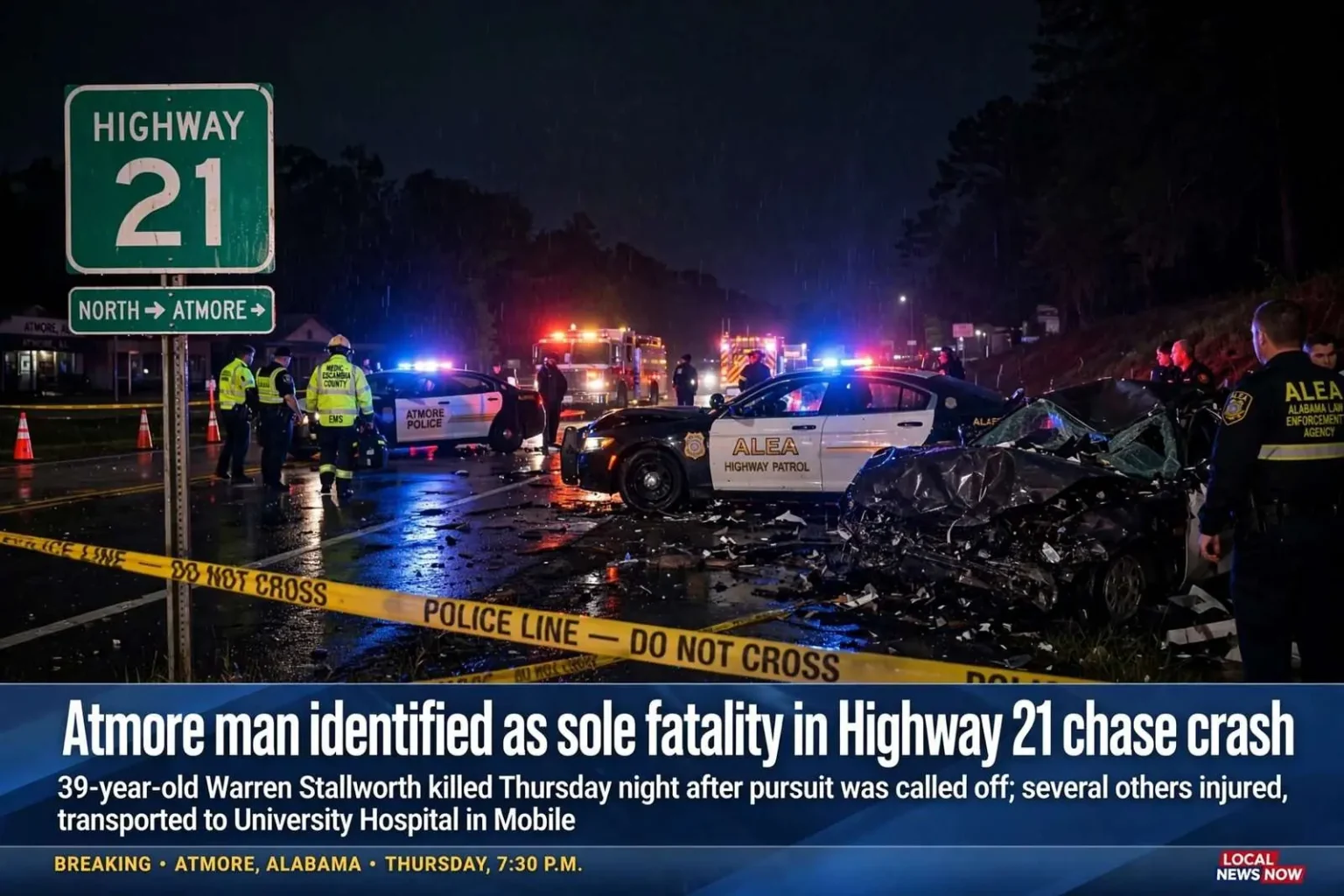
ATMORE, Ala. — A 39-year-old Atmore man was killed Thursday night when a police pursuit ended in a crash on Highway 21 in Atmore, according to the Alabama Law Enforcement Agency. The crash occurred after 7 p.m. in Escambia County, on the stretch of U.S. Highway 21 that runs through the heart of Atmore. Investigators said a pursuit had been called off just before the crash occurred.
ALEA later identified the man who died as Warren Stallworth, 39, of Atmore. Officials said Stallworth was not wearing a seat belt at the time of the crash and was ejected from the vehicle. He died from his injuries at the scene, making him the sole fatality of the night.
Other people were reported injured in the crash as well. Those patients were transported to University Hospital in Mobile, the region’s major trauma center, for treatment, authorities said. The severity of their injuries has not been publicly detailed, and officials have not said how many people were hurt or which vehicles they occupied.
How the crash happened
The chain of events began with a pursuit involving law enforcement, though authorities have not released details about which agency initiated the chase, why it began, or how long it lasted. What investigators have confirmed is that the pursuit was called off before the crash — a decision officers make when the danger a chase poses to the public outweighs the need to catch a fleeing driver immediately. Even after a pursuit is terminated, the fleeing vehicle can continue at high speed, and that is what investigators say happened here: the crash on Highway 21 came moments after the pursuit ended.
Crashes that follow terminated pursuits are investigated under the same protocols as any serious collision. ALEA’s Highway Patrol Division handles crash reconstruction across Alabama, and its units document skid marks, vehicle damage, roadway conditions and witness statements to piece together speed, timing and fault. In this case, the presence of other injured victims means investigators will examine every vehicle involved to determine the sequence of impacts and what role the fleeing vehicle played.
Atmore Police assisted ALEA with the crash response, helping close the roadway, direct traffic and support the paramedics who worked the injured. Nighttime crashes on a highway corridor like Highway 21 require shutting down lanes while evidence is collected, and local officers typically hold the scene for hours while ALEA completes its on-scene work.
Highway 21 and the Atmore corridor
U.S. Highway 21 is a main artery through Atmore, carrying commuter traffic, casino-bound visitors and commercial vehicles through the city and north-south across Escambia County. It intersects with U.S. Highway 31 and sits near the Interstate 65 corridor that connects Atmore to Mobile and Pensacola. Crashes on the highway through town happen at a mix of speeds — high-speed collisions at its edges, lower-speed ones at its signals — and serious wrecks routinely draw the city’s police and fire units as first responders.
For residents of Atmore, the Thursday-night crash was a stark reminder of how quickly a routine stretch of roadway can become a disaster scene. Emergency response on Highway 21 draws on the city’s police and fire services alongside county EMS units, and patients with critical injuries are typically routed toward University Hospital in Mobile, roughly 50 miles to the southwest, because it serves as the region’s Level 1 trauma center with the surgical capability that severe crash injuries demand.
Seat belts and ejection: why the outcome was likely decided in seconds
ALEA’s disclosure that Stallworth was not wearing a seat belt and was ejected from the vehicle underscores one of the most consistent findings in crash research: ejection is among the deadliest events in any collision. Motorists who are fully or partially ejected from a vehicle in a crash face dramatically higher risks of death than those who remain restrained inside, because the human body absorbs the impact with the roadway, the vehicle or both. Alabama’s seat belt law makes failure to buckle up a citable offense for front-seat occupants, and troopers across the state spend substantial enforcement effort on belt checks for precisely this reason.
Traffic safety officials have spent decades making the same case to Alabama drivers: in a rollover or high-speed impact, the belt is what keeps a person inside the vehicle’s protective structure. Crash investigators involved in fatal ejection cases routinely note that the difference between a survivable collision and a fatal one can come down to whether a belt was fastened. That lesson, repeated in crash report after crash report, is part of why agencies publicize belt status when they disclose the circumstances of a fatal wreck.
The decision to call off a pursuit
Pursuit policy has become one of the most closely watched areas of law enforcement practice in recent years, and Alabama agencies are no exception. Officers weigh the seriousness of the suspected offense, the danger a fleeing driver poses to the public, traffic and road conditions, and the speeds involved. When those factors tip toward risk, supervisors or the pursuing officers themselves can call the chase off — ordering their vehicles to slow and drop back while the fleeing driver continues on.
Calling off a pursuit does not end the danger a fleeing driver poses. A vehicle that continues at high speed after the pursuit ends remains a threat to everyone on the roadway, and crashes like Thursday night’s are the reason agencies document pursuit decisions in detail afterward. Investigators will review when the pursuit began, why it was terminated, how much time passed before the crash, and what the fleeing vehicle did in between — all of which becomes part of the record that prosecutors, courts and reviewing officials rely on.
The investigation and what comes next
ALEA has said its investigation is ongoing, and that means the public account of Thursday night’s crash will be filled in as troopers complete their work. Crash reconstruction can take weeks: investigators measure and photograph the scene, download data from vehicle systems where possible, interview witnesses and injured parties, and wait on toxicology results and any lab work before finalizing their findings. The completed report typically assigns contributing factors and, where appropriate, supports criminal charges filed by the district attorney’s office.
Because other people were injured in the crash, the file will include statements from every driver and occupant involved. Those accounts help investigators determine the sequence of the collision and whether the fleeing vehicle made contact with the other vehicles, forced them off the roadway, or caused drivers to swerve. The answers matter both for the families of those hurt and for any legal proceedings that follow.
Stallworth’s death is the kind of outcome that ends no one’s suffering. His family in Atmore is left to grieve, and the people injured in the crash face their own recoveries, some of them at a trauma center 50 miles from home. Officials have not released details about the other victims, and ALEA has not said whether additional charges are anticipated.
What drivers on Highway 21 should take from the crash
The crash is a reminder of the stakes on Alabama’s rural and small-city highways, where speeds run high, traffic mixes commuters with visitors unfamiliar with the road, and emergency response times can stretch. Traffic safety officials urge drivers to buckle up on every trip, to move over and slow down for emergency scenes, and to report dangerous drivers they encounter by calling 911 with a location and description rather than attempting to follow them.
Reporting a reckless driver instead of chasing one is the lesson agencies repeat most often in cases like this. A call to 911 gives trained dispatchers the information they need to send units ahead of the fleeing vehicle, while a civilian following too closely adds a second danger to the road. The Thursday-night crash on Highway 21 in Atmore, with one man dead and others hospitalized in Mobile, is a measure of how much rides on that choice — for the drivers involved and for everyone else on the highway that night.
Emergency response on a small-city highway
The response to a serious crash on Highway 21 pulls together agencies from across the area. Atmore’s police and fire units are typically first on scene in city limits, arriving within minutes of the initial calls. Paramedics triage the injured, package the most critical patients for transport, and coordinate with receiving hospitals while the roadway is shut down. When victims are hurt badly enough to require trauma-level care, the drive to University Hospital in Mobile becomes part of the treatment itself, with crews monitoring patients over a 50-mile transport.
Escambia County’s emergency dispatchers manage that coordination, deciding which units respond, where ambulances will transport each patient, and how to keep the roadway closure from paralyzing traffic through town. On a highway like 21 — one of only a handful of north-south routes through Atmore — a full closure after 7 p.m. sends detoured traffic through city streets and nearby county roads, and officers spend hours managing the flow while investigators work the scene.
Fatal crashes and the toll on a community
Each fatal crash in a community the size of Atmore sends ripples well beyond the families involved. Neighbors wake to closed roads, first responders carry the scene with them, and schools, churches and workplaces absorb the loss in the days that follow. Alabama’s traffic fatality figures are compiled each year by ALEA and federal safety agencies, and the state’s rural highways — including corridors like Highway 21 — consistently account for a disproportionate share of deaths, a pattern tied to speed, seat belt use and the longer distances to trauma care.
Safety advocates in southwest Alabama have long pushed the same basics: buckle up on every trip, drive at speeds suited to the road, and never flee from a traffic stop. The consequences of that last piece of advice cut both ways in this case — the fleeing driver who kept going after the pursuit was called off was the one who did not survive, and the people hurt alongside him now face the aftermath. As ALEA’s investigation continues, the findings will become part of the official record on what happened Thursday night on Highway 21 in Atmore, and the community will be left to absorb one more loss on a road it travels every day.