Atmore man taken into custody after barricading himself inside home
An Atmore man was taken into custody after barricading himself inside a Sneed Drive home during a domestic dispute, police said.
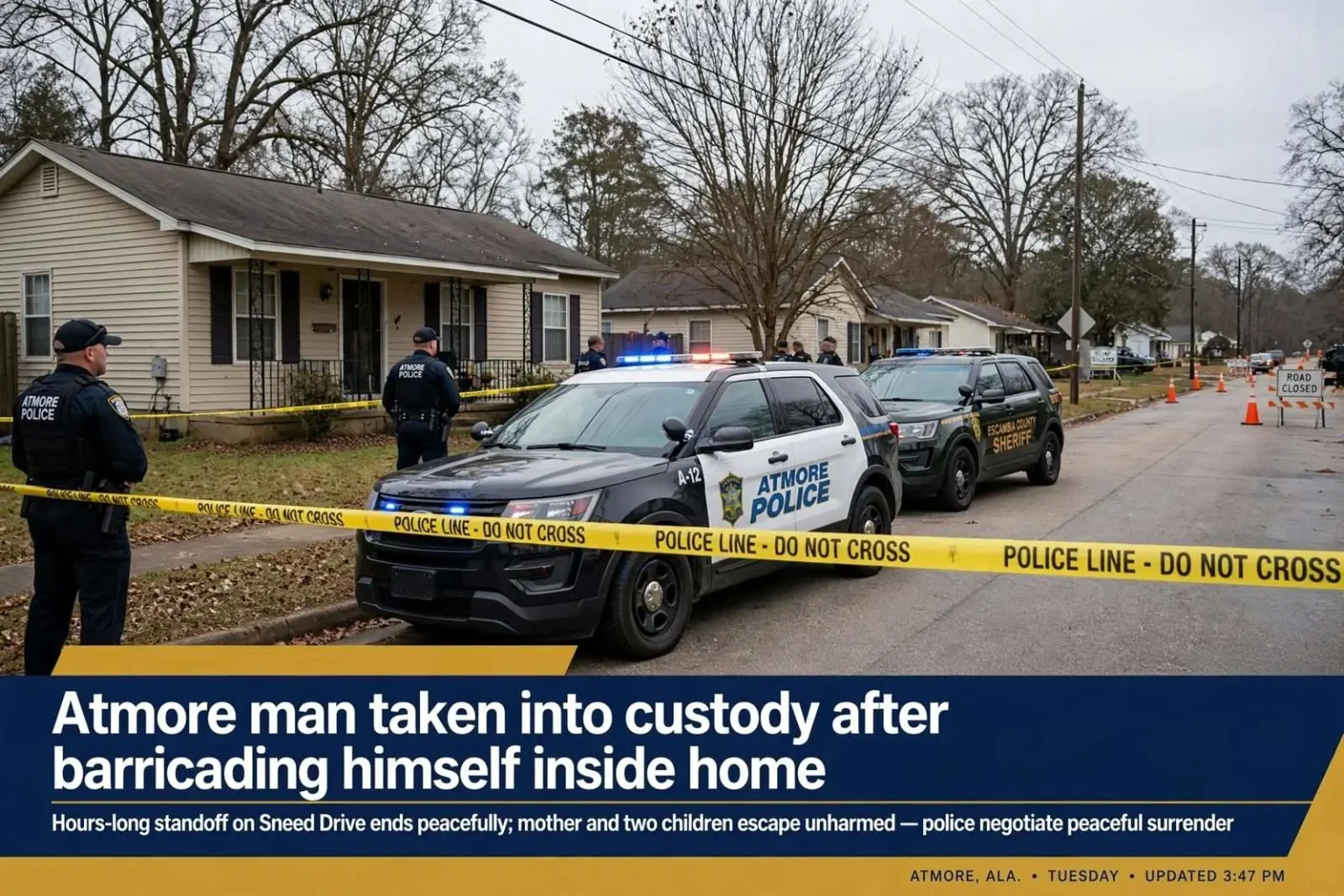
ATMORE, Ala. — A man who barricaded himself inside an Atmore home for several hours was taken into custody Tuesday after a standoff with police, ending an ordeal that began with a domestic dispute and a gunshot into the air. Atmore Police surrounded a residence on Sneed Drive as they attempted to make contact with the person inside, working through the kind of slow, methodical process that law enforcement agencies use to resolve barricade situations without gunfire.
Few details were available initially, but authorities said a man had barricaded himself in the home. The incident began as a domestic dispute between the suspect and his parents, police said — the familiar starting point for a large share of the barricade calls that departments across Alabama handle each year. What separates a argument that blows over from a neighborhood-shaking standoff is usually the presence of a weapon and the refusal of one party to come to the door.
How the incident unfolded
The suspect, identified as John Bradley James, fired a shot into the air Tuesday morning. Two children were inside the home at the time, and the sound of gunfire inside a residence with children present is precisely the circumstance that turns a domestic call into a full tactical response. Officers establish a perimeter, clear nearby residents from harm’s way and begin attempting communication with the person inside while waiting for specialized units to arrive.
Police said the mother was able to slip out of the house with the children and get to safety, removing the most vulnerable people from the scene before negotiations progressed further. The father was later allowed to leave as well. With the home’s other occupants out, officers could focus entirely on the man inside, applying the patience that barricade response demands — holding the perimeter for hours rather than forcing an entry that could provoke violence.
Inside a barricade response
Standoffs of this kind follow a well-worn playbook that departments across the Gulf Coast train on. The first officers on scene contain the residence and establish a safe distance; a supervisor takes command; and negotiators attempt to open a line of communication, often by phone, working to de-escalate while tactical officers stage nearby. The surrounding block is typically closed to traffic, and neighbors may be asked to stay inside or away from windows while the incident is resolved.
The goal from the first minutes is a surrender without injury. Commands are designed to give the person inside a face-saving way out — instructions to exit the home with hands visible, one step at a time, away from any weapons. Agencies measure these incidents in hours precisely because rushing them multiplies the risk to everyone involved, including the officers on the perimeter and any residents still nearby.
Statements that raised the stakes
Authorities said they believed James intended to harm officers based on statements he made earlier in the day during communications with police. Threatening language directed at officers changes the character of a standoff: it justifies the heavier tactical posture that departments adopt, and it becomes a factor in the charges prosecutors ultimately file, since assault-related offenses in Alabama cover threats and conduct aimed at peace officers performing their duties.
Despite that assessment, the resolution stayed on the peaceful side of the ledger. James was taken into custody without injury, police said — the outcome every agency involved in barricade response trains for and the one that, statistically, most standoffs reach when negotiators are given time to work. No officers, family members or neighbors were reported hurt in the incident.
Atmore and its police department
Atmore is a city of roughly 8,000 people in Escambia County, sitting just south of the Alabama-Florida line along the CSX rail corridor that built the town more than a century ago. The community’s police department is a small agency that handles the full range of municipal calls — traffic, thefts, domestic disputes — with mutual aid available from the Escambia County Sheriff’s Office and, when situations demand it, regional tactical teams. A hours-long barricade incident is among the most resource-intensive calls a department that size can face, pulling nearly every available officer into the perimeter and negotiation effort.
Domestic-related calls are a persistent and dangerous category of police work in communities of every size. Federal statistics have long shown that a disproportionate share of officers killed in the line of duty are responding to domestic disturbances, which is why dispatchers treat those calls with elevated caution and why departments send multiple units even to disputes described as verbal.
Domestic disputes and escalation
The sequence alleged here — a family argument, a firearm discharged inside or around a home, and a barricade — mirrors the escalation pattern that domestic-violence researchers have documented for decades. Firearms in the home dramatically raise the lethality of domestic disputes, and Alabama law provides specific protections in these situations, including domestic violence charges that carry their own sentencing structure and bond conditions once an arrest is made.
Under Alabama’s domestic violence statutes, offenses are graded by the relationship between the parties and the seriousness of the conduct, with first-degree domestic violence — involving serious physical injury or the use of a dangerous weapon — charged as a felony. Discharging a firearm in a occupied residence can also support reckless endangerment allegations, and threats made against officers during communications can be prosecuted separately. Which charges apply in the Sneed Drive case will be a decision for prosecutors reviewing the investigation file, and police had not announced formal charges at the time of the arrest.
Once a defendant is booked, the case moves to a bond hearing, and Alabama judges handling domestic-related cases have authority to impose no-contact conditions designed to keep alleged victims protected while the case is pending. Those conditions can prohibit the defendant from returning to the residence and from any contact with family members involved in the incident — protections that matter most in households with children.
The children and what comes next
The two children who were inside the home when the shot was fired will carry their own aftermath. Child-welfare practice across Alabama treats children’s exposure to domestic violence and gunfire as a form of harm in itself, even when no child is physically injured. Schools, pediatricians and family members are often the ones who notice the effects — sleep disruption, anxiety, behavior changes — in the weeks after an incident like the one on Sneed Drive.
Support resources exist in Escambia County and the surrounding region for exactly these situations, including crisis lines, counseling services and shelter programs for families fleeing domestic violence. Advocates stress that reaching out early — before an argument escalates to weapons or barricades — is the step most likely to keep a family out of the police blotter, and that a domestic dispute involving a firearm is a signal to seek help immediately, not to wait and hope the next episode resolves itself.
A quiet resolution after a long day
For the Sneed Drive neighborhood, the standoff meant a stretch of hours in which the street became a staging area — patrol cars along the block, officers at the corners and a slow wait for word that it was over. Incidents of this kind end the way this one did far more often than public perception suggests: with a surrender, an arrest and a neighborhood returning to normal, rather than with shots exchanged.
The Atmore Police Department credited the outcome to the containment-and-communicate approach that kept pressure off the man inside while the hours passed. James was taken into custody without injury, and the department said the investigation into the morning’s events would continue through the normal channels, with the evidence gathered at the scene forming the basis for whatever charges follow.
For residents of Atmore and the surrounding communities, the episode served as a reminder of the procedure to follow when a domestic situation turns dangerous: leave the area if it is safe to do so, call 911, and give responding officers the details they need — who is inside, whether weapons are present and whether children are in the home — so that the response can be built around protecting the people most at risk.
What neighbors saw and what it means
Standoffs reshuffle the normal rhythms of a residential street. Schools may hold buses, deliveries get rerouted and residents learn the outcome from a knock on the door or an official social media post rather than from anything they can see from behind closed blinds. In the days after the Sneed Drive incident, the questions most likely to circulate in the neighborhood — what set it off, whether anyone was hurt, what happens to the family — are answered in the details police have already released: a domestic dispute between the suspect and his parents, a shot fired into the air, two children escorted to safety by their mother, and an arrest made without injury.
Departments that handle these calls well tend to be transparent afterward, and Atmore officials kept the public informed through each stage as the situation developed Tuesday. The information flow matters beyond reassurance; accurate public accounts reduce speculation, and speculation in a small city travels fast. Atmore’s residents, like those of any community its size, know the streets and the families involved in incidents like this one, and clear facts from the department help keep rumor from filling the gap.
The case now moves from the street to the courthouse, where the decisions about charges, bond and conditions will be made by prosecutors and a judge rather than by negotiators. What happened on Sneed Drive on Tuesday — a full day that began with gunfire inside a family home and ended with a man in custody and a family safe — follows a path that Alabama’s courts have walked many times before, and the outcome of those proceedings will determine what accountability and, perhaps, what intervention looks like for the household involved.