
Atmore police search for armed, dangerous suspect Rayvon Desha Madison
Atmore Police are searching for Rayvon Desha Madison, 31, described as armed and dangerous after allegedly breaking into an ex-girlfriend's home and firing.
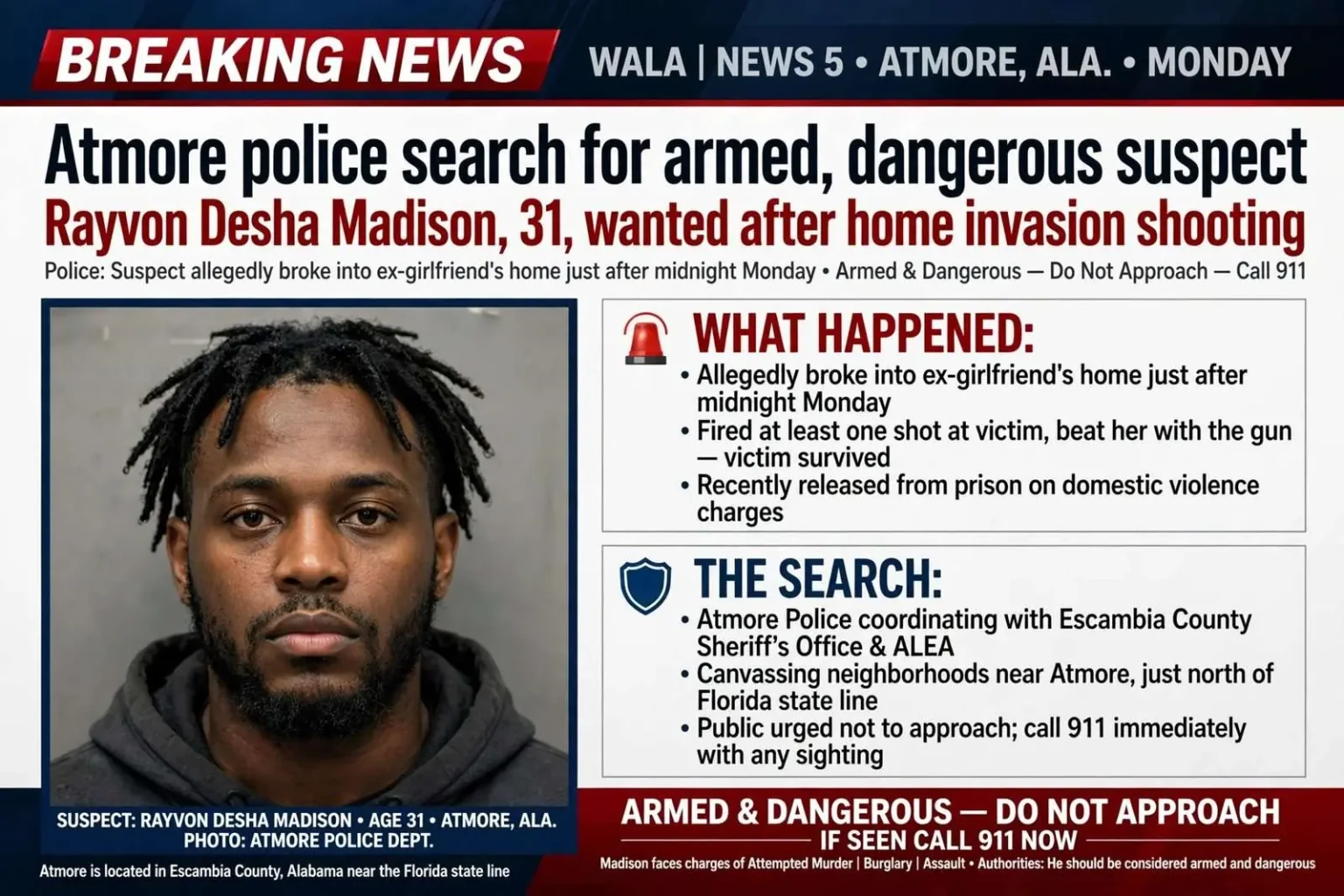
ATMORE, Ala. — Atmore Police are asking for the public’s help in locating Rayvon Desha Madison, 31, of Atmore, who they say is armed and dangerous. Investigators said that just after midnight Monday, Madison allegedly broke into the home of an ex-girlfriend, fired at least one shot at her and beat her with the gun, according to authorities. The victim survived the attack, and police have been actively searching for Madison since the break-in was reported.
Officials said Madison had recently been released from prison on domestic violence charges, a detail that has intensified the urgency of the search. Detectives consider him armed and dangerous, and they are warning residents that he should not be approached under any circumstances. Anyone who spots Madison is urged to call 911 immediately rather than contact him or try to detain him.
Madison faces charges of Attempted Murder along with several other offenses stemming from the early-morning home invasion, investigators said. The charges reflect the severity of the allegations: a forced entry into a residence, gunfire directed at the person inside, and an assault carried out with a firearm used as a weapon.
How the search is being conducted
Atmore police launched their search in the hours immediately after the attack, canvassing the neighborhoods around the victim’s home and following up on any information about where Madison might be staying. Officers have been checking with family members, associates and locations where Madison is known to spend time. Investigators have not said whether they believe Madison remains in the Atmore area or has left Escambia County, and they have not disclosed whether any vehicle is associated with the search.
The department has leaned on its standing partnerships with other agencies as the manhunt continues. Small-city police departments in south Alabama routinely coordinate with the Escambia County Sheriff’s Office, the Alabama Law Enforcement Agency and neighboring departments in Alabama and Florida when a suspect may have crossed the nearby state line. Atmore sits just north of the Florida border, roughly a dozen miles from the state line, so investigators are mindful that a suspect moving quickly could reach Florida within minutes.
Police have also emphasized the role of the public in the search. In cases like this, tips from residents — a sighting, a phone call about a familiar face, a report of someone knocking on doors after dark — often determine how quickly a suspect is found. The department’s message has been consistent: do not approach, do not confront, and call 911 with any sighting or information.
The danger of domestic violence after release from custody
The allegations in this case fit a pattern that domestic violence advocates and law enforcement officers know well: the period immediately after a defendant’s release from prison or jail is among the most dangerous for a former partner. Research on intimate partner violence has repeatedly shown that separation and its aftermath — custody changes, court dates, release from incarceration — are peak-risk moments for escalation, and attack. Advocates say the risk is highest when the prior relationship involved firearms, threats or prior violence.
Alabama’s courts treat repeat domestic violence with escalating seriousness, and a charge of Attempted Murder — filed here along with several other offenses — signals that prosecutors view the alleged attack as a deliberate attempt to kill. Under Alabama law, attempted murder is a Class A felony, the state’s most serious class short of capital offenses, punishable by up to life in prison. Burglary of an occupied home and assault charges layered on top of it can add decades more exposure if convictions follow.
For the victim, the immediate aftermath involves more than the criminal case. Domestic violence advocates in southwest Alabama help victims with safety planning, emergency shelter, protective orders and court accompaniment. Organizations serving Escambia County and the broader region operate 24-hour hotlines and work closely with law enforcement when an offender is at large, because an offender who has attacked once and remains free poses an ongoing threat to the person he targeted and to anyone sheltering her.
Atmore and the response of a small-city department
Atmore is a city of roughly 8,000 people in Escambia County, Alabama, near the Florida line, best known as the home of the Wind Creek Casino resort and as a waypoint along Interstate 65 and U.S. Highway 21. Its police department handles the full range of municipal law enforcement with a modest roster of officers, which makes an around-the-clock manhunt a significant strain on resources. Departments of this size typically pull investigators, patrol shifts and command staff into a coordinated effort and lean on mutual-aid agreements to fill gaps elsewhere in the city.
The department’s decision to publicize Madison’s name, age and description quickly is standard practice in armed-suspect cases, and it serves two purposes at once: it enlists thousands of extra eyes across the area, and it warns residents — especially anyone who knows Madison — that he should be treated as dangerous. Authorities have stressed that anyone who helps hide a fugitive can face criminal charges of their own, and that tips leading to a peaceful capture are far preferable to a confrontation.
What residents should do
Atmore police laid out clear guidance for the public. If Madison is spotted, do not approach him, do not call out to him and do not attempt to follow him. Call 911, give the dispatcher a location and description, and stay at a safe distance until officers arrive. Residents who believe they know where Madison is staying should report that information as well; dispatchers can pass tips directly to detectives without requiring a caller to leave a name.
Authorities also urged anyone connected to Madison — family members, friends, acquaintances — to encourage him to turn himself in rather than harbor him. A surrender to law enforcement ends the danger to everyone involved, and investigators have repeatedly noted that fugitives found through tip lines are typically taken into custody without injury. Until then, police say, the search continues around the clock, and the public’s calls remain the most valuable tool detectives have.
The wider problem of domestic violence in south Alabama
The case has drawn renewed attention to a problem that Escambia County and communities across south Alabama confront year after year. Domestic violence shelters and advocacy organizations in the region report steady demand for their services, and court dockets in the area carry a constant flow of protection-order petitions. Statewide, Alabama has strengthened its domestic violence statutes over the years, creating dedicated felony classifications for repeat offenders and for assaults committed in violation of a protective order, and law enforcement agencies have adopted lethality-assessment practices to identify victims at the greatest risk.
Firearms sit at the center of the most dangerous cases. Advocates note that a gun in the hands of a domestic violence offender multiplies the odds that an assault turns fatal, and the allegations in this case — a shot fired at a former partner, then the gun used as a bludgeon — illustrate exactly the escalation that advocates warn about. Judges handling such cases routinely order no-contact conditions and firearms restrictions as conditions of any release.
Support available to victims
For victims of domestic violence in the Atmore area and across southwest Alabama, help is available around the clock. Regional domestic violence shelters operate emergency hotlines that connect callers to safe housing, counseling, legal advocacy and help with protective orders, and advocates can meet victims at hospitals or police departments after an assault. The Alabama Law Enforcement Agency’s criminal justice division and county victim services offices can also connect victims with compensation programs that help cover medical costs, counseling and relocation expenses.
Advocates emphasize that anyone in immediate danger should call 911 first, then reach out to a hotline or a trusted person once they are safe. Safety planning — varying routines, securing documents, identifying places to stay — is most effective when it is done before a threat escalates, and advocates stress that leaving or reporting an abusive partner is the moment to ask for help, not to go it alone.
As the search for Rayvon Desha Madison continues, Atmore police say updates will come from the department as the investigation develops. The charges against him — Attempted Murder and several other offenses — are accusations at this stage, and the case will be decided in court. Until he is in custody, the department’s request to the public stands: keep watch, stay away, and call 911 with any sighting.
How manhunts typically unfold in Escambia County
When an armed fugitive is at large in the Atmore area, the search usually combines several approaches at once. Patrol officers maintain a visible presence in the neighborhoods where the suspect is known, both to deter further violence and to catch sightings quickly. Detectives re-interview witnesses from the original incident, run down addresses tied to the suspect, and monitor phone contacts and known associates. Meanwhile, deputies from the Escambia County Sheriff’s Office can extend the search into the rural roads and small communities surrounding the city, where a person familiar with the area might lie low.
Time is the critical variable. Law enforcement experience across south Alabama shows that fugitives in their home territory are most often found through acquaintances — someone sees them at a relative’s house, at a store, or parked along a county road. That is why departments publicize a suspect’s name and photograph early and keep the appeal for tips active day after day. Each passing hour also raises the possibility that a suspect has left the area, which is why agencies near the state line, like Atmore’s, loop in counterparts in Florida early in a case.
The outcome that police and advocates alike hope for is a peaceful arrest. A suspect taken into custody without incident preserves evidence, protects officers and the public, and moves the case into the courts, where the victim can begin to see the process play out with the suspect behind bars. Until that happens, Atmore authorities say the department will keep its search active and its request for public help open-ended: anyone who sees Rayvon Desha Madison, or knows where he is, should call 911 and let officers do the rest.