Atmore police seeking man with 9 felony warrants for credit card fraud
Atmore police are asking for the public's help finding Joseph Dooley, who is wanted on nine felony warrants for fraudulent use of a credit or debit card.
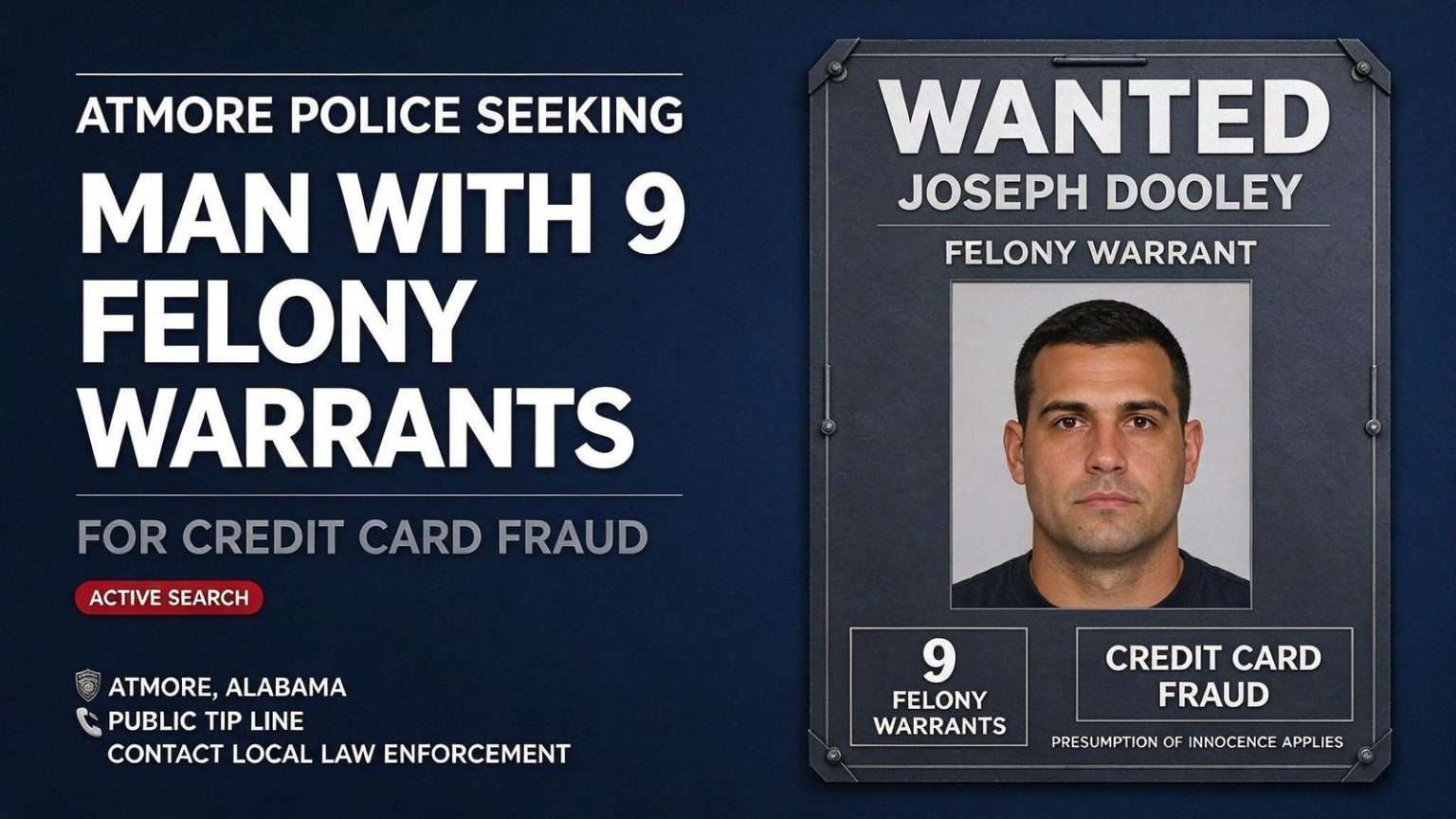
ATMORE, Ala. — Atmore police are asking the public for help locating a man they say tried to use a credit card that did not belong to him at a local Walmart, and who is now wanted on nine felony warrants. Investigators have identified the suspect as Joseph Dooley, and authorities have been working to find him since March, when the fraudulent card activity first came to their attention.
According to the Atmore Police Department, Dooley is wanted on nine felony warrants for fraudulent use of a credit or debit card. The charges stem from an investigation into attempts to make purchases with a card that was not his at the Atmore Walmart, a case that unfolded over weeks as detectives reviewed transactions and surveillance footage. Officials have not released details about the total value of the purchases involved or the specific dates connected to each warrant.
The department is urging anyone who sees Dooley not to approach him, but to contact local law enforcement immediately. Tips can be directed to the Atmore Police Department or to the Escambia County Sheriff’s Office, which works alongside the city department on cases that extend into the surrounding county. Callers who wish to remain anonymous can ask that their information be kept confidential when they report what they know.
Wanted-person notices like this one circulate among law enforcement agencies across south Alabama and the Florida Panhandle, and investigators say public sightings are often what finally bring a months-long search to an end. The department has continued to publicize the case in the hope that someone will recognize Dooley from the information released and report it.
How Credit Card Fraud Cases Are Built
Credit and debit card fraud investigations typically begin when a cardholder reports unauthorized charges or when a business flags suspicious purchase attempts. Detectives then pull transaction records from the affected accounts and match them against surveillance video from the stores where the card was used. That combination of paper trail and camera footage is often what allows investigators to identify a suspect, as it did in this case after months of work.
Under Alabama law, fraudulent use of a credit or debit card covers a range of conduct: using a card without the owner’s consent, using a card known to be revoked or canceled, obtaining goods or cash by misrepresenting oneself as the cardholder, or selling a card to someone else without authorization. The charge can be brought as a felony when the amounts involved or the circumstances of the offense meet the statutory thresholds, which is why a pattern of repeated attempts like the one described in Atmore can pile up into multiple felony counts rather than a single misdemeanor.
Each separate transaction attempt can support its own count, which helps explain how a single suspect ends up facing nine warrants from what might sound like one trip to one store. Prosecutors treat these cases seriously because card fraud costs businesses and cardholders across the region millions of dollars each year, and because the crime is often tied to identity theft that leaves victims dealing with damaged credit long after the purchases themselves are resolved.
For the victim whose card was used, recovery usually begins with a call to the issuing bank to cancel the account and dispute the charges. Federal consumer protections limit a cardholder’s liability for unauthorized credit card charges, but the process of filing disputes, correcting account records, and dealing with any ripple effects on credit reports can drag on for months. Businesses that accept a fraudulent card may also absorb losses if the transaction is charged back to them.
Atmore and Its Law Enforcement Landscape
Atmore sits in the northern part of Escambia County, Alabama, near the Florida state line along the U.S. 29 and Interstate 65 corridors. The city of roughly eight thousand residents is home to its own police department, which handles municipal calls, while the Escambia County Sheriff’s Office covers the unincorporated areas around it. The two agencies routinely coordinate, particularly on cases like this one where a suspect may move between city limits and the county to avoid detection.
The city’s location just south of the Poarch Band of Creek Indians reservation and its Wind Creek casino complex, and within easy driving distance of Pensacola and Mobile, means its retail corridors draw shoppers from a wide area. Stores like the Atmore Walmart handle high transaction volumes daily, making them a common focal point for fraud attempts — the combination of busy registers, self-checkout lanes, and distant cardholders makes large retail stores attractive targets for someone using a card that is not theirs.
When a suspect is identified but not immediately located, the warrants remain active indefinitely. Escambia County’s wanted-person lists circulate among area agencies, and deputies in neighboring Baldwin, Monroe, and Conecuh counties in Alabama and Escambia County in Florida all keep watch for people wanted across the state line. Someone driving on Interstate 65 or U.S. 29 through the region can be stopped for a routine traffic violation and taken into custody on outstanding warrants within minutes of the stop.
What Residents Can Do
Police departments across south Alabama consistently ask the public to help locate wanted individuals, and tips from residents often close cases that investigators have worked for months. Anyone who recognizes Dooley or knows where he has been staying is encouraged to come forward. Officials stress that people should not attempt to detain or confront a wanted person themselves — the safest approach is to call 911 or the local police department and report the sighting, along with the time, place, and direction of travel if the person is moving.
Residents can also protect themselves from becoming fraud victims in the first place. Financial institutions and consumer protection agencies recommend monitoring bank and card statements weekly, setting up transaction alerts through a bank’s mobile app, keeping debit and credit cards secured, and reporting any unfamiliar charge immediately. Quick reporting is one of the most effective tools in limiting losses, and it also gives investigators the freshest possible transaction records when they begin pulling surveillance video from the stores where a stolen card was used.
Business owners in the area have their own role to play. Training cashiers to check identification on large purchases, watching for repeated failed PIN entries, and preserving surveillance footage from suspicious transactions all strengthen the evidence available to detectives. In cases like the Atmore investigation, that store-level vigilance is frequently what turns a vague complaint into a set of warrants a prosecutor can take to court.
The Atmore case is also a reminder that fraud suspects identified through store surveillance can sometimes be linked to additional incidents once their photographs circulate. Investigators routinely share images of unidentified fraud suspects with other area departments, and a person wanted in one jurisdiction is often connected to similar attempts in others before an arrest is made. Each new connection can add counts to the charges a suspect ultimately faces.
Area retailers have seen a steady stream of card fraud attempts in recent years, reflecting a broader trend across the Gulf Coast region as card skimming, stolen card use, and online purchase fraud have grown. Local police departments have responded by building closer working relationships with store loss-prevention teams, who are frequently the first to spot a pattern and alert detectives.
What Happens When the Suspect Is Found
Once Dooley is taken into custody, he will be booked into the Escambia County jail system and brought before a judge for an initial appearance, where the nine warrants will be addressed and bond will be set. From there, the case moves to the Escambia County District Attorney’s office, which will review the evidence detectives gathered — transaction logs, store surveillance, witness statements, and any recovered property — before deciding how to proceed. As with any defendant, Dooley will be entitled to counsel and to the presumption of innocence as the case moves through the courts.
If the case is resolved by conviction, whether by plea or by trial, sentencing would follow Alabama’s guidelines for felony offenses, taking into account the amounts involved, the defendant’s prior record, and any restitution owed to the cardholder or the affected businesses. Restitution is a routine component of fraud sentences in Alabama, and courts typically order defendants to repay victims as part of the judgment.
Until an arrest is made, the nine warrants remain active, and the Atmore Police Department continues to ask for the public’s help. Investigators have spent months building the case since the fraudulent attempts were first reported in March, and they are counting on area residents to help finish the job. Anyone with information about Dooley’s whereabouts is urged to contact the Atmore Police Department, the Escambia County Sheriff’s Office, or any local law enforcement agency immediately.