Attorneys Speak Out After Pensacola Bridge Protester Jason Uphaus Is Arrested
Attorneys for Jason Uphaus release a statement after the Pensacola Bay Bridge protester was charged with disorderly conduct and criminal mischief.
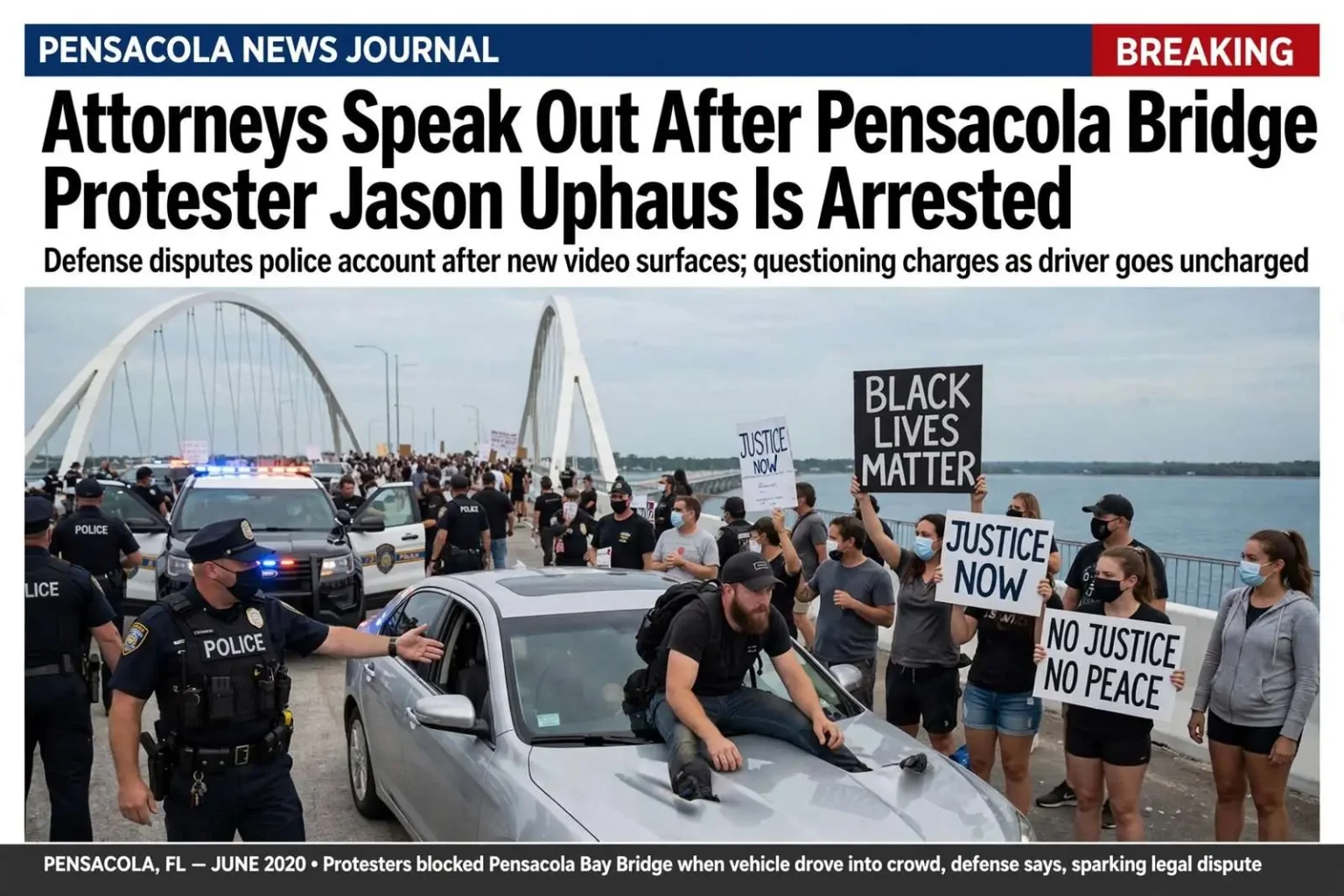
The attorneys for a Pensacola man seen in viral video riding on the hood of a car during a June protest have released a statement after his arrest, disputing the account that led to charges against him. Jason Uphaus was part of a demonstration that blocked the Pensacola Bay Bridge when, according to police, a vehicle drove into the crowd. The case has become a flashpoint in the ongoing national argument over how protest activity should be policed and prosecuted, and the release of additional video has sharpened the dispute between the defense and the city’s police department.
Newly released video shows officers directing drivers to make a U-turn, but one vehicle continued toward the protesters before crossing the bridge into Gulf Breeze — with Uphaus seen on its hood. That footage, the defense says, changes the picture presented in early accounts of the incident: rather than a protester leaping onto an innocent motorist’s car, it captures a driver passing through a line of officers into a crowd of demonstrators, with Uphaus ending up on the vehicle as it pushed through. What the video shows between the frames — who climbed where, and when — is precisely what the courts will now be asked to sort out.
Pensacola police charged Uphaus with disorderly conduct and criminal mischief following his Thursday morning arrest. The driver of the car has not been charged. That asymmetry sits at the center of the defense’s complaint: a demonstrator faces two criminal counts, while the motorist who allegedly drove into the crowd faces none. Prosecutors have not publicly detailed their reasoning, and it remains possible that charges could be added or evaluated as the investigation continues, but for now the charging decisions have themselves become part of the controversy.
The arrest also unfolded against the backdrop of a police department already navigating intense public scrutiny that summer. Agencies across the Gulf Coast faced pressure to demonstrate even-handedness in their handling of protest-related incidents, and every charging decision made in that climate invited second-guessing. Whether the Pensacola Police Department’s file on the bridge incident contains evidence that never reached the public — witness statements, additional camera angles, statements from the driver — is the unknown that both sides say the eventual trial will resolve. What is public so far is the video, the charges and the dueling interpretations of both.
The attorneys’ statement
In a statement, attorneys Chris Klotz and Eric Stevenson of Stevenson Klotz Law Firm described their client as part of a peaceful protest they say was interrupted by a driver who ignored an officer’s directions and drove into a crowd of people. The firm, a Gulf Coast practice known for personal injury and civil rights work, framed the case in those civil terms from the outset — a framing designed for both the courtroom and the court of public opinion. Their account emphasizes the sequence the video shows: officers managing the bridge closure, traffic being turned around, and one vehicle refusing to comply.
The attorneys criticized the timing and manner of the arrest, noting nearly a month passed before charges were filed and saying law enforcement did not wait the 24 hours they expected for Uphaus — a single father — to arrange childcare before voluntarily surrendering on what they called a minor misdemeanor. Instead, they said, he was taken from his home in front of his young child and transported to jail. The passage of nearly a month between the incident and the charges, they argued, undermined any claim that Uphaus was a flight risk or a danger, and the decision to arrest him at home rather than allow a scheduled surrender was, in their view, unnecessary theater at a child’s expense.
Both objections rest on the same principle: that the criminal process should be proportionate to the alleged offense. Disorderly conduct and criminal mischief are misdemeanor counts, not violent felonies, and defense attorneys across the country routinely negotiate voluntary surrenders in comparable cases. Whether the early-morning home arrest was standard procedure or an escalation is the kind of question that rarely gets litigated publicly — but in this case, the defense has made it a centerpiece of its narrative.
The arrest drew immediate attention locally, in part because of how widely the video had spread and in part because of the questions it raised about proportionality. Uphaus was booked into the Escambia County Jail and released on the misdemeanor counts, but by then the story had already traveled beyond the local news cycle, picked up by observers of the summer’s protest litigation across the country. Cases like this one — a demonstrator charged, a driver uncharged, and dueling videos — became a recurring pattern in 2020, and Pensacola’s version now sits in that larger docket.
“We look forward to trying this case, telling the whole story of what happened on the bridge, showing the reckless and callous history of the driver, and getting justice for Mr. Uphaus,” the statement read, adding that the firm would have more to say in the coming days. The reference to the driver’s “history” signaled that the defense intends to put the motorist’s record and conduct at issue, not just the events on the bridge itself.
The context on the bridge
The distinction between the two charges Uphaus faces illustrates the legal stakes. Disorderly conduct is a breach-of-the-peace offense, typically tied to conduct that obstructs or alarms; criminal mischief involves damage to the property of another, which in this case presumably refers to the alleged damage to the vehicle he was seen riding on. Neither charge requires injury, and neither is a felony, which is why the defense’s framing — minor misdemeanors, a month of silence, a home arrest in front of a child — has resonated with readers who followed the case. The prosecution’s task will be to show that the counts, however modest, rest on conduct the video actually proves.
The demonstration that blocked the Pensacola Bay Bridge was part of the wave of protests that swept the country in the weeks following the death of George Floyd in Minneapolis in May 2020. Marches and bridge blockades became recurring features of that summer in communities large and small, and the three-mile bridge connecting Pensacola to Gulf Breeze — one of the region’s principal crossings over Pensacola Bay — was a natural focal point for demonstrators seeking visibility. Blocking a highway is legally fraught, and police responses varied widely across the country that summer; the images from Pensacola joined a national catalog of encounters in which vehicles and crowds converged with dangerous results.
The viral video’s journey matters to the case as well. Cell phone footage from multiple angles circulated widely online in the days after the incident, shaping public perception long before any charging decision was announced. Defense attorneys now routinely build their cases around such footage, and the “newly released video” cited in the statement — material that had not been part of the initial public record — illustrates how these disputes evolve as more recordings surface. In an era when every protest is recorded from a dozen phones, the argument is rarely about whether something happened; it is about which angle of it becomes the official account.
What comes next
For Uphaus, the immediate path runs through the misdemeanor courts of Escambia County, where arraignment and pretrial proceedings will test the strength of the state’s evidence against the video the defense has highlighted. Misdemeanor cases often move quickly, but cases that carry public attention — and a defense firm promising further disclosures — tend to unfold under a spotlight. The firm’s pledge to “have more to say in the coming days” suggests additional evidence or statements were still being prepared when the statement was released.
The case also lands amid broader scrutiny of how law enforcement handles both protesters and drivers who enter crowds. Nationwide, the summer of 2020 produced dozens of incidents in which vehicles drove into demonstrations, prompting debates over when drivers bear criminal responsibility and when protesters blocking roadways assume risk. Pensacola’s bridge case has become the local chapter of that national argument, with the charging asymmetry — protester charged, driver not — standing in for the larger question of whose conduct the criminal law is policing.
Both sides, in the end, say the full video will vindicate them: prosecutors that it supports the charges against Uphaus, and the defense that it shows a peaceful demonstrator victimized twice — once by a car and once by the process that followed. A jury will eventually be asked to decide which reading holds. Until then, the bridge, the hood and the arrested single father remain the raw material of a case that has already outgrown its misdemeanors.