Aug. 28 Deadline Nears in Perdido Key Beach Access Fight
Escambia County residents have until Aug. 28 to submit evidence on historic public use of Perdido Key beaches as commissioners weigh a customary use ordinance.
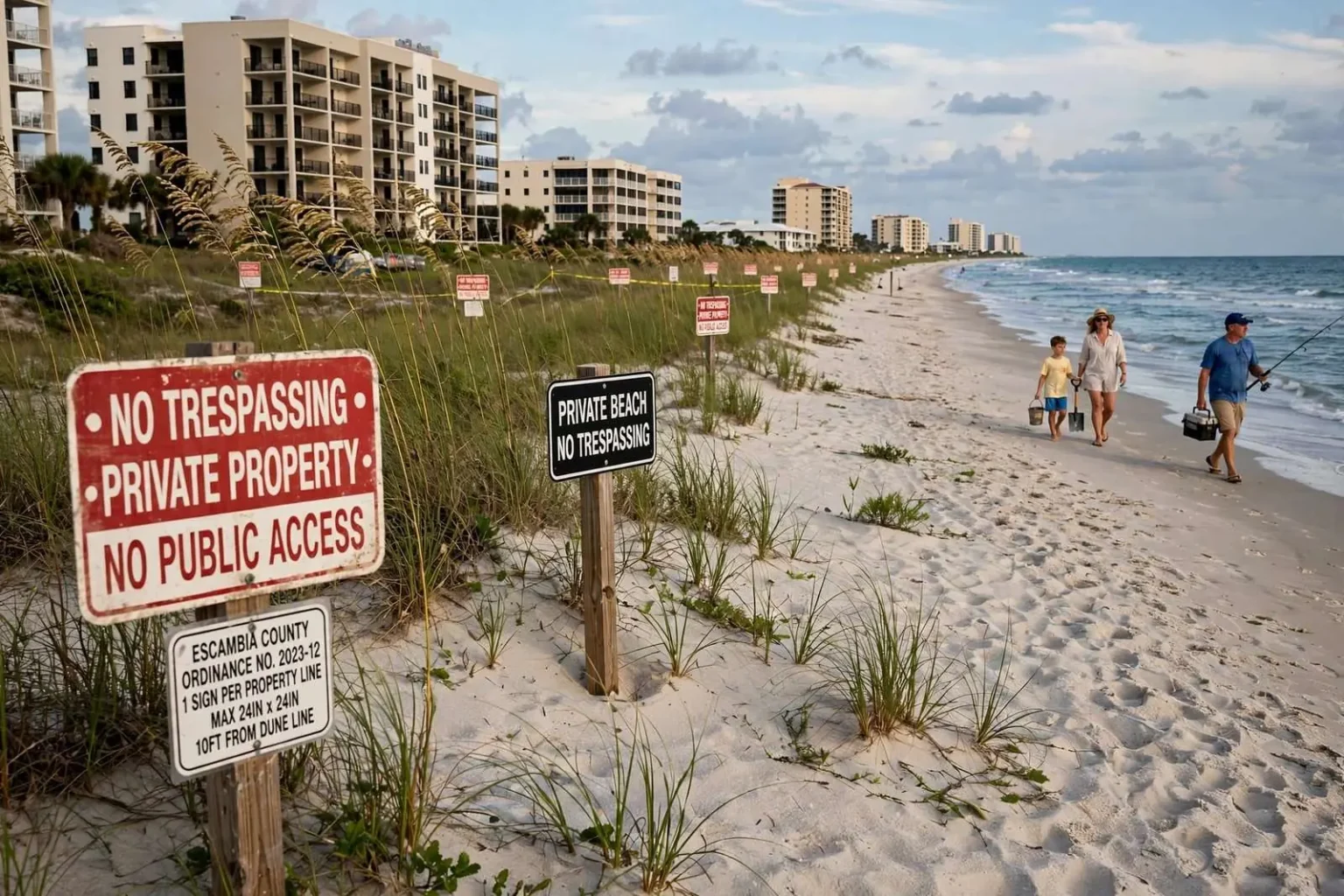
The public has until Aug. 28 to submit materials to an Escambia County portal that will help commissioners decide whether they can adopt a “customary use” ordinance — a rule that would allow public use of beach areas beyond the high tide line on Perdido Key beaches fronting private property.
“Many people may not realize that the ordinary things their families have done on Perdido Key for decades — walking the beach, fishing, swimming, bringing their children to the beach or simply spending summer afternoons there — may be an important part of documenting our community’s history,” said Sarah Brown, a spokesperson for a group advocating customary use.
A divided commission
This past June, seeking a permanent solution to a long-running dispute between private property owners and public access advocates, Escambia County commissioners voted 3-2 to approve a six-month plan to draft a customary use ordinance. Commissioners Steven Barry, Lumon May and Mike Kohler voted in favor, while Commissioner Steve Stroberger, who represents Perdido Key, opposed it, as did Commissioner Ashlee Hofberger, who represents Pensacola Beach.
County officials will take another 90 days to evaluate submissions, but there is no timeline for when — or whether — a customary use ordinance would pass.
The legal standard
The Florida Constitution already allows public access to all beaches below the mean high water line — the area that becomes wet at high tide. The doctrine of customary use extends public access above that line, into the dry sand, only if the use is “ancient, reasonable, without interruption and free from dispute.”
The number of no-trespassing signs in front of Perdido Key Drive condominiums has grown sharply over the past decade as condo owner associations aggressively marked their property. In 2023, the county limited owners to one no-trespassing sign per property line, placed 10 feet from the dune line — down from a previous allowance of three signs. That vote passed 5-0, and the ordinance also caps signs at 24 inches by 24 inches with a maximum height of 6 feet. According to reports, some condo associations are paying off-duty Escambia County deputies to keep people off portions of the beach during summer, and a widely circulated Facebook post is asking beachfront owners to submit deeds, plats, surveys and photos to defend their property.
The evidence question
Escambia County Attorney Alison Rogers said the county’s ordinance would need to designate the specific beach areas it covers, and that evidence such as deeds, historical records, easements, photographs and personal accounts would be necessary to back customary use claims. “Obviously, the best way to defend against lawsuits is that people voluntarily provide that access,” Rogers said — an outcome the article notes is not expected.
For decades before the late-1970s condo boom, Perdido Key was an Escambia County outpost where hanging out at night and building campfires was common. The commission is asking citizens to submit photos, testimonials and affidavits showing the public historically accessed the beaches without resistance from landowners.
“If we need to give board direction to say we think it’s an important enough issue that it’s worth the staff’s time to allow them to receive information from citizens,” Barry said. “Maybe we don’t get a lot of substantial, competent evidence, but maybe we do.” Kohler said he remembered when public access was customary: “I can tell you as a sailor that came here that it was customary use out there. That’s where you went when you didn’t have money.”
Property rights arguments
Reading from a statement at a March 26 meeting, Stroberger said asking for citizen input was a waste of county resources and that the county should instead continue trying to purchase Perdido Key beachfront for public use. “What we cannot do, at least not constitutionally, is redefine private land as public simply because it’s desirable,” he said. “Property rights include the right to exclude.”
“At its core, this debate is not about beach towels, umbrellas or access points. It’s about the right of exclusion — the most fundamental attribute of private property ownership. Without the right to exclude, ownership is hollow,” he added, arguing that active litigation itself undermines the claim that use has been “free from dispute.” Hofberger, before the vote, asked: “Where does it end? Because all waterfront property is desirable.”
Precedents and shifting law
For precedent, Escambia County can look to the town of Redington Beach, which passed a customary use ordinance in 2018 allowing public use of dry sand up to 15 feet from waterfront properties. Waterfront owners sued in 2019, arguing an unconstitutional taking, but a District Court concluded the town adequately showed a history of customary use dating to its 1935 founding. In Walton County, by contrast, a years-long legal battle has largely favored property owners, with most of the 1,200 targeted beachfront parcel owners securing dismissals or settlements — some of which established narrow public walking-and-sitting zones while explicitly declaring customary use does not apply.
The legal landscape shifted when the Florida Legislature passed a 2018 law stripping local governments of the ability to declare customary use without individual court challenges. Gov. Ron DeSantis signed a bill last year repealing that statute to restore local control, and an appeals court used the new law to deny appeals from Redington Beach homeowners earlier this year.
Deeded easements
Adding another wrinkle, the discovery of original deeds to Gulf-front properties on the westernmost two miles of Perdido Key, dating to 1957, revealed 75-foot public access easements written into them — opening about 1.2 miles of beach previously thought exclusive. The transfer of 64 deeds, from federally declared surplus land to private ownership, specified that the southerly 75 feet of the Gulf-front lots were subject to a perpetual easement for public beach use. A Perdido Key customary use ordinance, if implemented, would exempt that deeded property from the doctrine that long-standing public use overrides private property rights.
“I do believe that the beaches are for the public, but I also believe in property rights. It’s really quite a tightrope we have to walk with that,” Stroberger said in 2025.
Beachfront property owners have organized against the ordinance. “Don’t allow someone’s recollection of using a beach years ago to drown out documented evidence about how your specific property was actually owned, maintained, managed and protected,” read one statement on the group’s Facebook page, arguing that a person’s memory of walking, fishing, swimming or sitting on a stretch of beach does not, by itself, satisfy the legal requirements to establish customary use.
Where the Doctrine Comes From
Florida courts first recognized customary use in 1974, when the Florida Supreme Court ruled in City of Daytona Beach v. Tona-Rama Inc. that the public's long-standing use of the dry sand beach gave it a right to keep using that area, even though the land was privately owned.