Austal USA awarded two more LCS contracts from the Navy
Austal USA will build two more Independence-variant Littoral Combat Ships for the U.S. Navy, its 18th and 19th in the class, the Mobile shipbuilder.
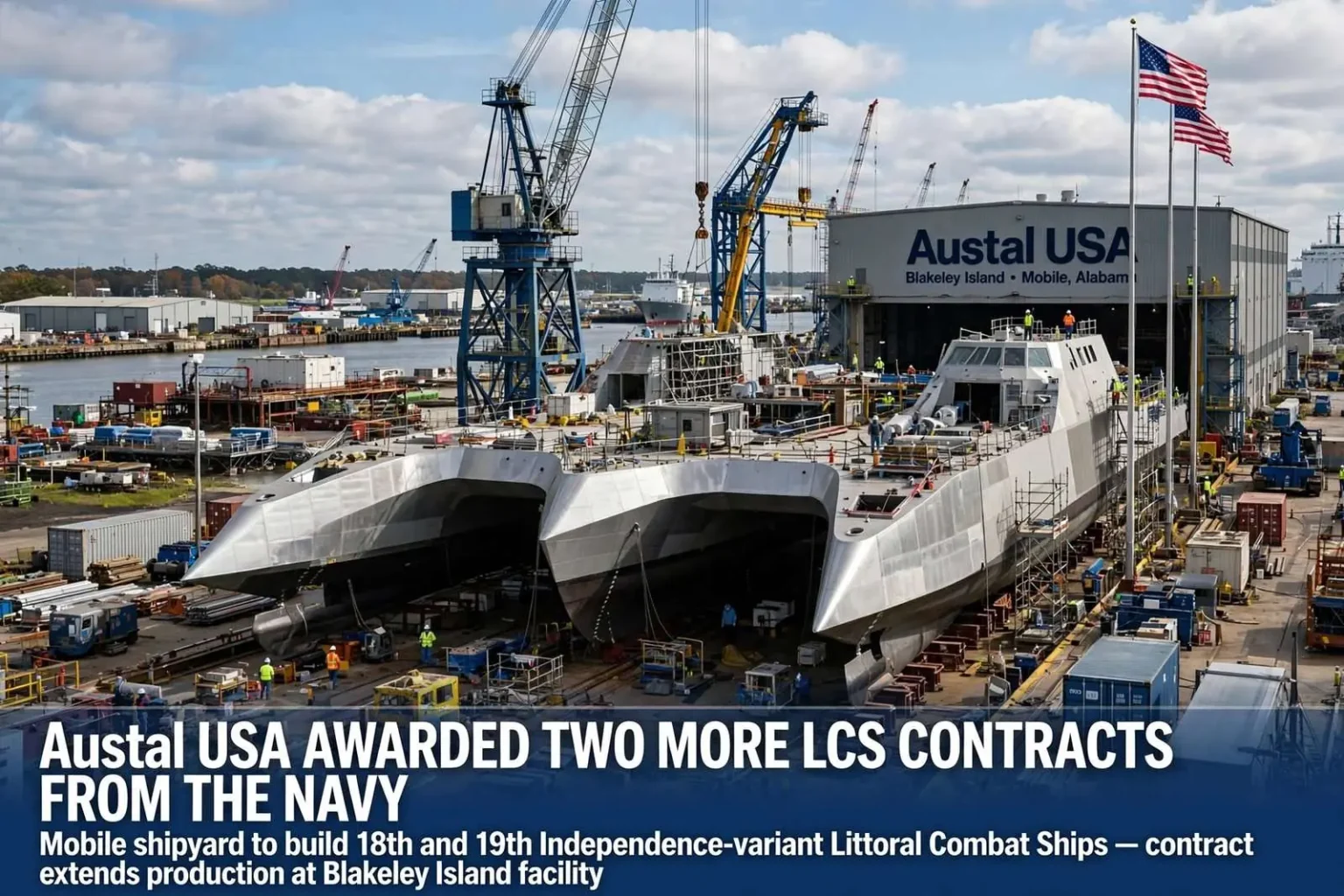
MOBILE, Ala. — Mobile’s largest industrial employer, Austal USA, will build at least two more Littoral Combat Ships for the U.S. Navy, adding to a run of contracts that has made the shipyard on the Mobile River one of the defining industrial enterprises of the Gulf Coast. The company will build at least two more of the fast, trimaran-hulled warships, extending production at the Blakeley Island facility.
The two additional ships will be Austal USA’s 18th and 19th in the Independence-variant class of the Littoral Combat Ship program. Austal USA has already delivered eight LCS to the Navy and has six more under construction at the Mobile shipyard, with three additional ships awaiting the start of construction — a workload that stretches the yard’s production line years into the future.
The value of each new contract is below the congressional cost cap of $584 million per ship, a figure set by law as a ceiling on what the Navy may spend on each hull of the class. “To be awarded two more LCS contracts before the end of the year is beyond exciting,” said Austal USA President Craig Perciavalle. “This contract directly reflects the confidence the U.S. Navy has in Austal USA and our supplier base of over 10,000 nationwide and our ability to build highly capable ships at an affordable cost.”
The Independence-Variant LCS
The Littoral Combat Ship program was conceived as a fast, flexible surface combatant designed to operate close to shore — the littoral zone — where larger destroyers and cruisers are less nimble. The Independence variant, the class Austal builds in Mobile, is the program’s distinctive aluminum trimaran, with three hulls and an unusually wide flight deck that allows it to carry helicopters and unmanned aircraft alongside interchangeable mission modules for mine countermeasures, surface warfare, and anti-submarine work.
Building in aluminum trimaran form gives the Independence variant speed and stability, and the modular design lets the Navy reconfigure each ship between missions by swapping equipment packages. Austal’s American operation grew out of that design: the Australian parent company Austal, a veteran builder of fast ferries, partnered on the LCS design and established its Mobile shipyard to build the class, eventually taking over the Independence-variant line outright as production matured. What began as a partnership rooted in ferry-building experience became a full American naval shipbuilder on the Mobile River, with the capacity to design, build, and sustain warships for the United States fleet.
For the Navy, the class has served as both a workhorse and a controversy. The program’s early years drew criticism over cost growth and early hulls’ durability, prompting congressional scrutiny and the cost cap that now limits per-ship spending. But the ships have deployed, delivered operational service, and sustained a shipbuilding workforce on the Gulf Coast, and awards of additional hulls have continued as the fleet works through planned production.
What the Contract Means for Mobile
Austal USA’s shipyard on Blakeley Island anchors the largest industrial workforce in the Mobile area. The company has grown from a startup operation into a shipbuilder employing thousands of workers directly, and its orders ripple through the region’s economy: naval architects, welders, pipefitters, electricians, and a supply chain stretching across the Gulf Coast and beyond. The company credits a supplier base of more than 10,000 businesses nationwide for its ability to deliver the class, and a meaningful share of those suppliers operate in Alabama.
Each new hull means years of work spread across that network — steel and aluminum from suppliers, propulsion and combat systems from defense contractors, and outfitting services from local firms. The steady flow of LCS work has also made Mobile one of the centers of American naval shipbuilding, alongside Pascagoula to the east and the Gulf Coast’s other yards. For the city’s economy, the difference between a production line running and one winding down is measured in thousands of jobs, which is why each contract award matters far beyond the shipyard’s gates.
The awards also came as the yard’s future work mix was becoming a live question for the region. Navy budgets, program decisions in Washington, and the natural arc of the LCS production run all shape how long the class continues, and Mobile’s industrial future depends partly on what follows the final hull — whether that is additional Navy work, commercial contracts, or new classes building on the yard’s aluminum-shipbuilding expertise.
Perciavalle’s Case for the Program
Austal USA President Craig Perciavalle framed the award as a vote of confidence in both the yard and its far-flung network of vendors. “To be awarded two more LCS contracts before the end of the year is beyond exciting,” Perciavalle said, adding that the contract “directly reflects the confidence the U.S. Navy has in Austal USA and our supplier base of over 10,000 nationwide and our ability to build highly capable ships at an affordable cost.”
For the yard’s workforce, comments like those carry practical meaning. Shipbuilding employment follows contracts: when awards land, hiring notices go out; when production pauses, trades workers move to other yards or other industries. The promise of two additional hulls reaching construction gave suppliers room to order material and gave the company’s recruiters a pipeline of work to hire against — the difference, in a heavy-industry region, between a production line planning growth and one quietly preparing to shrink.
The emphasis on affordability pointed to the program’s central political challenge. Congress set the $584 million per-ship cost cap precisely because earlier hulls had exceeded their budgets, and every subsequent award has been judged against the yard’s ability to stay under it. Staying below the cap on the 18th and 19th ships — hulls built well into the learning curve, with a trained workforce and established suppliers — allowed Austal to argue that the program had matured into what the Navy originally wanted: capable ships delivered at a predictable price.
The “before the end of the year” framing of Perciavalle’s comment also underscored the cadence of Navy shipbuilding procurement. Contracts for additional hulls arrive as budget cycles and multi-year arrangements line up, and an award landing late in the calendar year signals production continuity at the yard — work that flows directly into hiring plans, supplier orders, and the construction schedule for the ships already in the queue.
The Ships Already Built and Underway
With eight Independence-variant ships delivered and six more under construction, Austal’s production line represented one of the most sustained shipbuilding efforts in the Navy’s modern fleet plans. The delivered hulls have commissioned into the Navy and deployed from the West Coast, where the Independence variant is based, serving in the surface and mine-warfare missions the class was designed around. The three ships awaiting the start of construction give the yard a banked workload — modules and long-lead materials moving through the supply chain even before assembly begins.
Each ship takes shape through a modular process: modules are fabricated across the yard and by suppliers, joined into the distinctive trimaran hull, and progressively outfitted with propulsion, electrical, and combat systems before delivery. The aluminum construction that gives the class its speed demands specialized welding skills that Austal has spent years cultivating in its Mobile workforce — a human asset as significant as any physical plant, and one that takes years to assemble.
The class itself carries a Mobile fingerprint beyond construction: the Independence-variant ships are named for American cities, and the first of the class, USS Independence, was joined by hulls named for communities across the country as production continued. For the Gulf Coast, the ships’ presence in the fleet is a standing reminder of where they were built.
Mobile’s Shipbuilding Future
The award of the 18th and 19th hulls positioned Austal USA to keep its production line running while the Navy and Congress weighed the program’s long-term shape. Debates over the LCS class have never been far from Washington’s defense budget discussions, and yards on the Gulf Coast watch those debates closely because their workforces rise and fall with the decisions. For Mobile, the stakes are straightforward: the shipyard is the region’s largest industrial employer, and its orders set the tempo for hiring across the entire construction trades.
The company has repeatedly pointed to its record as evidence for its own future — ships delivered, costs held under the statutory cap, and a supplier network of more than 10,000 businesses that the latest contracts keep in production alongside the yard itself. Whether the class ends with the 19th hull or continues further, the contracts announced in Mobile ensured that the ships on the yard’s ways would keep Alabama shipbuilders busy, and that the Navy’s littoral force would carry the work of Mobile’s industrial waterfront into the fleet for years to come.