
Austal USA delivers future USS Savannah to the Navy
Austal USA has delivered the future USS Savannah to the U.S. Navy — the 14th Independence-variant Littoral Combat Ship built at its Mobile, Alabama.
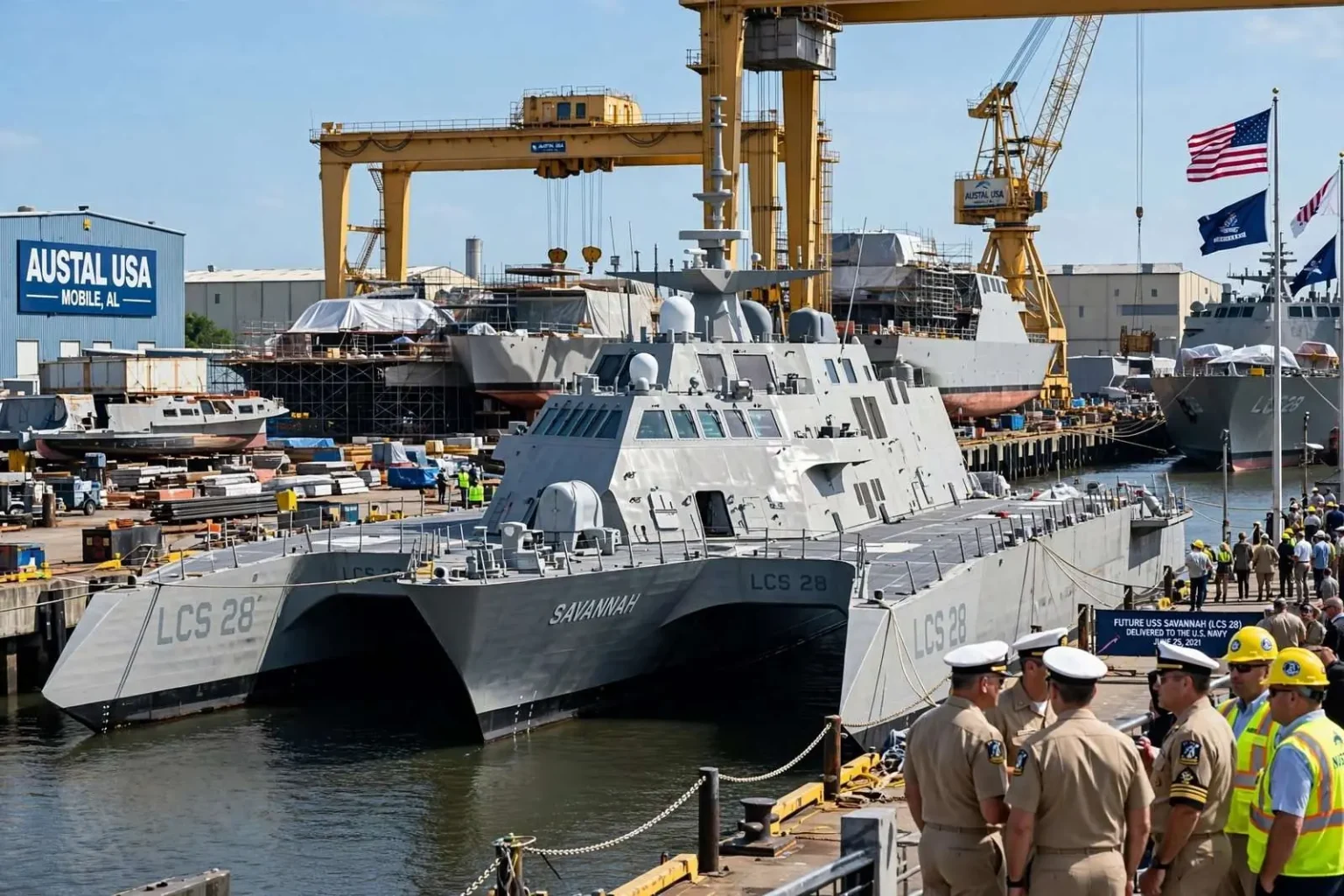
MOBILE, Ala. — Austal USA has delivered the future USS Savannah to the U.S. Navy, marking another milestone for the shipbuilder’s Mobile operations. The delivery hands the Navy a completed warship and puts the Savannah on the path to joining the fleet, the latest in a rapid series of handovers from the shipyard on the Mobile River.
The Savannah is the 14th Independence-variant Littoral Combat Ship (LCS) completed for the Navy and the seventh delivered in the past two years, a pace that has made the Mobile shipyard one of the busiest naval construction facilities in the country. Delivery is the formal moment when the Navy accepts the ship from the builder — the end of construction and sea trials, but not the end of the story, since the vessel will not officially enter service until its commissioning ceremony.
According to Austal, the ship was completed in just under three years — a full 12-month improvement over earlier ships in the LCS program. Shaving a year off construction time is a significant achievement in warship building, where first-in-class programs frequently struggle with delays and cost growth. The improvement reflects the maturing of the production line: each hull benefits from lessons learned on the ones before it, workers move through repeatable processes, and the yard’s supply chain delivers modules on the rhythm the schedule requires.
The Independence variant
The Independence-variant LCS is a distinctive ship, an aluminum trimaran whose outward spread hull sets it apart from nearly everything else on the Navy’s roster. The design gives the class a wide flight deck and a large reconfigurable interior, features the Navy uses to swap mission packages — surface warfare, mine countermeasures and other focused capabilities — onto the same hull depending on where the ship is sent and what it is asked to do.
Littoral Combat Ships are built for work close to shore, the littoral zone that gives the class its name, where larger deep-water warships are less maneuverable. At nearly 420 feet long and capable of speeds well beyond most surface combatants, the Independence variant pairs speed and shallow draft with the volume to carry helicopters, unmanned systems and the crews that operate them.
For Mobile, each delivery is also a jobs story. Austal USA’s shipyard is among the largest industrial employers on the central Gulf Coast, drawing thousands of workers — welders, pipefitters, electricians, engineers and the trades that support them — into steady, multi-year construction programs. A steady delivery cadence like the one behind the Savannah means those workers flow from one hull to the next rather than facing the boom-and-bust cycles that have historically followed single-ship programs.
The pipeline in Mobile
Four more LCS are currently under construction at Austal’s Mobile shipyard: the Canberra (LCS 30), Santa Barbara (LCS 32), Augusta (LCS 34) and Kingsville (LCS 36). Each is at a different stage of assembly, moving from module fabrication toward final integration, and the yard’s bays and waterfront ways are arranged to keep multiple hulls progressing at once — the assembly-line approach that made the accelerated delivery pace possible.
Fabrication on the future USS Pierre (LCS 38) is expected to begin later this year, extending the production line once more. Cutting steel on a new hull is the traditional shipbuilding milestone that marks a program’s continuation, and for the Mobile workforce it signals hiring and work orders reaching further into the future.
The yard’s work is not limited to Littoral Combat Ships. Final assembly is underway on two Expeditionary Fast Transports, the Spearhead-class aluminum catamarans Austal builds for the Navy’s sealift and transport mission. The high-speed vessels shuttle troops, equipment and supplies across theater at transit speeds conventional sealift cannot match, and their construction alongside the LCS line keeps the shipyard’s two product streams moving in parallel.
The delivery cadence also matters to the Navy’s force planning. Fleet size depends not only on new construction but on the predictable rhythm of handovers, which allows crews to be trained, homeports to be staffed and deployment schedules to be built months in advance. A yard that delivers seven ships in two years gives fleet planners a reliability they can build around, and each on-time delivery like the Savannah’s reinforces Mobile’s standing as a production line the Navy can count on.
From Mobile to San Diego
After delivery and commissioning, the Savannah will sail to California to be homeported in San Diego alongside its sister ships. San Diego’s naval station hosts the bulk of the Pacific Fleet’s surface force, and the Independence-variant ships based there put the class where the Navy wants it — facing the Pacific’s island chains, shallow seas and vast distances where a fast, flexible, near-shore combatant fits the mission.
Residents along the Mobile River and Mobile Bay have grown accustomed to the sight of the trimaran warships transiting the bay on their way to sea, a routine that belies the scale of what is passing: a ship assembled over years, handed over in a ceremony, and sent to a homeport thousands of miles away. For the workers who built it, watching a delivered hull clear the bay marks the practical end of years of labor — and the beginning of the same cycle again on the next ship down the line.
Commissioning will follow in due course, the ceremony that transforms a delivered warship into USS Savannah, with a crew bringing the ship to life and a city — Savannah, Georgia, like Mobile a port with deep maritime roots — claiming its namesake. Until then, the ship remains the newest product of a Mobile production line that has already delivered more than a dozen of its sisters, with more hulls rising in the yards behind it.
How a ship comes together in Mobile
The Independence variant’s construction process turns shipbuilding into large-scale assembly. Hull modules are fabricated in the yard’s facilities — steel structures rising under cranes, aluminum components welded nearby — and then joined into larger blocks that eventually become the trimaran’s distinctive hull. Modularity is what makes the schedule work: several modules for different ships can be under fabrication at once, feeding the final assembly ways where each hull takes shape and then moves to the water for outfitting and testing.
Sea trials come before delivery, the period when the Navy and the builder push the ship through its paces — propulsion, maneuvering, combat systems, damage control — to prove that what was built on paper works on the water. Passing trials is what allows the formal delivery that the Savannah has now completed, and it is the moment construction workers and Navy supervisors alike measure their years of effort against.
The ship carries a name with naval history behind it. Previous ships named Savannah have served the fleet through the 20th century, and the name honors the Georgia city whose own waterfront heritage parallels Mobile’s in many ways. Naming ships after American cities keeps a connection between the vessels and the hometowns of the sailors who will crew them, a tradition the Navy has leaned on heavily in naming the Independence-class hulls.
What LCS delivers to the fleet
The littoral combat ship program was conceived to give the Navy a fast, agile surface combatant for near-shore missions — the crowded coastal waters where mines, small boats and submarines pose the threats that big-deck warships handle less efficiently. The class trades heavy armor for speed, shallow draft and mission flexibility, carrying interchangeable packages that let one hull shift between roles as deployments require.
The program has weathered its share of public debate over cost and survivability, but the operational tempo of the delivered ships has continued, particularly in the Pacific where their speed and access to shallow ports fit missions from patrol to cooperation with partner navies. For the Navy, each additional hull like Savannah expands the number of ships available for those rotations; for Mobile, it sustains the assembly line that has become the yard’s backbone.
The view from the Gulf Coast
Shipbuilding on the Mobile River reaches back generations, and Austal’s rise to major naval construction has made the yard a cornerstone of the regional economy. Suppliers across south Alabama and the panhandle feed the operation — fabricators, specialty trades, logistics firms — so that each delivered hull represents work spread across dozens of companies beyond the shipyard’s gates.
With the Savannah delivered, four LCS hulls still rising in the yard, fabrication on the Pierre ahead, and two Expeditionary Fast Transports in final assembly, the pipeline at Austal USA remains full. The future USS Savannah’s next stops are commissioning and the long voyage to San Diego — but its construction story, like the stories of the ships delivered before it, belongs to the banks of Mobile Bay.