
Austal USA Partners with Saildrone to Build Unmanned Sea Vehicles for the Navy
Austal USA is partnering with Saildrone to manufacture 65-foot unmanned Surveyor vehicles in Mobile for the Navy's ocean-mapping and intelligence missions.
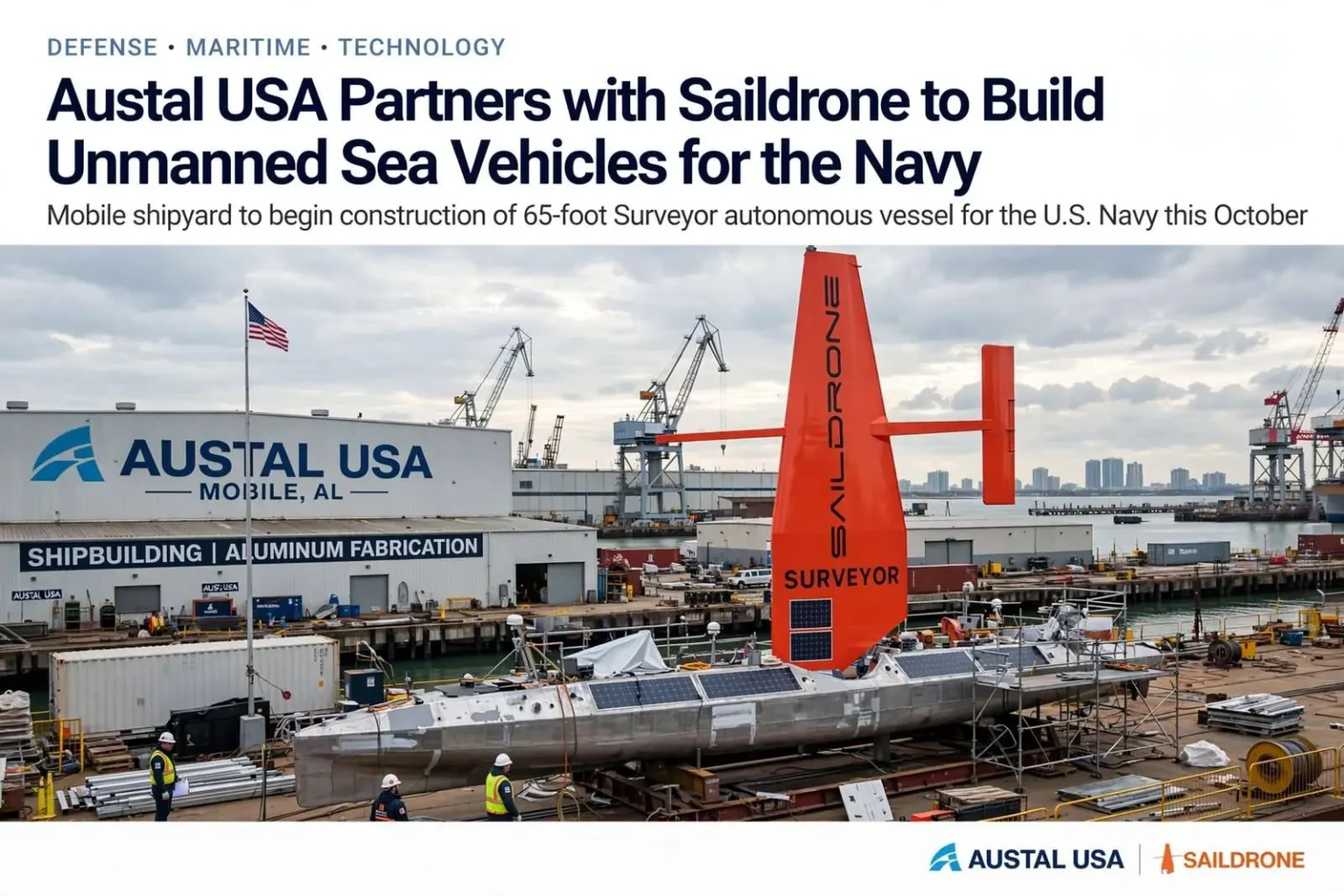
Austal USA is branching into yet another new area of shipbuilding: uncrewed ocean vehicles. The Mobile shipyard has reached a partnership with Saildrone, the California-based autonomous vessel maker, to manufacture the company’s Surveyor unmanned surface vehicles for the U.S. Navy — a deal that pairs one of the Gulf Coast’s largest industrial employers with one of the most visible names in robotic ocean research.
The Saildrone Surveyor is a 65-foot diesel-electric vessel designed for deep-ocean mapping and intelligence collection. Builders say the same platform can also be driven directly into hurricanes to gather wind-speed, wave-height and other data that were previously nearly impossible to capture on station — the kind of on-site measurements that weather forecasters and Navy oceanographers have historically had to approximate from satellites and scattered buoys.
Construction to begin within weeks
Austal said fabrication of the Surveyor hulls at its Mobile River facility is expected to begin in October, adding new jobs to the yard’s workforce. The work puts a new product line on the shop floor of a shipyard that has spent recent years deliberately widening what it builds, adding program after program to a base that was once essentially a two-product operation.
The partnership further diversifies the program mix at an operation that was once devoted almost exclusively to the Navy’s Littoral Combat Ship and Expeditionary Fast Transport lines. Those two programs made Austal a fixture of the Mobile waterfront, but reliance on a small number of large programs is a structural risk for any shipyard, and the company has responded by courting work across a range of hull sizes and missions — from large surface combatants and submarine modules to, now, autonomous vessels a fraction of the size of a combatant.
For Saildrone, the deal brings a large, established defense shipbuilder with space, workforce and classification-society experience that the smaller company did not have on its own. Building boats one at a time in California is a different proposition from serial production in a full-scale yard, and the partnership gives Saildrone the throughput to deliver the Navy quantities that research-stage production could not.
For Austal, the contract gives the Mobile yard a foothold in the fast-growing autonomous maritime sector without requiring new construction bays or major capital spending. The hulls fit the facility’s existing skill set — aluminum fabrication, precision outfitting, production planning at scale — and they open a market that defense planners expect to expand rapidly over the coming decade.
Why the Navy wants unmanned surface vessels
The Navy’s interest in vessels like the Surveyor follows from a simple problem: keeping ships and people on station is expensive, and some missions do not require a crewed warship. Ocean survey, acoustic collection, weather observation and persistent surveillance are all missions where a small, efficient, uncrewed platform can do the work for weeks at a time at a fraction of the cost of a manned ship — with no sailors exposed to weather, fatigue or risk.
The Surveyor’s 65-foot hull puts it in the sweet spot of that market: large enough to cross oceans and carry serious sensor payloads, small enough to be built in numbers. Its diesel-electric propulsion gives it range and endurance, and its ability to operate in severe weather — including deliberately steering into hurricanes to collect storm data — makes it a tool for missions no crewed vessel would be sent on.
Hurricane data collection is one of the most striking applications. Flying aircraft into storms and dropping instruments from altitude produces snapshots; a surface vessel on station inside the storm produces continuous measurements of wind speed and wave height from the very place forecasters need them most. Platforms like the Surveyor give agencies that data without putting a single crew member in the storm’s path.
What Saildrone brings to the partnership
Saildrone has spent the past decade proving the concept at sea. The company’s smaller uncrewed surface vehicles have crossed oceans under wind and solar power, mapped fisheries and ocean currents, and carried scientific instruments for government agencies and research institutions, logging voyages that would have required crewed research vessels and months of provisioning. The Surveyor is the company’s large-scale platform, built for exactly the deep-ocean mapping and collection missions the Navy needs.
What the company has not had, until now, is a production partner. Designing and demonstrating an autonomous vessel is one industrial challenge; delivering them in Navy-relevant numbers, to naval standards, on a schedule, is another. The Austal partnership supplies the second half of that equation: a yard with decades of aluminum shipbuilding experience, a trained workforce of thousands, and the quality and classification infrastructure that defense procurement demands.
The arrangement also reflects a broader pattern in defense shipbuilding. Rather than building everything in-house, established yards increasingly partner with technology companies that bring the sensors, autonomy software and mission knowledge, while the yard contributes hull production, integration capacity and program management. Mobile, with its deep bench of shipbuilding labor, is positioned to capture more of that work as it emerges.
Austal’s evolution on the Mobile River
Austal USA’s history in Mobile is a story of deliberate reinvention. The yard made its name building the Navy’s aluminum-hulled Littoral Combat Ships and Expeditionary Fast Transports, becoming one of the largest private employers on the Gulf Coast in the process. As those program cycles matured, the company invested in steel production capability, expanded its footprint along the Mobile River, and pursued new Navy work — submarine module fabrication and large surface combatant construction among it — so the yard’s workload would not rise and fall with a single program line.
The Saildrone partnership slots into that strategy neatly. Autonomous vessels will not replace combatant programs in the yard’s revenue — a 65-foot uncrewed survey vessel is a very different order book from a warship — but they add steady, scalable work that uses existing facilities and skills, and they put the yard on the ground floor of a sector the Navy has signaled it intends to grow.
The jobs added for Surveyor fabrication also matter locally. Mobile’s shipbuilding cluster — Austal, the historic yard operations across the river, and the network of suppliers that feed both — has long been the backbone of the region’s industrial workforce, and every new product line that lands on the river strengthens the case for keeping that workforce growing in place.
The autonomous maritime market comes to the Gulf
The Gulf Coast has been positioning itself for exactly this kind of work. The region’s shipyards, research institutions and military installations have made the Gulf a natural testbed for uncrewed maritime systems, and defense planners have talked openly about fleets that mix crewed ships with large numbers of autonomous platforms in the years ahead. A yard in Mobile producing Navy autonomous vessels in serial production would give the Gulf Coast a central role in that shift.
What the Surveyor missions look like
At sea, a Surveyor operates with no one aboard. The vessel sails to its operating area, runs its mapping and collection missions under a mix of autonomy and remote supervision, and transmits data back to shore while it works. Missions that would tie up a crewed survey ship and its entire complement for weeks can run continuously, in weather that would send a crewed vessel home, at a fraction of the operating cost.
For the Navy, deep-ocean mapping is a foundational mission — the world’s oceans remain imperfectly charted, and accurate bathymetry underpins everything from safe navigation to submarine operations. Persistent intelligence collection is the other half of the brief: a platform that can hold station quietly for extended periods gives fleet commanders eyes in places they cannot keep a ship.
Then there is the storm mission. A platform that can be driven into a hurricane and hold on station through landfall produces wind-speed and wave-height data from the most dangerous and least-measured part of the ocean — measurements that feed directly into forecast models for Gulf Coast residents who live with hurricane risk every season. It is a rare defense program whose technology has a clear civilian payoff for the very region building it.
What it means for Mobile’s workforce
The October start of Surveyor fabrication adds work at a yard that has been busy repositioning itself, and the hiring that comes with it lands in a labor market where shipbuilding skills — welding, fitting, electrical, outfitting — remain among the region’s most valued trades. Austal has historically hired and trained at scale, and production lines for smaller vessels give early-career shipbuilders another entry point into the trade.
The local economic logic compounds from there. Supplier contracts for materials and components, service contracts for the vessels’ outfitting, and the ongoing work of program support all spread through the Mobile industrial base. A new program line does not just add welders; it adds weeks of steady production planning, procurement and skilled-trade hours that ripple across the region’s manufacturing economy.
For a city that has staked much of its industrial identity on the ships built along its river, the sight of autonomous research vessels taking shape alongside Navy combatants says where the industry is headed — and Mobile’s shipyard has now positioned itself to be building it first.