
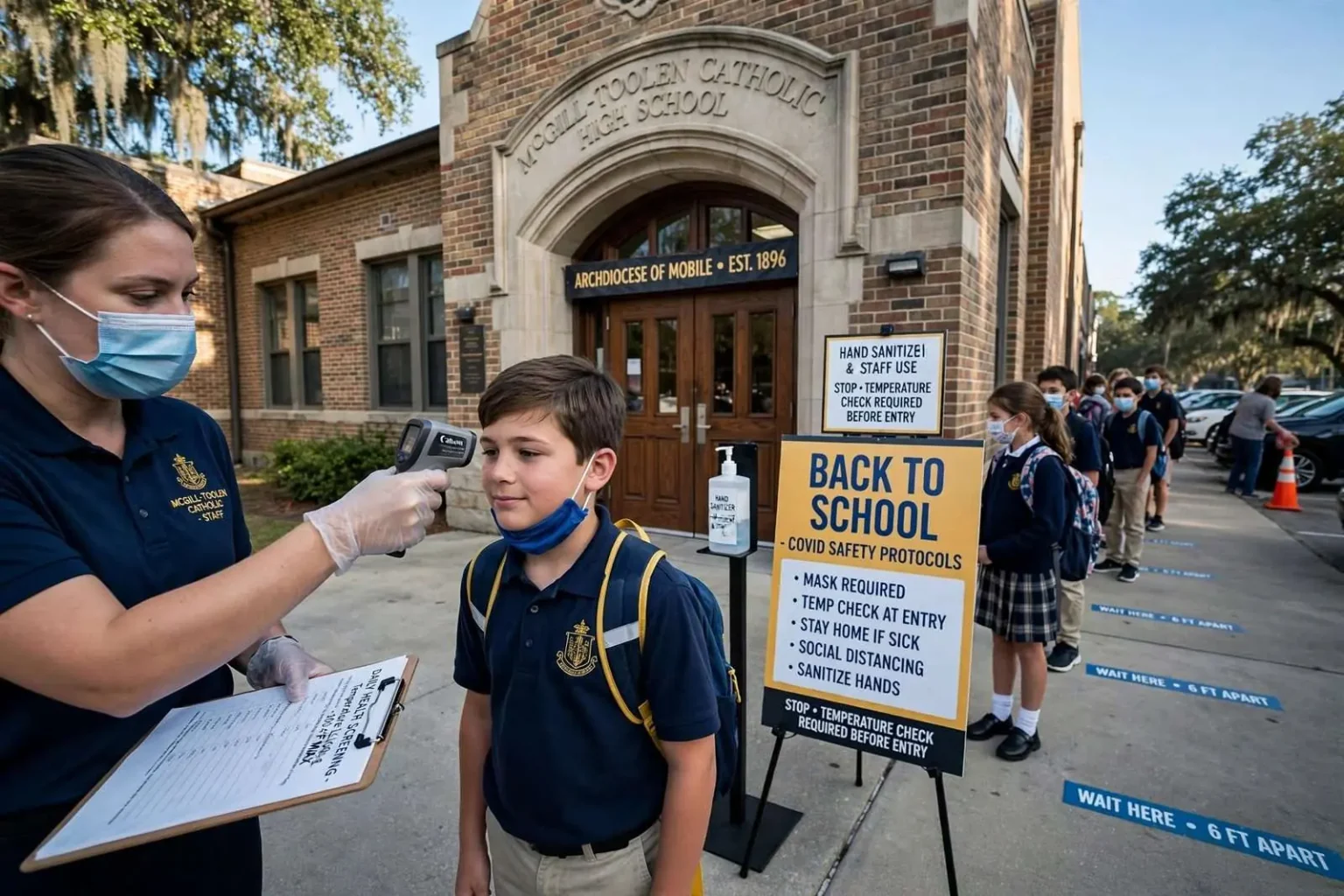
MOBILE, Ala. — Students at schools across the Archdiocese of Mobile walked back into classrooms Wednesday morning for the first time since March, as south Alabama’s Catholic school system reopened amid the COVID-19 pandemic. The return marked a milestone in the region’s pandemic recovery — and the start of a school year that looks unlike any before it.
For the students, teachers and parents involved, the first day carried a weight that no ordinary August homecoming ever has. Five months after the pandemic emptied classrooms across the country and forced an abrupt shift to remote learning, the sight of backpacks and car lines returned to south Alabama’s Catholic campuses. The reopening came with new rules at every turn, from the front door to the lunchroom, and everyone involved understood that the school year’s success would depend on how faithfully those rules were followed.
Teachers and staff are watching closely for any students showing symptoms of COVID-19 as classes resume, a responsibility that now sits alongside lesson plans and grading. In practice, that means every adult on campus has become part of an early-warning system, trained to recognize the signs of illness and to act quickly when a student appears unwell. The vigilance is intended to catch potential cases before they spread through classrooms, and it reflects the reality that schools operate on trust — families are asked to keep sick children home, and schools are asked to catch what slips through.
Daily Temperature Checks
Under the new protocols, every student and employee will have their temperature taken with a touchless thermometer upon arrival each day. Anyone recording a fever higher than 100.4 degrees will not be allowed to enter the building. The daily screening puts a checkpoint at the entrance of every campus, a moment that will repeat each morning for as long as the pandemic protocols remain in place.
Fever screening became one of the signature practices of the pandemic era, adopted by workplaces, government buildings and schools across the country. A fever above 100.4 degrees is one of the most common indicators of COVID-19 infection, and touchless thermometers allow the check to be performed quickly without physical contact, keeping car lines and entrances moving. Students and staff turned away at the door will be expected to seek medical guidance before returning, an approach designed to keep potentially infectious individuals out of the building entirely.
The screening protocols extend beyond the thermometer. Schools are also limiting social contact between students and staff in ways administrators described as feasible and practical, an acknowledgment that every campus is different and that measures must fit the reality of each building. Class spacing, modified schedules and adjustments to the movements of students through hallways and common areas are all part of the effort, tailored where possible to each school’s layout and enrollment.
All campuses have also stepped up cleaning routines, with high-touch surfaces — door handles, desks, railings, shared equipment — receiving attention throughout the day rather than only after hours. Hand sanitizer will be readily available throughout the buildings, giving students and staff the means to clean their hands between the more thorough washings that hand-washing stations and classroom sinks provide. The layered approach mirrors the public health guidance issued for schools nationwide: no single measure stops the virus, but multiple measures together reduce the risk.
The Archdiocese’s Schools and the Region’s Reopening
The Archdiocese of Mobile operates Catholic schools across south Alabama, including McGill-Toolen Catholic High School and elementary campuses throughout Mobile County. The archdiocese, which spans the southern portion of the state, has been part of the region’s educational landscape for generations, and its schools serve families from Mobile Bay across to the state’s western counties. McGill-Toolen, the system’s flagship high school in Mobile, has long been among the most prominent Catholic schools on the Gulf Coast, with a history that reaches back more than a century through its predecessor institutions.
The decision to reopen in person placed the Catholic schools slightly ahead of many of the public systems around them, a flexibility that smaller systems with independent governance can exercise. Catholic school leaders weighed the health guidance against the educational needs of their students, and the archdiocese’s administration committed to the protocols that made a return to buildings possible. Parents were given the details of the plan in advance, and families made their own decisions about returning in light of their household circumstances.
Public school systems in the region staggered their own reopening plans that same month as officials balanced instruction against public health guidance. The patchwork of start dates and instructional models — some systems opening in person, some remotely, some with hybrid schedules — reflected the difficulty of the choices facing every district as the pandemic stretched from spring into a new academic year. Each system’s plan evolved with local infection data, and parents across south Alabama navigated a reopening landscape that looked different from district to district.
For the archdiocese’s schools, the reopening plan drew on the experience of the spring, when the pandemic’s arrival forced an emergency shift to distance learning with almost no preparation. Teachers spent the summer preparing for a school year that could pivot between in-person and remote instruction, and the archdiocese invested in the cleaning supplies, equipment and training the new protocols required. The cost of the preparations added to the financial pressures already facing schools during the pandemic, but administrators judged the expense essential to reopening safely.
Wednesday’s return began the test of whether the plan works. School leaders have emphasized that the protocols will be adjusted as circumstances change, and that communication with families will remain constant. If cases emerge, the response will follow public health guidance on isolation, contact tracing and any needed closures. The goal shared by teachers, parents and administrators alike is to keep students in classrooms safely — a goal that now depends on daily temperature checks, careful distancing and the cooperation of an entire school community.
The Broader Pandemic Context in South Alabama
The reopening unfolded against the backdrop of a summer that reshaped daily life across the Gulf Coast. Since the pandemic reached Alabama in March, the state had seen waves of infections that filled hospital beds, closed businesses and canceled the events that normally define a coastal summer. By the time August arrived, residents had grown accustomed to masks, distance and the constant arithmetic of risk — and schools were the largest and most consequential institution still deciding how to operate in that environment.
The conversation over reopening schools became one of the most contested questions of the pandemic nationwide. Public health officials acknowledged the costs of keeping children out of classrooms — learning loss, missed meals, social isolation and the strain on working parents — while warning that schools could become engines of transmission if precautions failed. The resolution, in south Alabama as elsewhere, was to reopen with conditions, treating the return to class as a managed experiment whose results would depend on discipline and adaptation.
For Catholic schools, the pandemic also raised questions of enrollment and finances. Tuition-dependent institutions felt the economic pressure that families were under, and the uncertainty of the school year made some parents hesitant to commit. At the same time, the archdiocese’s ability to open its buildings in person appealed to families who had watched the spring’s remote learning experiments strain their households. School leaders across the country watched enrollment numbers closely through the fall, knowing the pandemic would leave a lasting mark on the private education landscape.
What the School Day Looks Like Now
The protocols changed nearly every rhythm of the school day. Arrival now begins at a temperature check instead of the front office. Hallways run in one direction where layouts allow. Lunch periods are staggered or held in classrooms to keep large groups from gathering in cafeterias. Assemblies, pep rallies and the other gatherings that build school culture are curtailed or reimagined, and field trips and shared equipment are limited. Each adjustment is small on its own; together they redefine what a school day feels like.
Athletics proceed under their own set of rules, with screening for athletes and coaches, limits on spectators and hygiene protocols for shared equipment. Fall sports on the Gulf Coast — football above all — carry particular weight in school communities, and their fate through the season became one of the most watched questions of the reopening. Games proceed with modified attendance and safety measures, another facet of school life adjusted to the pandemic’s constraints.
Teachers carry perhaps the heaviest load of the new arrangements. They must deliver instruction while enforcing distancing and sanitizing routines, teach students separated by plexiglass and spacing, and remain ready to shift their classes online at any moment if conditions change. The professional demands of the pandemic classroom have redrawn the job description of teaching, and school administrators across the archdiocese have leaned on their faculties’ flexibility to make the reopening possible.
Parents, too, are part of the system’s success. The daily screening works only if families check their children for symptoms before the school day begins, and the distancing protocols in classrooms depend on students understanding why the rules exist. Schools have asked parents to reinforce the measures at home — proper hand-washing, mask use where required, and keeping sick children home — so that the effort on campus is not undone in the hours students spend away from it.
The months ahead will show whether the plan holds. Schools nationwide that reopened under similar protocols have experienced both success and disruption, with some campuses forced to close temporarily after clusters of cases and others sustaining in-person instruction for months. The archdiocese’s schools will write their own version of that story, one school day at a time, with the health of students, staff and families as the measure of whether the risk was managed well.
For now, south Alabama’s Catholic schools have done what few institutions managed in the pandemic’s first months: reopened their doors, welcomed their students back, and begun the work of education under rules no one imagined a year ago. The first Wednesday of the school year was the start of that test — and the community will be watching closely how it is answered.