
Baldwin County Landmarks Glowed Green for National 811 Day, Promoting Safe Digging
Baldwin County cities and utility partners lit up local landmarks in green from Aug. 10-14 to mark National 811 Day, reminding residents to call 811 before digging to protect underground utility lines.
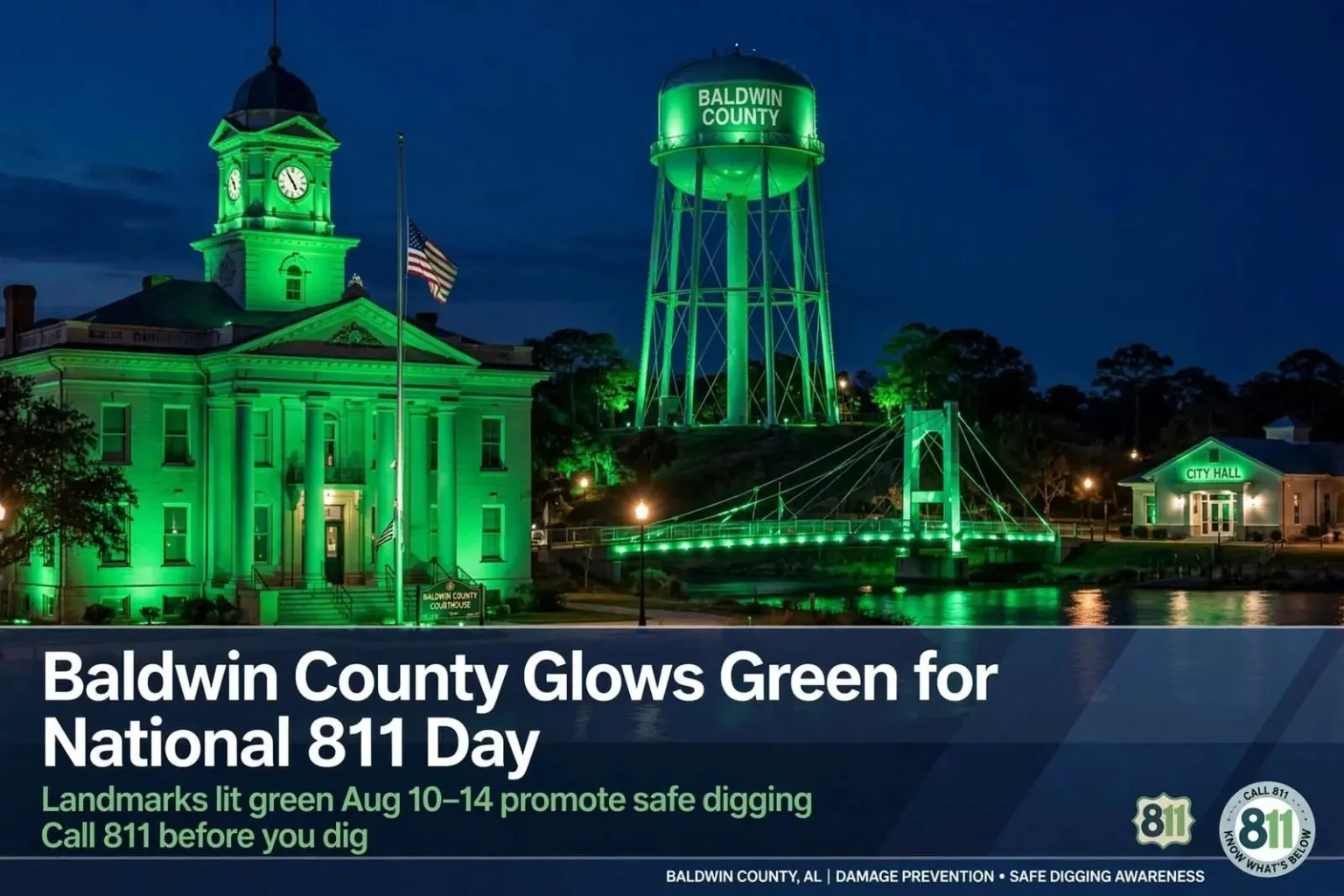
Baldwin County “glowed green” from Aug. 10-14 as local cities and utility partners joined together to promote safe digging awareness in recognition of National 811 Day, a nationwide initiative reminding residents to always call 811 before starting any digging project. Landmarks across Baldwin County shone bright green throughout the week to highlight the importance of protecting underground utilities.
The dates were no accident: Aug. 11 — written as 8/11 — spells out the three-digit number every resident should dial before breaking ground. The campaign turns that bit of calendar wordplay into a week of visible reminders, and Baldwin County’s participating cities lit courthouses, water towers, bridges and civic buildings in the campaign’s signature green.
Whether installing a fence, planting a tree, or undertaking major construction, contacting 811 ensures buried lines are located and marked, helping prevent injuries, service outages, and costly damage. In a county growing as fast as Baldwin — where new subdivisions, commercial builds and residential landscaping projects go up year-round — the habit matters on every lot, in every season.
A Regional Push for Safe Digging
Local utility partners said they were proud to stand alongside Baldwin County communities to support the Glowing Green initiative. Calling 811 before digging is a simple action that protects residents, infrastructure, and the essential services communities rely on every day. Lighting Baldwin County landmarks in green served as a visible reminder that safety starts with a single phone call.
The 811 system connects anyone planning to dig with local utility companies, who then mark the approximate location of underground pipes, cables, and lines free of charge. The service applies to projects of any size, from a homeowner setting fence posts to a contractor breaking ground on a major development. In Alabama, the one-call system routes requests through the state notification center, which alerts every utility with facilities in the dig area.
Buried beneath Baldwin County’s lawns, rights-of-way and job sites is a dense web of infrastructure: natural gas lines feeding coastal neighborhoods, water and sewer mains, fiber optic cables carrying internet traffic, and electric distribution lines serving the county’s fast-growing population. Some of those lines sit just inches below the surface, close enough to be struck by an ordinary shovel.
A single strike can do far more than damage a shovel blade. Cutting a gas line risks explosion and evacuation; severing a fiber cable can knock a neighborhood’s internet offline for a day or more; hitting an electric line can injure or kill the digger. Nationally, utility damage prevention organizations attribute a large share of underground strikes to digging that was never located first — the very preventable behavior the 811 campaign exists to end.
How Residents Can Get Involved
Residents were encouraged to join the effort by watching for glowing landmarks around the county, sharing the message on social media, and remembering the campaign’s simple guidance: call 811 before every digging project, every time. The call is free, the marking service is free, and the request can also be filed online for those who prefer it to a phone call.
National 811 Day campaigns like this one are held annually across the country to reduce accidental utility strikes, which can cause dangerous gas leaks, power outages, and expensive repairs. Baldwin County’s participation reflects a broader statewide and national effort to keep digging projects safe for both residents and utility crews.
The week’s activities earned attention beyond the county line as well. Gulf Coast neighbors in Mobile and the Florida panhandle run parallel 811 awareness efforts each August, and the coordinated timing means the safe-digging message travels up and down the coast in the same week — useful in a region where crews, contractors and residents cross state lines for work every day.
The timing of the campaign week also matters locally. Late summer and fall are heavy digging seasons along the Gulf Coast: hurricane recovery repairs, landscape refreshes after summer heat, pool installations, drainage work and construction projects that accelerated through the year. Every one of those projects begins with ground that someone should have located before lifting a shovel.
Baldwin County is among the fastest-growing counties in Alabama, and that growth multiplies both construction and risk. New utility lines are installed as older ones remain in service, so the underground network becomes denser each year — which is precisely why utility partners say the locate-before-you-dig message needs annual reinforcement rather than a single education push.
What Happens When You Call 811
The process is simpler than most residents expect. A homeowner calls 811 or files a request online a few business days before digging, describes the project and its location, and the notification center transmits the ticket to every member utility with facilities near the site. Crews then come out and spray paint or flag the approximate paths of their lines — red for electric, yellow for gas, orange for communications, blue for water, green for sewer, in the color code used across the country.
Once the lines are marked, the digger knows where to exercise care: hand-digging near marked utilities rather than using heavy equipment, and keeping a respectful buffer around each paint line. The marks are good for a limited window, so projects that start later than planned should have their tickets refreshed.
Contractors and professional excavators are required by Alabama law to notify the one-call center before excavation, and homeowner DIY projects fall under the same practical rule even where enforcement differs. Utility partners at the Baldwin campaign emphasized that the system exists for the smallest projects as much as the largest — a mailbox post or a new shade tree can hit a line just as surely as a backhoe can.
Utility crews who respond to locate requests say the marking visit usually takes only a short time for a typical residential yard, and the wait between the request and the marking is measured in business days rather than weeks. Homeowners planning weekend projects are advised to file their request early in the week so the marks are in place before the shovel comes out.
The cost of skipping the call lands in several directions at once. The digger may face repair charges and liability for the damage; neighbors may lose service while crews make repairs; and in the worst cases, a gas strike endangers an entire block. Insurance does not always cover damage caused by unlocated digging, and the delay and disruption fall on everyone connected to the line.
Local officials see the green-lighting tradition as a way to make an invisible subject visible. Underground utilities are, by design, out of sight and out of mind, so the campaign borrows the language of awareness months and civic lighting displays to put the message where residents cannot miss it — glowing from the skyline for a full week each August.
Utility partners who joined the Baldwin effort spanned the services residents use every day: natural gas, electric, water, sewer and telecommunications providers, along with the one-call center that coordinates their locate crews. Their shared message during the campaign week was unity of purpose — every utility benefits when every digger calls first, and every resident benefits from the reliability that protects.
The Bigger Picture on Damage Prevention
The 811 program sits within a national damage-prevention framework coordinated by industry and safety organizations, including the Common Ground Alliance, which promotes consistent best practices for excavation around buried infrastructure. The alliance’s research consistently shows that a substantial share of underground damage comes from digging done without a locate request — the exact gap that National 811 Day is designed to close.
For Baldwin County’s municipalities, participation also carried a service message: the cities that lit their landmarks green are the same cities whose public works and utility crews answer the damage calls when lines are struck. Prevention, they noted, is cheaper for everyone than repair — in dollars, in disrupted service and in safety.
The campaign’s organizers thanked the cities, utilities and residents who took part, and they encouraged residents to keep the habit going long after the green lights dim: know what’s below, call 811 before you dig, and wait for the marks. Those three steps, repeated on every project, are the whole of the message — and they are free.
Residents who want to submit a locate request can call 811 from any phone or use the online ticketing system operated by the state one-call center. Requests should be filed a few business days before digging begins, and homeowners should have their project details ready — the address, the type of work and the area to be dug — so the marking crews can do their job quickly and completely.
As Baldwin County keeps growing, its underground network will keep growing with it. The green glow that washed over the county’s landmarks from Aug. 10-14 will fade until next August, but the habit it promotes is meant to last all year: every project, every time, call 811 first.