Baldwin County Logged 44 New Business Registrations in a Single Week, Led by Foley
Baldwin County cities recorded 44 new business registrations the week ending Jan. 14, down 12% from the prior week, with Foley registering the most.
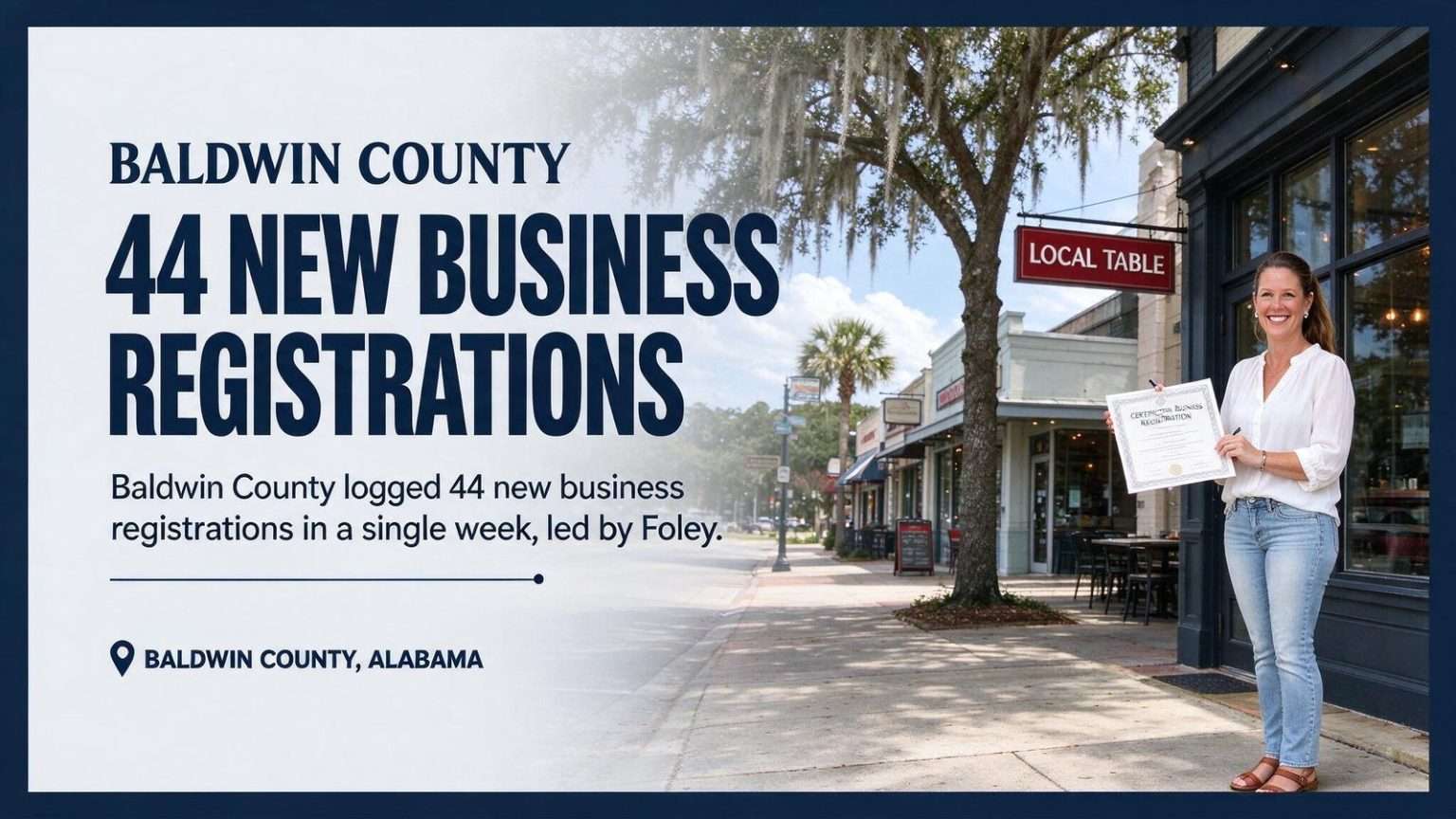
Cities across Baldwin County recorded 44 new business registrations during the week ending Jan. 14, down 12 percent from the 50 registrations logged the week before. Foley led all Baldwin County cities in new business filings for the week, according to registration data tracking commercial activity across the county’s municipalities.
The weekly count is a small sample of a large and fast-moving economy. New registrations are one window into the county’s entrepreneurial pace — an early signal of the shops, contractors, restaurants and service businesses that will open over the coming months in communities from Foley to Fairhope and Daphne to Gulf Shores.
The dip from one week to the next is the kind of movement that weekly data routinely produces. Fifty registrations one week and 44 the next is a 12 percent decline on paper, but weekly totals in any county rise and fall with the calendar, the weather and the number of entrepreneurs who got around to filing. The longer trend is what local economic developers watch, and Baldwin County’s longer trend has pointed one direction for years: more people, more rooftops and more businesses to serve them.
Small businesses drive Alabama’s economy
New registrations are one window into the county’s entrepreneurial pace. More than 99 percent of Alabama businesses are considered small businesses, and they employ more than 47 percent of the state’s workforce, according to the U.S. Small Business Administration. Those proportions hold across the Gulf Coast, where the economy is built on locally owned restaurants, charter boats, contractors, boutiques and professional offices rather than a single dominant industry.
The SBA’s numbers describe a state that runs on businesses too small to make headlines individually. Alabama’s small businesses account for the overwhelming majority of employers in every county, and they hire first and fire first as conditions change. When a new registration becomes a new storefront, the effect ripples through the local economy in wages, leases, insurance and the suppliers the business buys from.
That is why the weekly registration report matters more in Baldwin County than its modest numbers suggest. Each filing represents someone who has decided to take the risk of opening a business in a specific city — choosing Foley over Gulf Shores, or Daphne over Fairhope — and the aggregate of those decisions maps where the county’s commercial energy is heading.
Where the money goes
Advocates for locally owned shops point to research on where those dollars go: a Civic Economics study found that $100 spent at a locally owned business returns $47 to the local economy, compared with just $13 for spending at non-local businesses. The difference, researchers argue, comes from what stays behind — local wages, local suppliers, local profits spent at other local businesses and local taxes and charitable giving.
The arithmetic behind those figures is straightforward. A chain store or national franchise sends a portion of every dollar out of the community in the form of profits to distant headquarters, supplies purchased through national contracts and fees paid to corporate services. A locally owned competitor banks, buys, hires and gives locally, so more of each sale circles through the same economy before it leaves. Multiplied across a county the size of Baldwin — with retail hubs in Foley, Daphne, Fairhope, Gulf Shores, Spanish Fort and Robertsdale — the gap compounds.
Business advocacy groups along the Gulf Coast have used that research in campaigns urging residents to shop locally, particularly during the holiday season and after hurricanes, when recovery spending is at its peak. The argument is not that national chains have no place — they anchor the commercial corridors that draw shoppers from across the region — but that the margin between 47 cents and 13 cents on the local dollar is the difference between an economy that recirculates and one that leaks.
For a newly registered business, the research is also a sales pitch to its first customers. A new local firm competing against national brands sells more than its product; it sells the knowledge that a dollar spent there works twice — once for the goods or services, and again when the owner spends the proceeds down the street.
Foley leads the week
Foley’s lead in the week’s filings continues a pattern that has held in Baldwin County for years. The city sits at the crossroads of U.S. Highway 98 and Alabama Highway 59, the corridor that carries beach traffic from Interstate 10 to the shore, and its retail districts draw shoppers from across south Alabama and the Florida Panhandle. Entrepreneurs looking for a location with traffic, rooftops and room to grow keep landing there.
The city’s growth has been fed by the same forces driving the county as a whole. South Baldwin County has absorbed decades of coastal growth, and Foley — once a railroad town serving the area’s farms — has become the commercial anchor between the interstate and the beach communities. New businesses opening in Foley serve both the year-round population of the surrounding area and the seasonal wave of visitors that moves up and down Highway 59.
The rest of the county’s cities divide the remaining registrations each week according to their own rhythms. Daphne and Spanish Fort anchor the Eastern Shore, drawing commuters and shoppers from the Mobile metro across the bay. Fairhope’s downtown supports a dense cluster of locally owned shops and restaurants that function as a regional destination in themselves. Gulf Shores and Orange Beach file registrations that rise and fall with the tourism economy, and the county’s smaller cities — Robertsdale, Loxley, Bay Minette, Summerdale, Elberta — log the steady trickle of service businesses that follow residential growth.
What a registration means
A business registration is a legal beginning, not an opening. The filing records the entity — a limited liability company, a corporation, a sole proprietorship — and puts the business on the map with the state and the municipality. Between that filing and a ribbon-cutting come the lease, the build-out, the licenses, the insurance and the hiring, and not every registration makes it that far. Economists treat the count as a leading indicator: more registrations today means more activity of every kind a few months from now.
The weekly cadence also smooths out over time. A 12 percent weekly decline within a month that shows strong totals is noise; the same decline repeated across a quarter would be a signal. Local chambers of commerce and economic development offices watch the longer arc, along with permit filings, occupancy data and sales tax receipts, to judge whether the county’s entrepreneurial pace is accelerating or cooling.
Baldwin County is among Alabama’s fastest-growing counties, and weekly registration totals offer an early read on how quickly new enterprises are opening across its communities. Growth of that kind is self-reinforcing: new residents need plumbers, dentists, dry cleaners and restaurants; those businesses hire; the workers need housing; and the housing draws more residents. The registration report is the first paper trail of that cycle.
The outlook
For the week ending Jan. 14, the story was continuity rather than change: 44 new businesses filed across the county, down modestly from the week before, with Foley at the top of the municipal list. Winter is typically a quieter stretch for filings than spring, when new ventures time their launches to the tourist season, and the county’s registration totals historically build through the first half of the year.
What the numbers confirm is the structure underneath them. A county where more than 99 percent of businesses are small enterprises, where local spending recirculates at more than three times the rate of chain spending, and where population growth keeps generating new customers is a county that will keep producing registration reports like this one — a few dozen filings a week, led by whichever city is growing fastest, adding up over a year to hundreds of new businesses competing for the customers who live and shop from Foley to Fairhope and Daphne to Gulf Shores.
For residents and local officials, the practical takeaway of the weekly report is simple. Behind each of the 44 filings is an entrepreneur who chose a Baldwin County address, and the community’s response — where they shop, where they bank, which firms they hire — determines whether those registrations become the county’s next generation of employers.
Registration requirements themselves are part of the story local officials track. Alabama municipalities require businesses operating inside their limits to obtain a city business license in addition to any state filing, and cities use that licensing process to keep track of who is operating where. A business that registers in a Baldwin County city becomes part of that city’s tax base, its storefront inventory and its chamber roster — which is why the municipal breakdown of each week’s filings gets as much attention as the total.
The county’s economic development organizations also use the registration data when recruiting and supporting businesses. A steady flow of new filings in one city tells brokers where demand sits, tells lenders which corridors are active and tells existing owners that their market is growing. In a county adding residents every month, the weekly report functions as a scoreboard for which communities are converting that growth into commercial activity.