Baldwin County Public Schools Welcomes Teachers Back With Annual Institute
Baldwin County Public Schools kicked off the new school year with its annual teacher institute, bringing educators from across the county together ahead of the first day of class.
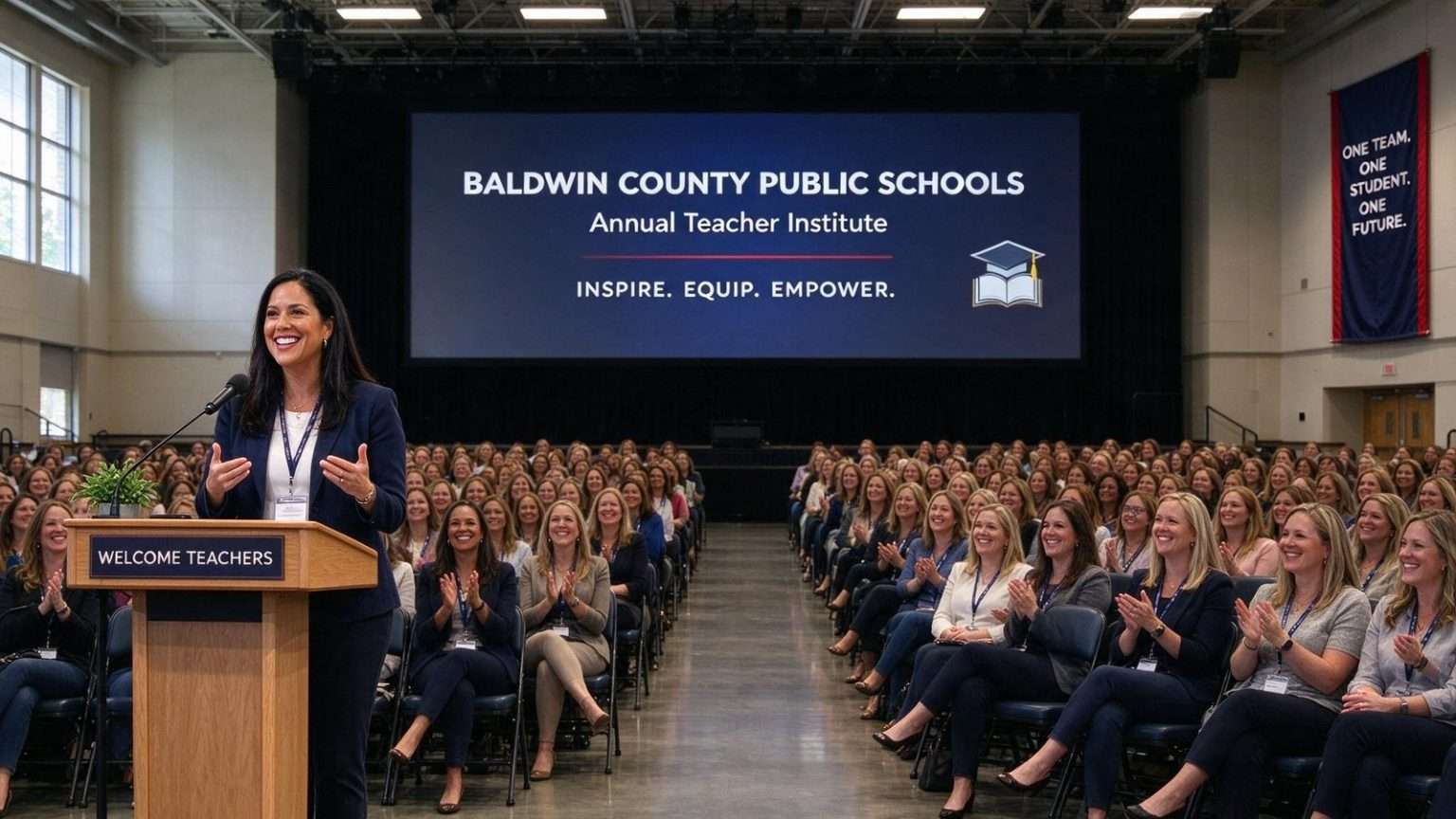
With a new school year just days away, Baldwin County Public Schools brought educators from across the district together for its annual teacher institute, a back-to-school welcome event meant to get teachers ready for the year ahead. “It’s a great opportunity to get back into it, get excited for the year, and kind of all start on the same page,” Summerdale Elementary teacher Schuyler Murrell said. “Our teachers are fired up.
The institute is the district’s traditional first act of the school year, staged before students return, and it functions as equal parts training, reunion and pep rally. Thousands of teachers, aides, counselors and administrators from across one of Alabama’s largest school systems gather under one roof for a day of speakers, professional development sessions and district-wide messaging before they scatter to their campuses from Bay Minette to Gulf Shores. The summer break that stretches back to May ends, for Baldwin County educators, with a single day designed to reset the calendar and the mindset at once.
Logistics on that scale are considerable. Baldwin County covers more square miles than any other county in Alabama, and its schools stretch across the Eastern Shore, the central farm belt, the northern timber country and the beach communities. Teachers drive from Fairhope, Foley, Elberta, Loxley, Robertsdale, Bay Minette, Spanish Fort, Daphne, Orange Beach, Gulf Shores, Perdido and the county’s rural crossroads to reach the institute site, which is one reason the district rotates attention among its regions and works to make the single gathering day worth the trip.
For new teachers, the institute doubles as an introduction to the district’s culture — its expectations, its support structures and its people. Baldwin County hires aggressively every summer to keep pace with enrollment growth that has made it one of the fastest-growing school systems in the state, and each August brings a fresh class of educators who have never taught a Baldwin County student. Pairing them with veteran faculty, laying out the year’s instructional priorities and getting everyone into the same auditorium on the same morning is how the district compresses months of orientation into a day.
A district built for growth
Baldwin County Public Schools operates one of the largest student enrollments in Alabama, spread across more than forty campuses, and its growth curve has reshaped the system’s planning for two decades. New subdivisions on the Eastern Shore, along the Foley corridor and around the beach cities have pushed enrollment upward year after year, forcing the district to build new schools, redraw attendance zones and recruit teachers at a volume few Alabama systems face. Each year’s institute, in that sense, is also a briefing on where the growth is landing and what it means for staffing.
The county itself lies directly east across Mobile Bay and is the largest county by area in Alabama. Its communities include the Eastern Shore cities of Fairhope, Daphne, and Spanish Fort, along with the Gulf-front municipalities of Gulf Shores and Orange Beach. The county has been among the fastest-growing in the state for two decades, driven by retirees, second-home owners, and tourism along the white-sand beaches.
That geography makes the school system unusually varied. A teacher in Gulf Shores serves a community whose economy swings with the tourist season; a teacher in Bay Minette serves a timber-and-industry town at the county’s northern edge; a teacher in Fairhope or Spanish Fort serves some of the fastest-growing suburbs on the Gulf Coast. The institute is the one day the whole system stands in the same room, and Murrell’s description of it — getting back into it, getting excited, starting on the same page — captures why districts hold such events at all.
Summerdale, where Murrell teaches, is a small central Baldwin community along U.S. 59, situated between Foley and Robertsdale, with a school campus that anchors the town’s civic life. Small-town schools like Summerdale Elementary carry particular weight in Baldwin County, where unincorporated communities and small municipalities rely on their schools as gathering places, employers and the chief public institution families interact with week after week.
Athletics and the school-year rhythm
The story is one of many that play out across high school campuses from Mobile to Baldwin County each year, where athletics and academics together shape a community’s sense of itself. Public schools across Mobile and Baldwin counties compete under the Alabama High School Athletic Association, with regular-season and postseason play organized into regions and classes. The state championships are held at venues around the state each year and are one of the biggest events in Alabama high school sports.
Friday night football in particular remains a fixture across south Alabama, where the Saraland Spartans, the Fairhope Pirates, the Daphne Trojans, the Foley Lions, the McGill Toolen Jackets, the Murphy Panthers, the Blount Leopards, the Baker Hornets, and a host of other programs each field teams that draw thousands of fans to their home stadiums during the fall.
The season that begins in the institute hallways reaches its most public expression in those stadiums. A Friday night game in Fairhope or Foley or Saraland is a municipal event as much as a school one — the marching band, the cheerleaders, the concession stands run by booster clubs, and the stands filled with families whose children attend the feeder schools. For the teachers assembled at the institute, the fall calendar that follows includes Friday duties, half-time recognitions and the steady rhythm of a school year that in south Alabama is inseparable from its football weekends.
Athletics also carry a practical weight for the district’s budget and culture. Successful programs draw community support that flows back into the schools, and regional rivalries — Fairhope against Daphne, Foley against Robertsdale, Spanish Fort against its Eastern Shore neighbors — give each community a stake in its campus. When the institute urges teachers to start on the same page, the athletic year is part of the page: eligibility rules, grade checks and the academic standing that keeps students on the field all run through the classroom first.
What the institute prepares teachers for
The professional side of the day matters most. Baldwin County’s institute programming typically addresses the instructional priorities the district has set for the year — literacy targets, mathematics standards, classroom technology, safety procedures and the assessment calendar that governs state testing in the spring. Teachers leave with their year’s framework in hand, their campus assignments in mind and the contacts they will rely on when a question arises in October that no manual answers.
Alabama’s public school calendar gives the institute its place. State law and State Board of Education rules govern the school year’s length and shape, and districts schedule their professional days in the window before students arrive, making the week before the first day the busiest stretch of the educator’s summer. Baldwin County’s first-day count — the enrollment snapshot taken shortly after school opens — drives state funding formulas, so the district’s preparation in August has consequences that reach into every campus budget.
The human stakes are just as real. A teacher’s first weeks set the tone for a year that runs 180 instructional days, and in a growing district the first weeks also bring enrollment surges, late transfers and classroom assignments that shift as new students arrive. The institute’s function — getting everyone excited, aligned and oriented, as Murrell put it — is the district’s attempt to start that uncertain season from a common footing.
Health care behind the school year
Health care in the Mobile area is anchored by a handful of large systems that together serve patients from across southwest Alabama and the Gulf Coast region, and that network matters to the school system in practical ways. School nurses, athletic trainers, special education health plans and student immunization records all connect Baldwin County’s campuses to the region’s hospitals and clinics, and families on both sides of the bay navigate the same providers — the university-affiliated system in Mobile, the Eastern Shore’s growing outpatient network and the coastal clinics that serve the beach communities.
The connection runs deeper during the school year itself. Concussion protocols that govern Friday night football require physician involvement; chronic conditions such as asthma and diabetes shape individualized education plans; and the mental health supports districts have expanded in recent years depend on partnerships with regional providers. A back-to-school institute that prepares teachers for those realities is preparing them for the medical infrastructure that surrounds south Alabama’s classrooms.
As the institute closes and teachers return to their campuses, the school year begins on the foundation the day provides: a district growing faster than almost any in the state, a calendar anchored by Friday nights, and a workforce that has, for one August morning, stood together in the same room and agreed on where the year is headed. Murrell’s summary — fired up, on the same page — is the intended product of the exercise, and in Baldwin County it has become the annual ritual that turns summer’s end into the school year’s start.