Bankhead Tunnel in Mobile to Close Nightly for Utility Work Starting March 1
ALDOT will close the Bankhead Tunnel in downtown Mobile nightly from 9 p.m. to 5 a.m. starting March 1 for Uniti Fiber utility work through March 18.
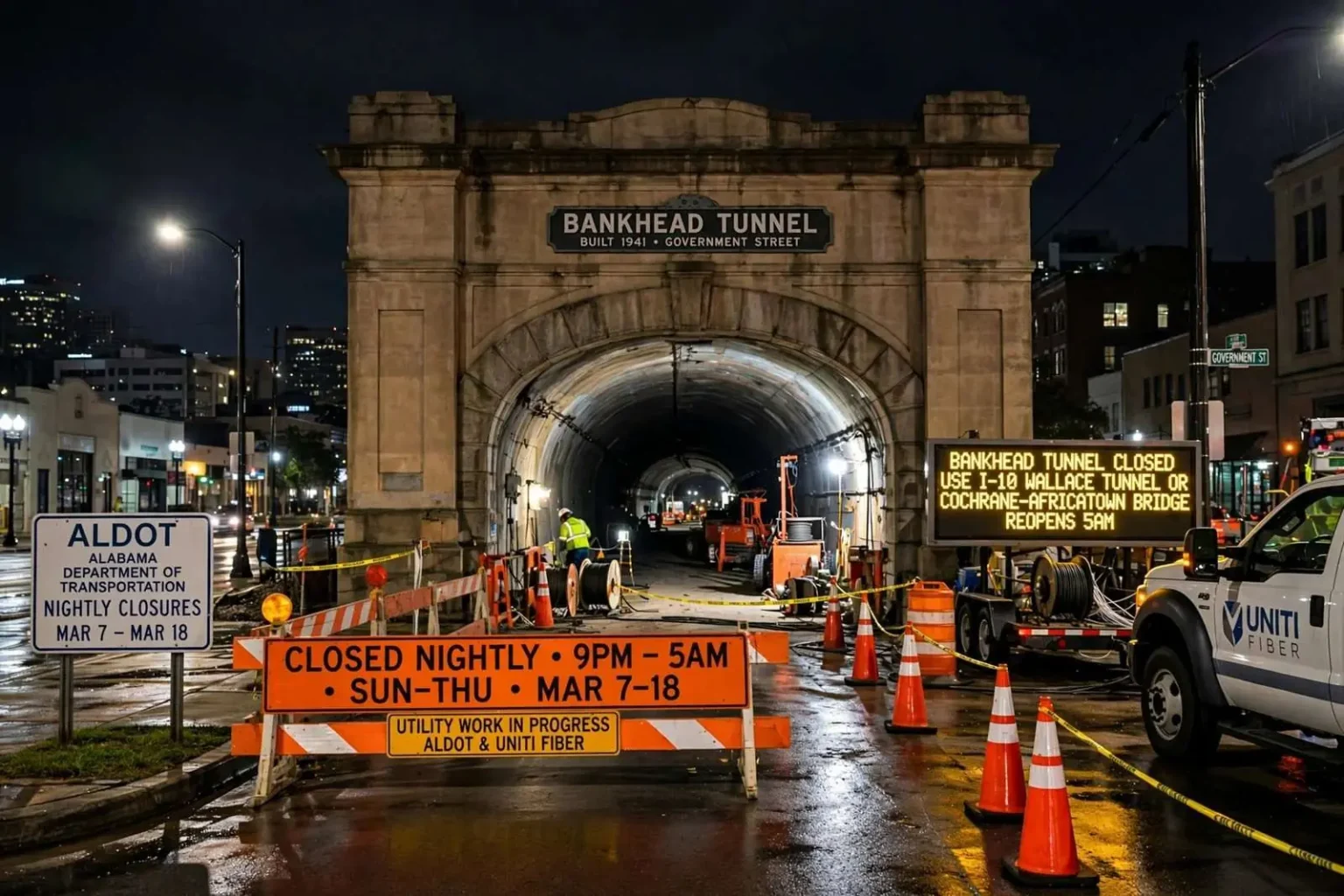
The Alabama Department of Transportation has announced that the Bankhead Tunnel in downtown Mobile will be closed on a nightly basis beginning Monday, March 1, to allow Uniti Fiber to perform utility work inside the tunnel. The closures are scheduled to run Sundays through Thursdays from 9 p.m. to 5 a.m. and are expected to continue through Thursday, March 18.
An update issued on March 10 pushed the start date back, with closures now beginning Sunday night, March 7. The work is part of a permitting arrangement with Uniti Fiber, which needs access to the tunnel interior to carry out its utility operations. ALDOT is advising motorists to plan alternate routes during the overnight closures.
Drivers can use the I-10 Wallace Tunnel or the Cochrane-Africatown Bridge to bypass the work zone. The Bankhead Tunnel, which carries Government Street under the Mobile River, has been a key piece of downtown Mobile’s transportation infrastructure since it opened in 1941. Nighttime closures for maintenance and utility access are not uncommon for the aging tunnel.
A downtown landmark with a long history
The Bankhead Tunnel opened in 1941, named for John H. Bankhead, the Alabama senator whose federal road advocacy left his name on infrastructure across the state. Built beneath the Mobile River to connect Government Street from downtown to the eastern riverbank, the tunnel was an engineering milestone for its era — a submerged-tube crossing that gave Mobile its first fixed river crossing for vehicles and predated the larger George Wallace Tunnel by three decades.
The tunnel’s design reflects its age. Traffic passes through its single tubes with lane restrictions, and its portals sit in the heart of downtown, where Government Street meets the riverfront district. Trucks and taller vehicles are barred from using it, and generations of Mobile drivers know the routine: many simply avoid the tunnel altogether, taking the Wallace Tunnel on I-10 for anything larger than a commuter car.
Eight decades of continuous service have made maintenance a recurring responsibility. The tunnel has undergone periodic closures for structural inspection, pump maintenance and utility upgrades, and ALDOT treats the facility as an asset that must be preserved despite its shrinking share of daily traffic. The Uniti Fiber work fits that pattern — allowing a private utility to modernize infrastructure inside the tunnel under a permit arrangement, with the state controlling when and how the closures occur.
Why fiber work needs the tunnel
Fiber optic routes follow the paths of least disruption across a city, and river crossings are the choke points. Running fiber through an existing tunnel — rather than directional drilling under the river or stringing cable on a bridge — gives a utility protected, accessible conduit between downtown Mobile and the river’s east bank. Uniti Fiber’s permitting arrangement with ALDOT follows a model the department uses for other utilities seeking passage through state-owned crossings.
The overnight work window is deliberate. Closing the tunnel from 9 p.m. to 5 a.m. on Sundays through Thursdays concentrates the disruption in the hours when Government Street traffic is lightest, while leaving the tunnel open during weekday rush hours and weekend nights, when downtown traffic from restaurants and events peaks. Crews working against a March 18 completion deadline need those repetitive overnight windows to pull cable and complete work inside the confined space.
Utility work inside a tunnel is slower than the same work on a street. Ventilation, lighting and access constraints mean crews move equipment in and out through limited entry points, and any electrical or fiber work must be sequenced around the tunnel’s own mechanical systems — the pumps and fans that keep the 1941 structure operating below the waterline of the Mobile River.
ALDOT’s schedule revision — announced March 10, moving the start from Monday, March 1 to Sunday night, March 7 — illustrates how coordination between a state agency and a private utility can shift timelines. Utility crews’ readiness, equipment schedules and the tunnel’s own calendar all feed into start dates, and the department’s update pushed the closure window’s beginning back while keeping the planned completion of March 18 in place.
Getting around during the closures
For drivers who use the Bankhead Tunnel regularly, the alternate routes are familiar. The I-10 Wallace Tunnel carries Government Street traffic’s heavier counterpart just blocks away, offering a four-lane crossing directly connected to the interstate. The Cochrane-Africatown Bridge, upstream to the north, provides another I-10 crossing at the head of the river, serving drivers coming from or heading to the Africatown and Plateau communities.
Overnight drivers should plan for the detour to add minutes rather than hours. With the tunnel closed only from 9 p.m. to 5 a.m., the alternate crossings absorb the light overnight traffic volumes without significant congestion. Downtown residents and overnight workers — hotel staff, port workers, late-shift employees — are the drivers most likely to feel the closures directly, and ALDOT’s advice to plan alternate routes is aimed squarely at them.
Commercial traffic already avoids the Bankhead Tunnel because of its height and load restrictions, so the trucking routes through downtown are unaffected in practice. The closures matter most for passenger vehicles making the short Government Street hop across the river — a trip that, during the closure window, moves to the Wallace Tunnel a few blocks south.
What the work means for the tunnel’s future
Fiber installation inside the Bankhead Tunnel is part of a broader modernization wave sweeping through downtown Mobile. The city’s riverfront redevelopment, the growth of data-dependent businesses downtown, and the expansion of fiber networks across the Gulf Coast have all increased demand for protected conduit routes across the Mobile River. State-owned crossings like the Bankhead Tunnel are among the most logical corridors for that infrastructure.
ALDOT’s willingness to permit the work reflects the tunnel’s ongoing role despite its age. While the Wallace Tunnel carries the bulk of cross-river traffic, the Bankhead remains an important downtown connector — and a structure the state must maintain regardless, given its historic significance and its continued function in the street grid. Utility work performed under permit brings modern infrastructure into the tunnel at private expense, sparing ALDOT the cost of similar upgrades.
The closure schedule — Sundays through Thursdays, 9 p.m. to 5 a.m., beginning Sunday night, March 7 and running through Thursday, March 18 — gives downtown Mobile a two-week window of overnight disruption. Motorists who plan around it will find the Wallace Tunnel and the Cochrane-Africatown Bridge ready to carry the load, and by mid-March the Bankhead Tunnel will be back on its regular schedule, carrying Government Street traffic under the Mobile River as it has since 1941.
The Bankhead Tunnel’s operational quirks are worth recapping for drivers who rarely use it. The tunnel’s Government Street approaches funnel traffic through portals with restricted heights, and its lanes operate as two-way inside a single bore — a configuration that requires drivers to be alert to oncoming traffic in a way modern tunnels do not. The tunnel’s pumps run continuously against groundwater and river seepage, a perpetual job that ranks among the facility’s biggest maintenance costs.
Those systems are also why closures cannot be improvised. Any work inside the bore must be coordinated with the tunnel’s ventilation and drainage operations, and ALDOT’s permit process for utilities like Uniti Fiber includes requirements protecting those systems while crews are inside. An overnight window lets crews work with the tunnel emptied of traffic, and lets ALDOT restore full service by the 5 a.m. reopening each morning.
Downtown development raises the stakes
The timing of the fiber work intersects with downtown Mobile’s busiest construction era in decades. The riverfront district around the tunnel’s portals — including the convention center, the cruise terminal and the growing collection of hotels and restaurants downtown — has been the focus of hundreds of millions of dollars in public and private investment. Reliable fiber connectivity across the river supports that growth, and the tunnel route is one of the few protected paths available.
ALDOT has its own major projects under way in downtown Mobile, from the I-10 Mobile River Bridge and Bayway work that will reshape the city’s highway crossings to routine bridge maintenance on the older river structures. In that environment, scheduling overnight closures of a secondary crossing for utility work is a small coordination exercise — but one more reminder that downtown Mobile’s transportation network, from the 1941 Bankhead Tunnel to the newest bridge plans, is being worked on simultaneously.
Advice for drivers over the next two weeks
The practical guidance during the closure period is straightforward. Drivers heading east on Government Street after 9 p.m. should continue to the Wallace Tunnel entrances rather than expecting the Bankhead bore to be open, and drivers coming into downtown from the east side of the river overnight can use the same crossing in reverse. The Cochrane-Africatown Bridge remains the better choice for traffic connecting to U.S. 43 and the northern river communities.
Friday and Saturday nights remain open throughout the closure period — the schedule runs only Sundays through Thursdays — which spares downtown’s weekend entertainment traffic any added detour. The exceptions are worth noting for anyone planning late-night travel: a Sunday night through Thursday night pattern, 9 p.m. to 5 a.m., through March 18.
ALDOT’s announcement closes with the same advice it always gives in work zones: plan alternate routes, allow extra time, and expect the unexpected as crews and equipment move around the tunnel approaches overnight. For a tunnel that has carried Mobile’s traffic since 1941, two weeks of overnight fiber work is a minor episode — but for the drivers who use Government Street nightly, it is two weeks of remembering that the bore under the river closes at 9.