
Bankhead Tunnel Overnight Closures Rescheduled for Utility Work
ALDOT rescheduled Bankhead Tunnel closures: nightly 9 p.m. to 5 a.m. shutdowns from March 7 through March 18 for Uniti Fiber utility work in Mobile.
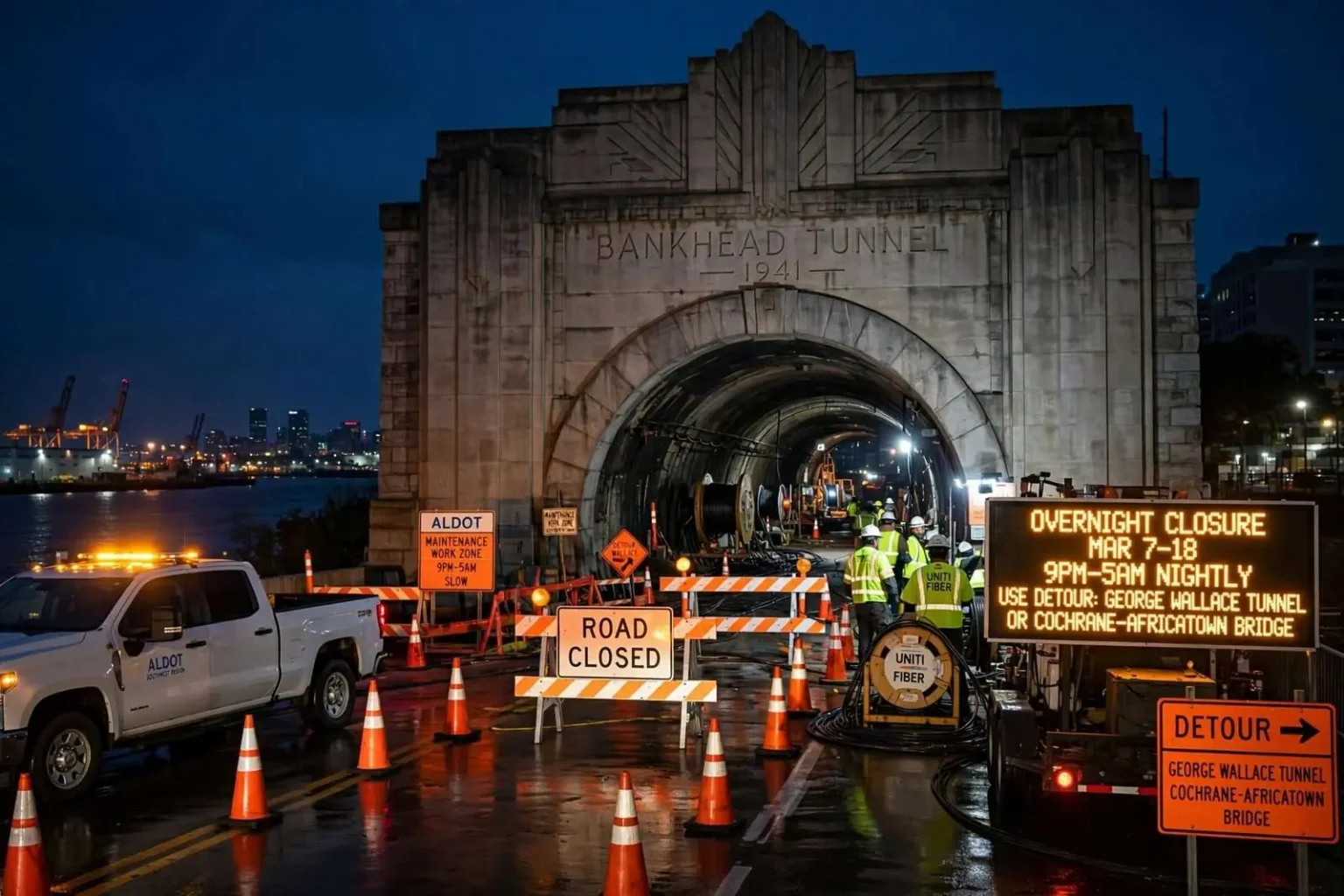
Downtown Mobile commuters will want to note a new schedule: the Alabama Department of Transportation has changed the dates for overnight closures of the Bankhead Tunnel while utility crews work inside it. The tunnel will now close Sunday night, March 7, from 9 p.m. until 5 a.m., with that nightly schedule continuing through Thursday, March 18.
Uniti Fiber is performing utility work inside the tunnel during those hours. The company installs and maintains fiber optic infrastructure, and the Bankhead Tunnel has long served as a conduit route for communications lines crossing beneath the Mobile River between downtown and the city’s eastern shore approach.
While the Bankhead is shut, ALDOT is pointing drivers to two alternates: the George Wallace Tunnel and the Cochrane-Africatown USA Bridge to the north. The George Wallace Tunnel, which carries interstate traffic beneath the river just downstream of the Bankhead, handles the same basic crossing, while the Cochrane bridge offers a route well north of downtown for drivers connecting to U.S. 90 and the communities beyond the river.
The Bankhead Tunnel, opened in 1941, is the older and smaller of Mobile’s two highway tunnels. It carries Government Street traffic beneath the Mobile River in a single tube, and its narrow lanes and tight curves make it a familiar choke point for downtown traffic even in the best of times.
Why the Work Requires Full Closures
Crews working inside a tunnel cannot safely share the roadway with live traffic, particularly in a tube with no shoulder and limited visibility. Closing the tunnel entirely each night gives workers room to stage equipment and move through the bore without exposing them to passing vehicles, and it eliminates the rear-end collision risk that comes with lane closures in confined spaces.
The overnight window — 9 p.m. to 5 a.m. — is the standard approach for tunnel maintenance, timed to the hours when traffic volumes through downtown are at their lowest. Traffic engineers plan these closures around freight schedules as well, since Port City truck traffic often builds before dawn for port and industrial deliveries.
Utility work of this kind typically involves inspecting and upgrading fiber optic lines and their supporting infrastructure inside the tunnel. Communications providers lease conduit space in major river crossings, and keeping those lines accessible requires periodic entry that interrupts traffic for everyone using the crossing.
What Drivers Should Expect
ALDOT’s message to commuters is straightforward: plan around the closure or take one of the alternates. Drivers who normally use the Bankhead to reach downtown from the east will find the George Wallace Tunnel the closest substitute, with signed detours expected during the closure hours.
The George Wallace Tunnel carries its own constraints. It was opened in 1973 as part of the interstate crossing and features steep approaches and lane restrictions on oversize vehicles, so truck drivers in particular will want to check clearances before diverting. The Cochrane-Africatown USA Bridge, a high-level span farther north, avoids tunnels altogether and is the usual recommended route for oversized loads even when the tunnels are open.
Motorists should expect the pattern to repeat nightly through Thursday, March 18, including weekends. The March 7 start is a rescheduled date — ALDOT had originally planned the work for different nights — and the department notes that schedules can shift again for weather or operational reasons.
Background: Mobile’s Tunnel Crossings
The Bankhead Tunnel and the George Wallace Tunnel are the only direct roadway links beneath the Mobile River, and together they have shaped downtown traffic patterns for decades. The Bankhead was a New Deal-era project, built with federal Public Works Administration funding and named for Alabama Senator John H. Bankhead, and its Art Deco portals remain a downtown landmark.
The George Wallace Tunnel was built a generation later as part of the interstate highway network, with tunnel segments floated downriver and sunk into place on the riverbed before being sealed. It carries substantially more traffic today, serving as the river crossing for the interstate route that threads through downtown Mobile.
Because the two tunnels are so close together, closures of one tend to push traffic onto the other almost immediately, and ALDOT coordinates with local police to manage signals and approaches during the work. The Cochrane-Africatown USA Bridge to the north provides the third crossing, connecting downtown Mobile with the communities across the river and serving as the detour of choice for heavy vehicles.
Regular maintenance is a fact of life for all three crossings. The tunnels require constant attention to ventilation, drainage, lighting, and fire safety systems, and the bridge undergoes routine inspections mandated for structures of its age and size. Drivers have grown used to periodic night work, though the duration of this closure cycle — nearly two weeks — is longer than most.
Impact on Downtown Businesses and Night Shifts
The closure window overlaps with late-night activity downtown, including restaurant and bar closings and the overnight shifts at the port, hospitals, and industrial facilities east of the river. Workers with overnight commutes are advised to build in extra time, particularly on weeknights when the detour routes carry combined traffic volumes.
Emergency responders plan around tunnel closures as well. Fire and ambulance units that regularly use the Bankhead for the quickest crossing to the east side will adjust their response routes during closure hours, and police presence at the tunnel approaches is typical during ALDOT night work to keep traffic moving through the detour.
Residents of communities east of the river who work downtown — and vice versa — will feel the change most directly. For them, the nightly five-hour window still leaves the tunnel available for morning and evening rush hours, which is by design: ALDOT’s maintenance windows almost always preserve peak-hour access.
The work is part of a broader pattern of infrastructure investment along the waterfront corridor, where communications, utility, and transportation upgrades have proceeded in stages over recent years. Officials say keeping the crossings maintained now helps avoid longer, more disruptive repairs later.
Questions about the closure schedule can be directed to ALDOT’s Southwest Region office, which oversees state routes in Mobile County and posts updates on night work and detours for major crossings.
Tips for Getting Through the Detour
Motorists with flexibility should shift trips outside the 9 p.m. to 5 a.m. window entirely, since the tunnel reopens each morning with no residual restrictions. Those who must cross during closure hours can smooth their trip by using the Cochrane-Africatown USA Bridge instead of funneling into the George Wallace Tunnel, spreading traffic across both detours.
Truckers and commercial carriers should note that both tunnels restrict vehicles over a certain width and height, which makes the northern bridge the practical routing for most freight during the closure. Dispatchers planning overnight runs through downtown Mobile will want to adjust routes for the full March 7 through March 18 period.
ALDOT urges drivers to slow down in work zones and watch for workers and equipment near the closed portals. Even though the work happens inside the tunnel, the approaches remain active with construction traffic entering and leaving the bore, and the detour routes themselves see heavier volumes than usual in the overnight hours.
The department typically announces any schedule changes through its regional office and variable message signs on the approaches. Drivers who encounter an open tunnel on a scheduled closure night should treat the change cautiously and follow posted signage, since closures occasionally lift early when crews finish ahead of schedule or pause for weather.
For most commuters, the rescheduled work means two weeks of paying closer attention to the river crossings than usual. Once the utility project wraps, the Bankhead returns to its normal 24-hour schedule with no remaining closures tied to this project.
What the Fiber Work Means Locally
Fiber optic infrastructure routed through river crossings is easy to forget about until it needs attention, but it carries a significant share of the region’s communications traffic. Lines through the Bankhead Tunnel corridor serve not just the tunnel’s own systems but commercial and institutional connections on both sides of the river.
Uniti Fiber, the contractor performing the work, maintains fiber routes across the Southeast, and maintenance entries like this one are scheduled months in advance with transportation officials. The overnight-only format is the compromise that lets the company reach its infrastructure while leaving the crossing open for the traffic that depends on it during the day.
Utility coordination is a routine but delicate part of tunnel management. The Bankhead’s bore houses drainage lines, electrical conduit, ventilation equipment, and communications cable in limited space, and any work near those systems requires care to avoid knocking out services that the tunnel itself relies on.
A Look Back at the Bankhead’s Role
When the Bankhead Tunnel opened in 1941, it was a marquee public works project, celebrated as an engineering link that finally connected downtown Mobile directly to the eastern shore roadway network without a ferry. For decades it was the region’s primary river crossing, and generations of Mobilians remember riding through its tiled walls and curved approach.
Traffic patterns shifted as new bridges and tunnels came online, and today the Bankhead functions mainly as the Government Street connection — a one-way passage that feeds drivers into the downtown street grid. Its age shows in its dimensions: the tube is narrower than modern standards, which is why commercial vehicles over a set size are directed to other crossings.
Preservation-minded residents have long taken an interest in the tunnel’s Art Deco details, and transportation officials have balanced that heritage against the constant maintenance demands of an eighty-year-old structure. Night closures like this one are part of how the department keeps the old bore serviceable without a full reconstruction that would shut it down for months.
For the next two weeks, the nightly routine will be the same: crews enter at 9 p.m., the tube goes dark to traffic, and the crossing reopens before the morning rush. Commuters with questions about the rescheduled dates or the detour routes can contact ALDOT’s Southwest Region office for the latest update.