
Bar Spotlight: Alchemy Tavern packs multiple experiences into one historic Dauphin Street building
Alchemy Tavern packs a downstairs whiskey bar, an upstairs music venue, and a patio into one historic Dauphin Street building in Mobile.
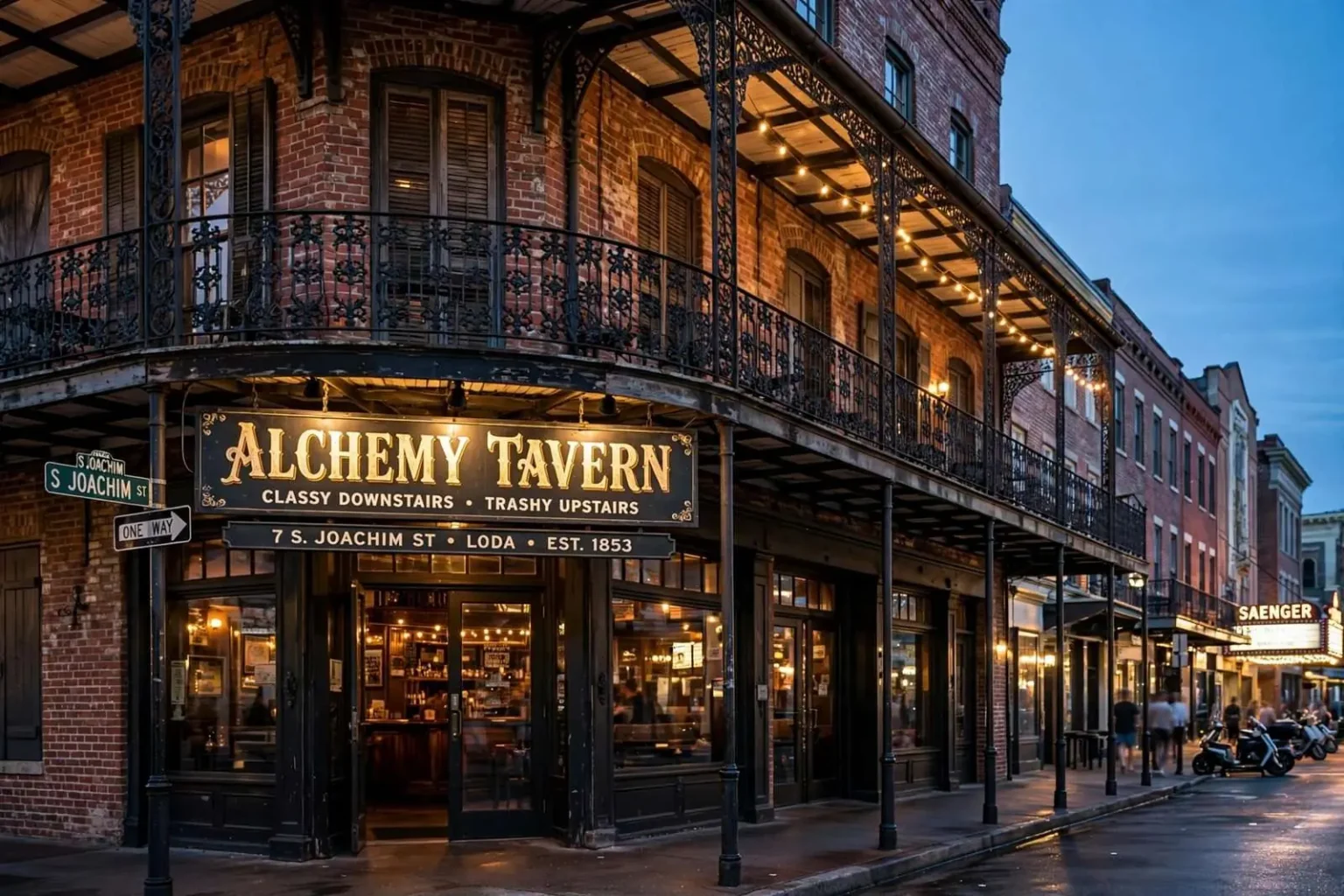
MOBILE, Ala. — LoDa regulars face a wall of bar options downtown, but those wanting a little of everything in one place should detour to 7 S. Joachim St.
Alchemy Tavern is a maze of distinct bar areas, housed in a historic building constructed by a former Mobile mayor in 1853.
Current owner Matt Charnetski’s concept is “classy downstairs, trashy upstairs.”
The address alone tells regulars much of the story. South Joachim Street sits one block off Dauphin in the Lower Dauphin entertainment district — LoDa, in the local shorthand — the strip of bars, restaurants and music rooms that has anchored downtown nightlife since the district’s revival in the 1990s. Buildings of that vintage line the block, and Alchemy’s home is one of the survivors: antebellum brick and timber raised by a former mayor of the city, recycled across a century and a half of commerce into one of downtown’s most distinctive nightspots.
The Downstairs Bar
The Downstairs Bar has a room-length wooden bar, vintage lighting, flat screens, 42 craft taps from regional breweries, and a whiskey collection of more than 100 options — including a $160 Scotch.
The tap lineup signals the bar’s ambitions. Forty-two handles devoted largely to regional craft breweries place Alchemy among the more serious beer destinations in Mobile, at a time when Alabama’s own brewery scene — from Mobile’s breweries to Huntsville’s and Birmingham’s — has grown into a genuine attraction. The whiskey wall works the same side of the street: a selection north of 100 bottles, from everyday bourbons to that $160 Scotch, gives the bartenders a repertoire for customers of any budget.
The street-level front room is smoke-free and hosts acoustic sets, karaoke, trivia, and video-game tournaments.
That programming is deliberate. A smoke-free front room keeps the space open to the after-work crowd, the trivia leagues and the acoustic acts that draw listeners rather than dancers — a different audience than the one upstairs, served from the same building on the same night.
Deeper inside, the Back Bar works for private events and opens onto a patio.
The private-event space is a quiet engine of the business. Rehearsal dinners, birthday parties, fundraisers and band after-parties fill the Back Bar on nights when the front room runs its usual schedule, and the patio — a rarity in a district built of attached historic buildings — gives smokers and conversationalists a place to spill out.
Upstairs: A Venue of Its Own
Upstairs is nearly a separate venue, with its own entrance and live music multiple nights a week, plus cheaper drink specials and indoor smoking.
The split-personality design is the point of the place. The upstairs room, with its own street entrance, lets Alchemy run a loud show on the second floor while the ground floor carries on with conversation and karaoke — two businesses sharing one roof, each drawing the crowd the other would drive away. Cheap specials and an indoor smoking area locate the upstairs firmly in the rock-and-roll tradition: sweaty rooms, ringing ears and bands that play inches from the audience.
“Independent local venues are the lifeblood of the music scene here in Mobile, and Alchemy most certainly plays a major role in that,” said Brian Dunbar of The Hallers.
The endorsement from a working musician captures the venue’s place in the ecosystem. For local and touring acts alike, Mobile’s challenge has always been the scarcity of rooms that present original music on weeknights — places where a band from New Orleans or Pensacola can route a show between bigger cities. Venues like Alchemy fill that gap, and bands remember which rooms treated them well and which crowds showed up.
An Anchor for the Scene
Alchemy is a key SouthSounds stage and a launchpad for up-and-coming bands.
SouthSounds, the downtown music festival that showcases emerging artists across the LoDa district each year, depends on exactly this kind of venue — rooms with stages, sound systems and staff who know how to move crowds between sets. During the festival, Alchemy’s multiple levels let it host acts back to back while the street outside turns into a pedestrian festival ground, and the exposure has introduced countless Mobile audiences to bands they would otherwise never have heard.
Its metal balcony overlooks Joachim Street toward the Mobile Saenger Theater, making it a natural pre- or post-show stop.
The geography matters. The Saenger, the 1925 movie palace that hosts touring acts and comedy shows a block away, sends hundreds of ticket-holders past Alchemy’s doors on show nights, and the balcony perched over Joachim Street gives the bar a literal view of the foot traffic. Pre-show dinners, post-show nightcaps and the lingering crowd that is not ready for the night to end form a dependable second wave of business on Saenger nights.
Weekly events range from Sunday open mic to Nerf Wars blacklight nights.
The calendar’s range is the quiet discipline behind the bar’s identity. An open mic on a Sunday gives songwriters and comedians a stage; trivia and video-game tournaments give competitive regulars a standing appointment; a blacklight Nerf battle gives the upstairs room a reason to exist on a slow Wednesday. Venue operators in college-adjacent downtowns learn quickly that an empty weeknight is a habit, and Alchemy’s schedule is built to break it.
The Building and the Block
A bar operating in a structure raised in 1853 carries obligations as well as atmosphere. Mobile’s historic district buildings — many of them antebellum survivors in a city that has lost far too many to demolition and storm — are the physical fabric of the LoDa revival, and the businesses that occupy them trade on authenticity no new construction can manufacture. Exposed brick, heart-pine floors and ironwork balconies are the district’s signature, and the balcony over Joachim Street belongs to a tradition of ironwork that Mobile shares with New Orleans: the city holds one of the largest collections of wrought-iron architectural work in the nation.
The former mayor who built the edifice put it up in an era when Mobile was a booming cotton port, its skyline rising on the fortunes of the river trade. That the building now houses craft beer and live music is a shorthand for the downtown’s own journey — from cotton-era commerce through decades of decline and suburban flight, to the entertainment-district revival that returned residents and nightlife to the city center. Every LoDa bar operates inside that history, whether its clientele knows the dates or not.
Where Different Crowds Meet
With a diverse, welcoming crowd and tight security, Alchemy has become a central hub steps from the heart of Dauphin Street — a place where completely different social groups intersect.
That mix is harder to engineer than it sounds. Downtown bars often stratify — a college crowd here, a cocktail set there, a biker bar down the block — and the venues that last tend to be the ones that keep the lines porous. Alchemy’s architecture does part of the work: a visitor can move from quiet whiskey at the long wooden bar to a loud band upstairs in the course of one night without changing bars, and the crowd the building attracts is, by design, several crowds at once.
Security is the unglamorous half of that reputation. A venue that hosts heavy-drinking late nights, smokers, live music and multiple entrances survives on door staff who manage the flow without turning the place hostile, and regulars judge a bar on exactly that — whether the room feels safe at 1 a.m. It is one of the reasons the tavern has held its place in a district where options multiply and tastes shift every season.
For visitors sorting through the wall of choices that LoDa presents on any given night, the pitch is the one the owner has made from the start: if the evening calls for a little of everything — craft beer, good whiskey, live music, a patio, a balcony over the street — one historic building on South Joachim Street delivers all of it under a single roof, classy downstairs and trashy upstairs, the way Mobile has liked its nights out for generations.
Inside the LoDa Ecosystem
Alchemy does not operate in isolation; it is one node in a district that works as a collective. On a busy weekend the blocks of Lower Dauphin function as a single entertainment destination — dinner at one address, a show at another, a nightcap at a third — and the bars thrive or starve together depending on how well the district draws. Venue owners in the district cooperate on festival weekends, share sound engineers and band bookings, and refer overflow crowds to one another, an alliance born of the recognition that a visitor disappointed anywhere in LoDa is unlikely to come back to any of it.
The craft-beer boom that Alchemy’s 42 taps reflect has reshaped the whole state’s bar culture in the years since Alabama loosened its brewing and taproom laws. High-gravity beer became legal in 2009, home brewing was legalized in 2013, and breweries followed in city after city, changing what bar patrons expect to find on the menu. A tap wall that once held national domestics now competes on selections from Gulf Coast breweries, and establishments that invested in craft lines — as Alchemy did — positioned themselves ahead of the shift rather than chasing it.
The whiskey shelf tells a parallel story. Bourbon’s boom has made a deep selection a marker of a serious bar, and bottles from the standard labels to collector-tier Scotishes give bartenders room to up-sell a newcomer into a tasting flight or guide a regular to something new. Staff knowledge is the multiplier: a hundred bottles mean little without someone behind the bar who can talk about them, and venues known for their lists are equally known for the training behind them.
Music programming, meanwhile, remains the hardest part of the business. Booking original acts multiple nights a week takes relationships with agents, a sound system that doesn’t drive musicians away, and the patience to absorb empty Tuesdays so that a Friday headliner has an audience that grew week by week. It is the least predictable revenue in the building and, by the owner’s own framing, the soul of the place — the reason a bar becomes a venue, and a venue becomes an institution the scene cannot easily replace.