Bartender Profiles: Wil Reid has poured drinks and stories at Hayley’s Bar for a decade
Wil Reid has tended bar at Hayley's Bar on Dauphin Street for more than a decade. In our Bartender Profiles, he shares stories from behind the stick.
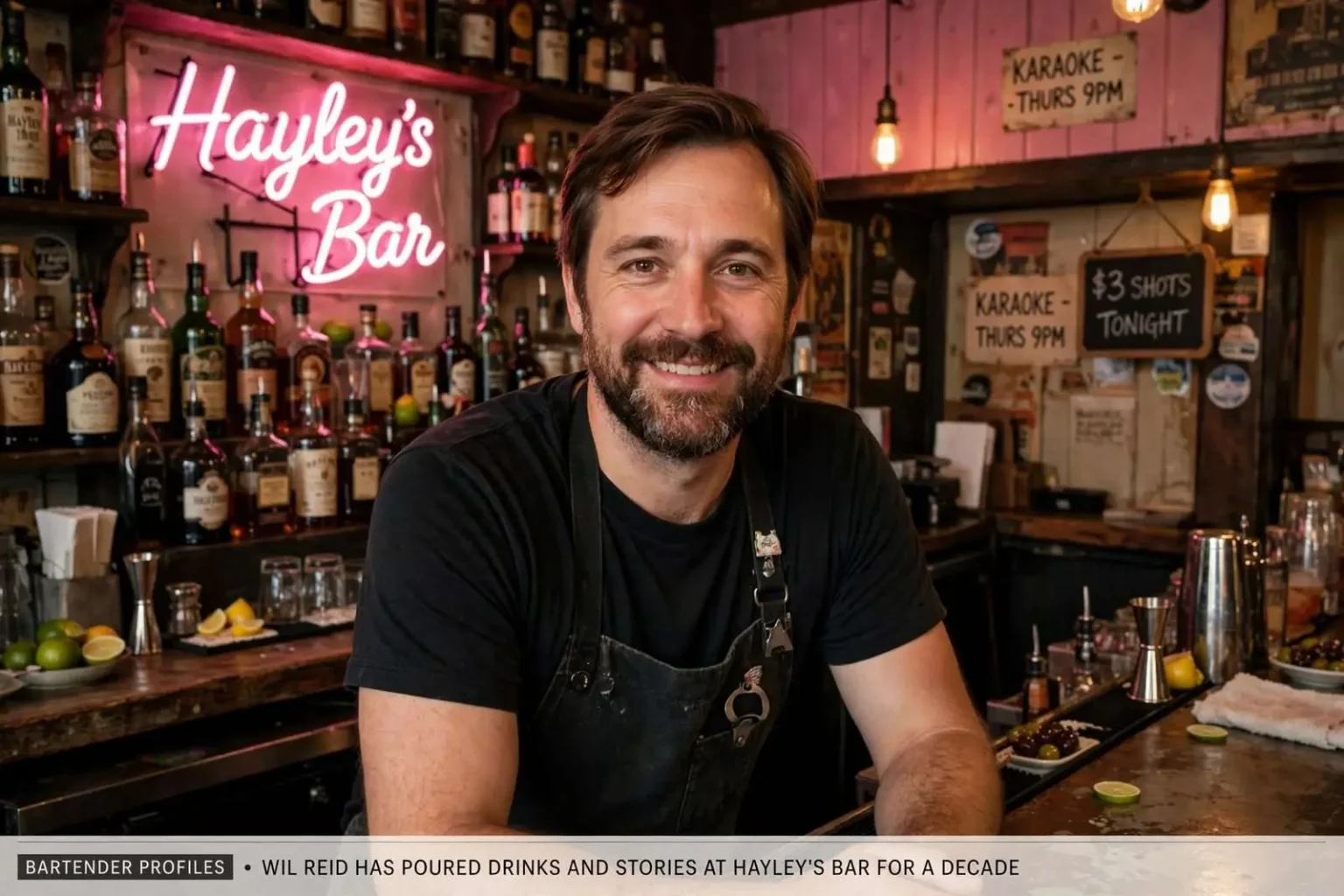
Our Bartender Profiles series gets up close with the people behind the stick, and there’s no better start than Wil Reid at Hayley’s Bar. Anyone who’s spent time at the pink Dauphin Street landmark has likely met the experienced — and often underappreciated — bartender. In a stretch of downtown Mobile where the bars change concepts as often as the seasons, Reid has become one of the constants: the man who knows the regulars by their orders, keeps the pours honest and holds court over a room that has grown into one of the street’s most dependable late-night destinations.
Bartenders occupy a peculiar place in the life of a city. They are counselors and referees, historians of the neighborhood and observers of everything from first dates to farewell parties. On Dauphin Street — the spine of Mobile’s downtown entertainment district, where a block can hold a dozen different ideas of what a night out should be — the person behind the bar sets the tone for the room. Over the course of a decade, Reid’s tone at Hayley’s has been easygoing, unpretentious and welcoming to just about anyone who walks through the door.
Hayley’s itself has a story worth telling. The pink building has stood on Dauphin Street through the district’s lean years and its revival, outlasting bars that opened with more fanfare and closed without ceremony. Longevity of that kind is not accidental. It comes from owners who keep the rent-and-specials math honest, and from bartenders who give people a reason to come back before they have even finished their first drink. In Mobile’s bar scene, where word travels fast and loyalty is earned in round increments, Hayley’s pink facade has become shorthand for a certain kind of unpretentious night out.
Reid’s route to that post was anything but direct. He started bartending school at 18, but his young looks kept him from being hired until he turned 22 and began working a real bar in his hometown of West Palm Beach, Fla. The delay is a familiar story in the trade: young bartenders often know the recipes long before anyone will trust them with a register, and the years of waiting build a patience that serves them later behind a busy bar. He also spent part of his childhood in Hackensack, N.J., a piece of personal geography that gives him a broader frame of reference than most Gulf Coast barkeeps.
He’s now been in Mobile for more than a decade, drawn south by family throughout Alabama and Mississippi. The move placed him in a city whose drinking culture rewards exactly the qualities he had already developed — consistency, conversation and the ability to make a small room feel like a living room. What was meant as a family-driven relocation turned into a career, and Hayley’s Bar became the place where that career took root.
A regular’s bar
At Hayley’s, Reid values the freedom to promote his own shifts and specials, from $3 shots to crawfish nights and karaoke. That kind of autonomy is rarer than it sounds. In many bars, promotions are handed down from owners or corporate offices, and bartenders simply execute them. At Hayley’s, the person pouring the drinks is also the person building the crowd, and Reid’s specials reflect an instinct for what his regulars actually want: cheap, fun and social, rather than craft-cocktail preciousness.
He describes the crowd as the most diverse on the block — “everybody knows it’s a place to get a drink for a good price” — and compares it to a New York neighborhood dive. That comparison carries weight. The great neighborhood dives of New York survive because they offer something the trendy spots cannot: a room where a lawyer, a line cook and a night-shift nurse can end up on adjacent stools without anyone feeling out of place. Hayley’s has cultivated the same dynamic on Dauphin Street, where the pink exterior hides a bar that has resisted the upsell and the velvet rope.
Mobile’s nightlife is mostly regulars, Reid notes, since the city lacks a big tourist industry. That gives bartenders room to build real relationships with the people they serve. In a destination city, a bartender might never see the same face twice, and the work becomes a performance aimed at strangers. In Mobile, the opposite holds: the same customers come back week after week, birthdays and anniversaries get remembered, and a bartender’s knowledge of his regulars becomes part of the bar’s value. It also raises the stakes — a bartender who treats people poorly in a town of regulars will hear about it, and so will the bar.
That regulars-driven rhythm defines the shift itself, too. A night at a regulars’ bar rarely builds the way it does in a tourist district, where crowds arrive in waves and leave with the last shuttle. Instead, the room fills gradually with familiar faces, the pace stays conversational, and the bar’s best business often comes on the nights that don’t look busy on paper — the Tuesday regulars, the birthday party that books the corner, the after-work crew that stretches happy hour into dinner. For a bartender, that means the job rewards memory and patience over flash, and it means the relationships Reid talks about are not just pleasant; they are the inventory the business runs on.
The trade itself has changed around him during his years in Mobile. Craft cocktail culture arrived downtown with tasting menus of bitters and house-made syrups, and plenty of bars chased it. But the core skills of the job have not changed at all: read the room, keep the drinks coming, remember the names, and know when to cut someone off before it becomes a problem for the door guy. Reid’s bar runs on those fundamentals. The $3 shot special will never make a cocktail blog, but on a Friday night it fills the room, and a full room is the entire business model of a neighborhood bar.
The regulars-first dynamic shapes the economics of downtown nightlife as well. Without a flood of visitors each weekend, Mobile’s bars depend on locals choosing to come downtown instead of staying in their neighborhoods, and the bars that thrive are the ones that give people a reason beyond the drink itself. Hayley’s cheap specials and familiar faces do exactly that.
The job, on the record
Reid is candid about the harder parts of the work — rude or inebriated customers, the occasional “I gave you a twenty” arguments — but says he tries to “kill them with kindness.” Every veteran bartender knows the disputes Reid describes: the closing-time math arguments, the patrons whose charm dissolves with each round, the nights when de-escalation matters more than drink-making. His approach — meeting hostility with warmth until it runs out of fuel — is the oldest and most effective tactic in the trade, and it explains why he has lasted as long as he has on a street where bar fights and bar drama are never more than a closing bell away.
He loves the rock-and-roll, anything-goes vibe of Hayley’s and the late-night singalongs that break out on the bar. Those moments are the ones bartenders remember: a crowded room at 1 a.m., a chorus rising from the bar tops, strangers who arrived separately singing the same lines. It is the kind of spontaneous community that no marketing plan can manufacture and that keeps people coming back — the sense that on a given night, something might happen in this room that happens nowhere else.
Reid also sees potential in Dauphin Street’s growth, suggesting a steady downtown police presence would keep the entertainment district from swinging between quiet and “the Wild West.” His observation touches a real tension in downtown Mobile’s revival. The street has gained businesses and foot traffic over the years, but perceptions of safety swing with the night and the season, and bar owners know that a stretch of sidewalk perceived as unpredictable empties rooms as fast as any bad review. A consistent, visible police presence, in Reid’s view, would give the street the stable footing it needs to keep growing rather than lurching between extremes.
His long tenure also makes him something of an informal historian of the block. Bartenders who stay put see everything: which concepts opened with big crowds and faded, which national acts passed through and which local bands filled the room, how Mardi Gras and holiday weekends reshape the street’s rhythm. That accumulated knowledge rarely shows up in city planning documents, but it is exactly the kind of on-the-ground insight that business owners and civic leaders could use more of — and it is offered nightly, for free, from behind the bar.
After a decade behind the same bar, Reid’s perspective carries the weight of ten thousand shifts: he has watched Dauphin Street’s cycles, survived its slow weeks and its wild ones, and built a following that will follow him anywhere he pours. For now, that place is Hayley’s, where the drinks are cheap, the karaoke is loud and the bartender knows your name — and probably your usual, too.