
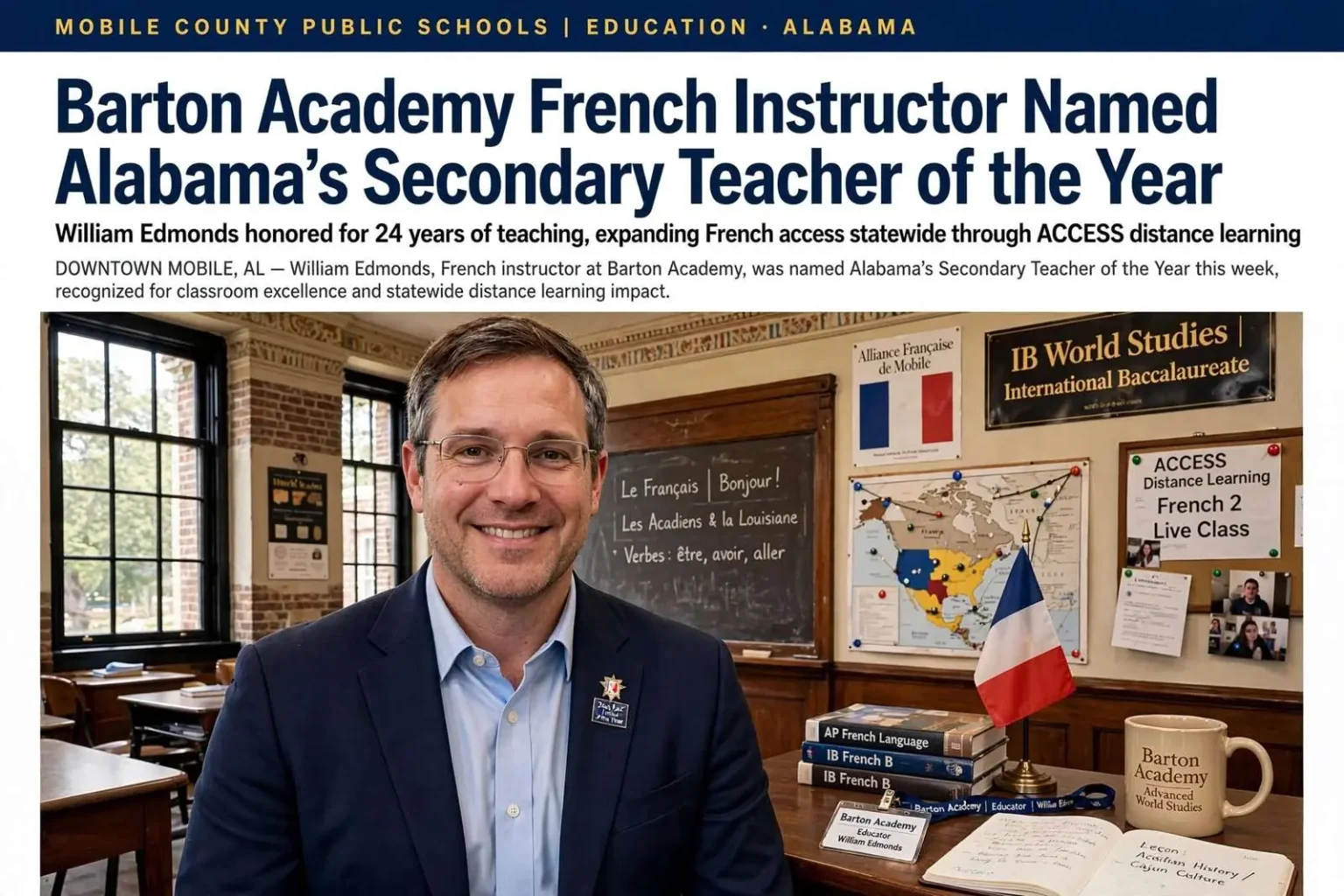
A French teacher at Barton Academy in downtown Mobile is headed to the top of the profession. William Edmonds has been named Alabama’s Secondary Teacher of the Year, according to the Mobile County Public School System, which announced the honor after a statewide recognition ceremony.
Two Mobile County Honorees
Edmonds was recognized alongside Kelly Parker of Tanner Williams Elementary, who earned a spot among the Top 16 finalists for Alabama Teacher of the Year — a strong showing for Mobile County Public Schools in the state’s annual teaching honors. For a single district to place a state winner at the secondary level and a finalist among the top sixteen overall speaks to the depth of its teaching corps, which is the largest school district employment base in Alabama.
The Alabama Teacher of the Year program recognizes educators at both the elementary and secondary levels, drawing nominees from each of the state’s school districts and putting the finalists through a review of their classroom practice, leadership, and contributions beyond their own schools. The winners go on to represent Alabama’s teachers nationally, carrying the responsibilities of the title into conferences, professional development, and public appearances across the state.
Tanner Williams Elementary, which Parker represents among the finalists, sits in the growing communities of west Mobile County, where the school has been part of the region’s rapid residential expansion. Edmonds’ honor, meanwhile, belongs to one of the district’s most distinctive campuses — Barton Academy, the historic downtown landmark that now houses the school system’s advanced international studies program.
Barton Academy itself carries a story worth knowing. The Greek Revival building on Government Street opened in 1839 as the first public school in Alabama, and after years as the school system’s central office and a period standing vacant, it was restored and reopened as Barton Academy for Advanced World Studies. The magnet program’s international focus — world languages, global studies, and an International Baccalaureate framework — makes a French instructor’s selection as the state’s top secondary teacher a fitting emblem of the school’s mission.
More Than Two Decades in the Classroom
Edmonds brings 24 years of teaching experience to his role at Barton Academy. Beyond his classroom duties, he has taught French to students across Alabama through the ACCESS distance learning program and has taught at both the University of South Alabama and the University of Mobile.
The ACCESS distance learning program deserves particular attention, because it is one of Alabama’s answers to a persistent rural problem: small high schools that cannot afford to staff courses in advanced languages, higher mathematics, or specialized electives. Through ACCESS, a certified teacher like Edmonds can deliver live, web-based instruction to students scattered across the state — from Black Belt counties to the Tennessee Valley — giving those teenagers access to coursework their own schools could never offer. Teaching French by distance to an audience that wide is a specialized skill, and it extends the reach of a downtown Mobile classroom to every corner of Alabama.
His university teaching at South Alabama and the University of Mobile places him on both sides of the transition that local students make from high school to college, and it reflects the kind of credential depth that university departments seek even from public school faculty. Mobile’s higher education community has long been tied to the region’s language and international business communities, and Edmonds’ work spans both worlds.
His résumé also includes service as an International Baccalaureate examiner, grading IB exams worldwide, and a term as president of the Alliance Française de Mobile, the local French cultural organization. The examiner role puts him on the global side of the IB network — the same assessments his Barton students sit for — which means he grades the work of IB candidates around the world while preparing his own students for the identical rubrics. The Alliance Française presidency, meanwhile, connects his schoolwork to Mobile’s broader francophone community, from the city’s French heritage events to the cultural programming the organization hosts.
From Banking to the Classroom
Edmonds came to teaching by way of banking. He holds a bachelor’s degree in global business and French from the University of Mobile and a master’s degree in education from the University of South Alabama.
That path — a business degree with a language attachment, followed by a career pivot into education — has become an increasingly common route into the classroom, and in Edmonds’ case it pairs neatly with the subject he teaches. A global business background gives a French teacher an answer to the question every language student eventually asks: what is this for? Mobile’s own economy makes the answer concrete. The Port of Mobile, the city’s international trade relationships, and the French-speaking corporate and cultural connections that run through the Gulf Coast all make French a practical credential in the region, not just an academic exercise.
His studies have taken him abroad repeatedly, including intensive language immersion in Belgium and France and a scholarship trip to Canada and Louisiana to research the deportation of the French-speaking Acadians — history with deep echoes along the Gulf Coast.
The Acadian Thread
That research topic ties Mobile’s classroom to one of the great stories of the French-speaking Atlantic world. The Acadians — French settlers of Nova Scotia and the surrounding maritime colonies — were forcibly expelled by the British beginning in the 1750s, scattered across the Atlantic world in one of the period’s most consequential deportations. Many eventually made their way to French Louisiana, where their descendants became the Cajuns of today, and their migration route ran through the Gulf of Mexico near the very coastline where Edmonds teaches.
Studying that history in Canada and Louisiana gives a Gulf Coast French teacher a regionally rooted curriculum: the language his students study arrived on this coast through that exile, and its echoes remain in place names, parish cultures, and the Cajun communities a short drive west of Mobile. For students at Barton Academy’s world studies program, a teacher who has done archival research on that story can connect a grammar lesson to the history of the Gulf they live beside.
The immersion stints in Belgium and France serve the same purpose from the other direction. Language teachers who have lived inside the cultures they teach bring accent, idiom, and contemporary reference into the classroom, and intensive immersion is the standard preparation for it. Combined with his distance teaching across the state, his university work, and his IB examining, the travel history completes the profile of a teacher whose subject has been a working career rather than a classroom assignment.
What the Honor Means for Mobile County
The state award carries visibility that reaches beyond one teacher’s career. The Alabama Teacher of the Year becomes the public face of the profession for the year ahead, and with the title comes a platform: speaking to education groups, mentoring other teachers, and representing the state in the national Teacher of the Year program. For Mobile County Public Schools, having that representative come from Barton Academy puts the district’s downtown flagship at the center of the state’s education conversation.
The district’s showing was doubly strong. Kelly Parker’s place among the Top 16 finalists means Mobile County had representation in both the elementary and secondary tracks of the program, and both honorees will carry the recognition into their schools this fall. Districts across Alabama compete for these honors annually, and a city-county district of Mobile’s size is often in the conversation — but placing a winner and a finalist in the same year stands out.
For Barton Academy specifically, the award lands on a campus that has been rebuilding its identity. The restoration of the 1839 building and the launch of the advanced world studies program were gambles on the idea that a historic landmark could house a modern, internationally focused school. A state teacher of the year teaching French in that building is evidence for the case.
Why World Languages Matter Here
Edmonds’ recognition also arrives at a moment when the value of language education is being reargued in schools nationwide, and Mobile offers an unusually concrete answer. The Port of Mobile’s expansion, the region’s growing international business base, and the city’s deep historic ties to French colonial and Acadian history all make French instruction locally meaningful in ways that transcend the standard curriculum argument.
Students at Barton Academy encounter that context daily — a downtown campus steps from the businesses and institutions that make up Mobile’s international footprint, taught by faculty whose own credentials include international research and university-level instruction. The ACCESS program extends that opportunity to students in districts that have no French teacher at all, which is precisely the equity gap the state program was designed to close.
The honor also reflects the partnerships that support language education locally. The Alliance Française de Mobile and the region’s universities form a small ecosystem for francophone culture on the Gulf Coast, and a teacher who has led the Alliance while teaching at two universities and one of the state’s signature magnet schools embodies how those institutions can reinforce one another.