
Bay Area Food Bank Named Finalist in National $100,000 Giving Contest
The Theodore-based Bay Area Food Bank became a finalist in a national public-vote contest for a $100,000 award to boost Gulf Coast hunger relief.
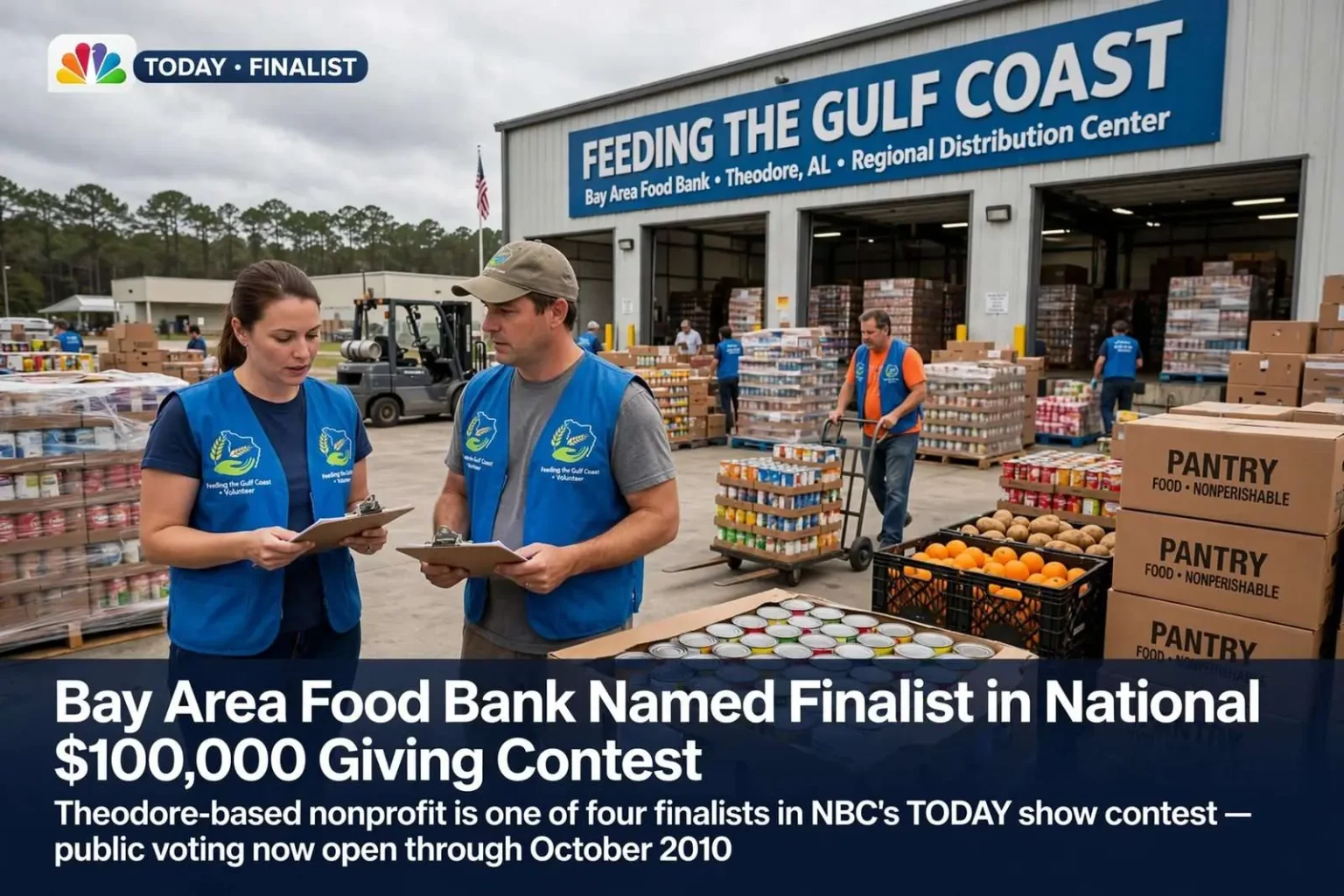
The Bay Area Food Bank, the Theodore-based nonprofit that supplies food pantries and meal programs across the central Gulf Coast, was named one of four finalists in a national public-voting competition offering a $100,000 award tied to NBC’s “Today” show. The contest format was simple and demanding in equal measure: the organization with the most public votes at the end of the round would take the money, and everything depended on mobilizing supporters online.
The food bank’s supporters were asked to cast votes online and spread the word in hopes of pushing the organization past the other finalists before voting closed. A win would have meant a significant infusion of cash for an organization that relies heavily on donations and grants to keep its warehouse and distribution network running.
For a food bank, $100,000 translates into food by the truckload. Because food banks purchase and move product at wholesale scale, a six-figure award multiplies into hundreds of thousands of pounds of groceries — a difference that shows up on pantry shelves in communities from Mobile to the Florida panhandle. Food banks calculate their impact in meals provided per dollar, and a grant of this size can underwrite distribution operations for months.
The finalist announcement put the Theodore warehouse at the center of a regional campaign. Churches, schools, civic clubs and businesses across the coverage area were enlisted to vote daily and pass along reminders through bulletins, newsletters and word of mouth — the kind of grassroots mobilization Gulf Coast communities have long shown they can produce when a hometown cause reaches a national stage.
A Regional Hunger-Relief Network
Bay Area Food Bank, now known as Feeding the Gulf Coast, has long served as the primary hunger-relief hub for Mobile and Baldwin counties and a wider swath of the central Gulf Coast, funneling donated and purchased food to smaller pantries, shelters and feeding programs that serve families directly. The organization operates as a regional distribution center in the national food bank network, receiving truckloads of donated product from manufacturers, retailers and federal programs, sorting and inspecting it at the Theodore warehouse, and moving it out to partner agencies across a multi-county territory.
The hub-and-spoke model is what makes a regional food bank efficient. Small-town pantries and church food closets rarely have the storage, refrigeration or purchasing power to secure food at scale; the regional bank aggregates demand, negotiates with donors and suppliers, and delivers what each partner can handle. In coastal Alabama, where the service area stretches from urban Mobile to rural inland counties, that logistics role is the difference between a full shelf and an empty one at hundreds of feeding sites.
Food banks in the region were under particular strain in the summer of 2010, as the Deepwater Horizon oil spill disrupted fishing and tourism jobs up and down the coast and pushed more families toward emergency food assistance. The spill’s economic toll fell on exactly the households least able to absorb it: deckhands and seafood processors whose fishing grounds closed, and restaurant, hotel and charter-boat workers whose summer seasons collapsed as visitors stayed away. Food banks along the coast became part of the spill response, distributing to families who had never needed a pantry before.
National contests tied to television programs were, at the time, a common way for charities to compete for large, one-time grants that could otherwise take years to raise through traditional fundraising. Corporations and networks discovered that public-voting contests built enormous goodwill and earned media, and charities discovered that they traded grant-writing labor for campaign labor — organizing votes instead of writing proposals, with the outcome in the hands of their supporters rather than a selection committee.
For a regional food bank serving thousands of households, a $100,000 prize represented the equivalent of a major grant windfall. Organizers of the food bank’s campaign leaned on local supporters, businesses and volunteers to help drive votes during the finalist round, framing the contest as a community-wide effort rather than simply an internal fundraising push.
What the campaign revealed
Whatever the final vote count, the campaign accomplished something beyond the prize itself. Making the finalist round put the food bank’s name in front of national television audiences and local news viewers alike, and the voting push gave thousands of residents a low-cost way to engage with an organization they may have supported only passively. Nonprofit leaders have long observed that campaigns like this convert casual awareness into committed donors and volunteers, and the Gulf Coast’s response to the finalist announcement demonstrated the region’s appetite for that kind of participation.
The contest also highlighted the food bank’s economics. Hunger relief is a volume business — warehouses, trucks, forklifts, refrigeration and fuel — and the organization’s costs continue whether or not the donations arrive. Grants and contests smooth those costs, but the base of support remains the recurring gifts, food drives and volunteer shifts that keep the distribution system moving day after day. Campaign organizers made that case explicitly: a win would help, but the network runs on the community’s steady support.
The need on the central Gulf Coast runs well past the headline moments. Coastal Alabama’s economy depends on seasonal industries — tourism, fishing, construction — where income swings with the weather and the calendar, and families can move from self-sufficient to food-insecure in a single lost season. Children in particular feel the swings, which is why school-year feeding programs and summer meal distributions have become a core part of the food bank’s work alongside the pantry network.
Feeding the Gulf Coast today
The organization’s evolution into Feeding the Gulf Coast reflected the widening of its footprint and mission. Operating from the Theodore facility, the organization now serves a broad territory along the central Gulf Coast through partner agencies that include church pantries, community kitchens, shelters, senior centers and school programs. Its warehouse operations handle millions of pounds of food annually, with volunteers sorting donations, checking dates and packing boxes that reach families through the partner network.
For the communities it serves, the food bank is part of the invisible infrastructure that keeps the coast functioning — rarely noticed until a hurricane, an oil spill or an economic downturn makes it essential. The finalist selection in a national contest was, in that sense, a moment of recognition: an organization built quietly in Theodore, sustained by volunteers and donors across two states, standing alongside the country’s most effective charities on a national stage, backed by a Gulf Coast community that showed up to vote for its own.
How public-voting contests work
The mechanics of a televised voting contest favor organizations that can build disciplined daily habits among supporters. Votes are typically limited to one per person per day, which turns the campaign into a marathon of reminders rather than a single push: church bulletins on Sunday, workplace emails on Monday, social media posts every morning. Food banks hold an advantage in this format because their supporter base is broad and geographically spread — every pantry, church and school in the service area is a potential voting bloc — but the competition is national, and four finalists means four communities doing exactly the same thing at the same time.
The corporate sponsors behind such contests design them as both philanthropy and marketing, and charities enter with eyes open. The prize money is real, the earned media is real, and the runner-up organizations usually keep the expanded mailing lists and new volunteers the campaign generates. For organizations with tight budgets, the calculus is straightforward: staff time spent organizing votes costs far less than the grant it might win, and the downside is only the possibility of finishing second.
Hunger on the Alabama coast
The food insecurity that the Theodore warehouse works against is often invisible along a coastline known for tourism. Postcards show beaches and marinas; they do not show the service workers behind the hospitality industry, the fishing families weathering closed seasons, or the retired households on fixed incomes choosing between groceries and prescriptions. Food bank planners track need through partner-agency reports and census measures, and the numbers in coastal Alabama’s more rural inland counties have historically exceeded the state average — a fact that surprises visitors who equate the region with waterfront prosperity.
The pantry network absorbs those realities one household at a time. A family that loses a job applies at a church pantry, which draws from the regional bank’s supply; a senior center orders staples through the same system; a school counselor refers a student’s family to a weekend backpack program. Each connection depends on the warehouse and trucks in Theodore running on schedule, which is why supporters were told during the campaign that the $100,000 was not an abstraction but a month-by-month operating cushion for exactly this machinery.
Volunteers remain the organization’s other indispensable resource. The warehouse depends on sorting crews, and the distribution drives depend on drivers and site teams; corporate groups and church youth groups fill much of the calendar. During the voting campaign, organizers asked for the same community energy in two forms — clicks and hands — and the response to the finalist announcement suggested the region was prepared to supply both.
The Bay Area Food Bank’s contest run ended where the campaign ended, but the organization it promoted continued its work: truckloads in from donors, boxes out to pantries, and a Gulf Coast community that had just demonstrated, in a national forum, how much it values the operation behind them.


