Crime & Public Safety Bay Minette
Bay Minette Housekeeper Booked on Felony Charge in $400,000 Theft From Elderly Residents
A 28-year-old Bay Minette housekeeper faces a felony count of financial exploitation of the elderly after investigators say she stole nearly $400,000 in cash from residents whose home she cleaned.
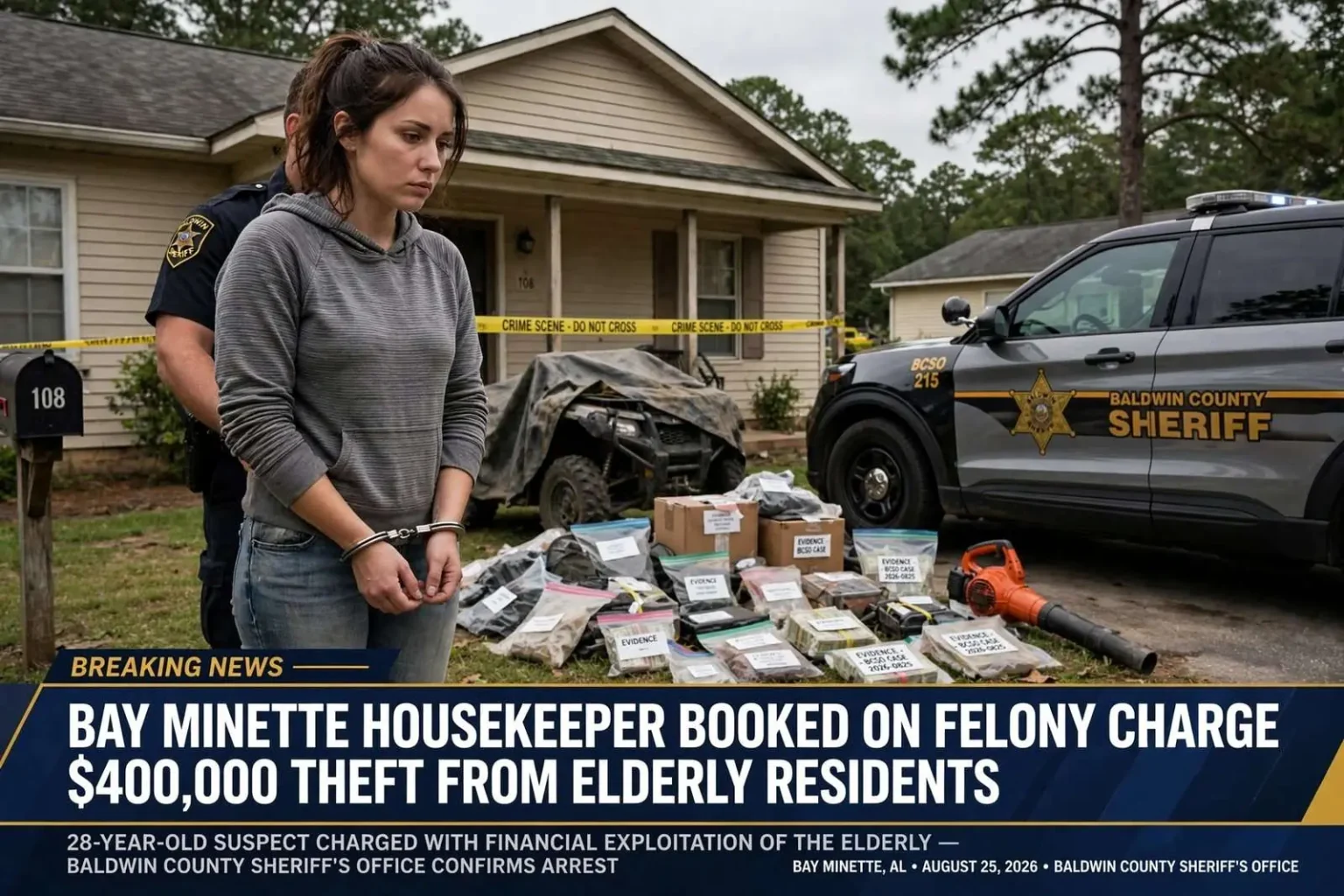
BAY MINETTE, Ala. — A 28-year-old Bay Minette woman is facing a felony charge after investigators say she stole nearly $400,000 in cash from the residents whose home she was hired to clean, according to the Baldwin County Sheriff’s Office.
Sheriff’s officials said the case began on August 25, 2026, when the office received a report of a large theft of U.S. currency from a private residence. The victims told deputies that close to $400,000 in cash had been taken from their home, and they identified their cleaning lady as the primary suspect.
Interview Led to Admission
Investigators identified the suspect as Tabitha White, 28, of Bay Minette, and brought her in for questioning about the missing money. During that interview, White told investigators that over the course of several months she had taken what she described as “handfuls” of cash while cleaning the victims’ residence, according to the sheriff’s office.
What began as a single report of stolen currency quickly widened, investigators said. As detectives continued their work, they developed information that White had allegedly used the stolen money to buy a range of goods — purchases that ultimately helped them build the case.
Search Warrant and Seized Property
That information led investigators to obtain and execute a search warrant at White’s residence. During the search, deputies seized documents connected to the purchases along with numerous items believed to have been bought with the stolen funds.
The seized property included vehicles, four-wheelers, electronics, lawn equipment, construction supplies, and other items, according to the sheriff’s office. Investigators say the documents recovered during the search will help them trace how much of the missing money was spent and where it went.
Felony Charge Under Alabama’s Elder Exploitation Law
White was booked on one felony count of Financial Exploitation of the Elderly. Alabama lawmakers elevated that conduct to a felony through legislation passed in 2013, a measure designed to give prosecutors a dedicated tool against those who take advantage of senior citizens’ trust, assets, or finances. The charge reflects that the alleged victims in this case are elderly residents.
Sheriff’s officials cautioned that the investigation is ongoing and that additional charges may be filed as the inquiry continues.
A Broader Problem on the Gulf Coast
Cases like this one highlight a pattern that law enforcement and elder advocacy groups across Alabama have warned about for years: a significant share of financial crimes against seniors are committed not by strangers, but by people in positions of trust — caregivers, housekeepers, contractors, and even family members with access to a victim’s home and finances.
Because many older victims are reluctant to report these crimes, sheriff’s offices across the state urge families to stay involved in the financial lives of elderly relatives, to watch for sudden changes in spending or missing valuables, and to report suspicious activity promptly so investigators can act while evidence is still fresh.
In this case, the quick report from the victims allowed Baldwin County investigators to move from an initial complaint to an interview, a search warrant, and an arrest within days.
White’s case now moves through the Baldwin County court system. Anyone with additional information related to the investigation is encouraged to contact the Baldwin County Sheriff’s Office.
How Alabama Classifies Theft by Dollar Amount
Beyond the elder exploitation statute itself, the scale of the loss alleged in this case — nearly $400,000 — would place it at the highest end of Alabama’s theft-of-property classification scale if prosecutors ultimately pursue related property offenses alongside or as an alternative to the exploitation charge. Alabama law breaks theft into degrees based largely on the value of what was taken: theft of property in the first degree applies to losses of $2,500 or more and is a Class B felony, while losses exceeding certain higher thresholds, or theft involving specific aggravating circumstances, can be charged under enhanced provisions carrying still longer potential sentences. A case involving an alleged loss approaching $400,000 sits well beyond the baseline for a first-degree theft charge, which is one reason investigators typically spend considerable time after an arrest documenting exactly how much money is unaccounted for and where it went — work that in this case is reflected in the search warrant executed at the suspect’s residence and the range of purchases investigators are now working to trace.
Financial exploitation and theft charges can, in some cases, be pursued together or as alternatives depending on how a district attorney’s office decides to structure the prosecution, since the underlying conduct — taking money without the owner’s consent — can support more than one statute depending on the relationship between the accused and the victim. Prosecutors generally choose the charge, or combination of charges, that best fits the evidence and carries penalties proportionate to both the dollar amount involved and the vulnerability of the victims, which is part of why sheriff’s offices frequently caution, as Baldwin County did here, that additional charges may still be filed as an investigation continues.
What a Search Warrant Requires — and What Comes Next
Executing a search warrant at a suspect’s home is a significant step in a property crime investigation, and Alabama law requires that investigators first present a judge with sworn evidence establishing probable cause — reason to believe that evidence of a specific crime will be found at a specific location — before a warrant can be issued. In financial crime cases, that evidence often includes the kind of admission described here, in which a suspect described the general manner in which money was taken, combined with bank records, victim statements or other documentation tying the suspect to unexplained spending. Once a warrant is executed and property is seized, investigators typically have to build a second layer of evidence connecting each seized item back to the stolen funds, often through purchase receipts, sales records from dealers or retailers, or financial records showing cash purchases that do not match the suspect’s known legitimate income. That tracing process is frequently the most time-consuming part of a large financial exploitation case, since it can involve subpoenaing records from multiple businesses and cross-referencing purchase dates against when money reportedly went missing.
The Limits of Background Checks for In-Home Caregivers
Cases involving housekeepers, caregivers or other workers who gain access to a client’s home are a recurring theme in elder financial exploitation prosecutions nationally, in part because Alabama, like most states, does not require a state license or a mandatory criminal background check for someone to work as a private housekeeper hired directly by a family, as opposed to through a licensed home health agency. Workers placed through licensed home care or hospice agencies are generally required to pass a background check as a condition of the agency’s own licensure, but families who hire help informally or through word of mouth — a common practice, particularly in smaller communities — often have no equivalent screening requirement at all. Elder-advocacy organizations, including the Alabama Department of Senior Services, routinely encourage families who hire in-home help directly to run their own background checks, request and check references independently rather than relying solely on a candidate’s own account, and consider limiting a new hire’s unsupervised access to cash, checkbooks or valuables until a longer working relationship has established trust. Financial advisors who work with elderly clients also frequently recommend that families keep large amounts of cash out of the home altogether, since cash, unlike a bank withdrawal, leaves no transaction record that could later help investigators establish when and how much was taken.
Bond and Pretrial Release in Alabama Felony Cases
When someone is booked on a felony charge in Alabama, a judge or magistrate sets bond based largely on the severity of the offense, the amount of loss alleged, the defendant’s ties to the community, and any prior criminal record. For felony property and financial crimes, bond amounts are typically set using a county-specific bail schedule as a starting point, with judges retaining discretion to adjust the figure up or down based on the specific facts of the case. A defendant who posts bond is released from custody while the case proceeds through the court system, usually subject to conditions such as regular check-ins, restrictions on contact with victims or witnesses, and a requirement to appear at all scheduled court dates. Failure to appear can result in the bond being revoked and a new warrant issued, which is part of why courts frequently require secured bonds — backed by cash, property or a bail bondsman — for felony cases involving significant dollar amounts, as opposed to the unsecured or lower-cost bonds sometimes available for lower-level misdemeanor charges.
From Arrest to Trial in Baldwin County
Once a felony case like this one is booked, it typically moves first through a preliminary hearing or is presented directly to a grand jury, depending on how the district attorney’s office chooses to proceed and how quickly the investigation has developed. A grand jury indictment formally establishes the charges the case will proceed on, after which the case is assigned to a circuit judge and enters the normal pretrial process — discovery, in which prosecutors and defense attorneys exchange evidence, followed by pretrial motions and, in many cases, plea negotiations that resolve the case well before it would ever reach a jury trial. Restitution, meaning a court order requiring a convicted defendant to repay the value of what was taken, is a common component of sentencing in financial crime cases and can be ordered whether or not a defendant is also sentenced to prison time, though collecting on a restitution order in full is often difficult when a defendant has limited assets beyond whatever property was already recovered during the investigation.