
Bay Minette’s No-Kill North Baldwin Animal Shelter Opens Its Doors
A new no-kill shelter, North Baldwin Animal Shelter, opened in Bay Minette in June 2010, giving homeless dogs and cats a place to be cared for until.
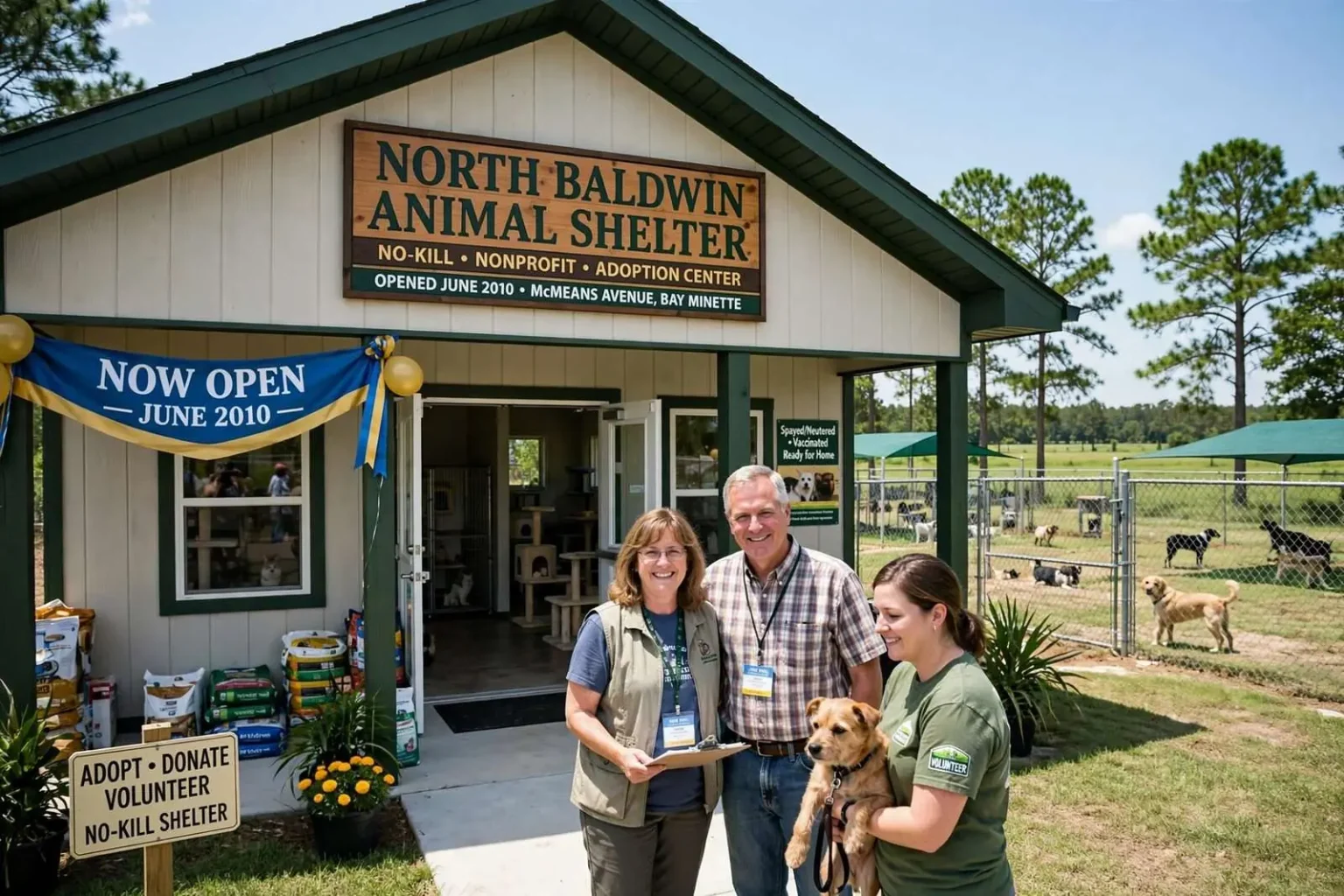
A new no-kill animal shelter is now caring for homeless dogs and cats in Bay Minette. The North Baldwin Animal Shelter, a privately funded nonprofit facility, opened in June 2010 on a five-acre property on McMeans Avenue. The shelter, which spans more than 7,000 square feet, accepts healthy dogs and cats found within Bay Minette city limits.
The opening gave Bay Minette something the county seat of Baldwin County had long lacked: a dedicated facility where stray and abandoned animals could be housed, cared for and placed in new homes without the threat of euthanasia for lack of space. For a city that had previously depended on animal control arrangements that too often ended in destruction of healthy animals, the shelter represented both a humane upgrade and a point of civic pride.
Before arriving at the shelter, animals are examined by a veterinarian, spayed or neutered, and vaccinated. They then remain at the facility until they are adopted into a new home. That intake routine serves two purposes at once — it protects the health of the animals already living at the shelter, and it ensures that every dog and cat leaving the facility for a new home has received basic veterinary care that many adopted pets might otherwise go without.
The five-acre setting allows room for outdoor runs and exercise areas alongside the indoor kennel space, an arrangement that reduces stress on the animals and gives staff and volunteers the ability to socialize dogs outside the confines of a kennel. The more than 7,000 square feet of facilities provide separate areas for cats, isolation space for animals arriving with unknown medical histories, and room for adopters to meet prospective pets.
The physical layout of a shelter shapes nearly everything about how it functions. Adequate kennel size and outdoor access reduce the behavioral problems that can develop in animals confined for long periods, and animals that stay healthier and better socialized are adopted faster. Space for adopters to interact privately with a dog or cat is equally important: shelters have long observed that animals chosen after a meeting in an outdoor run or a meet-and-greet room are far less likely to be returned than animals adopted on sight from a kennel card alone.
A Four-Year Effort to Build the Shelter
The shelter grew out of a private effort started in November 2006 by Judy and Red Wilkins, Bayless Biles and Tom Mitchell, all of whom wanted to address the number of homeless animals in the Bay Minette area. It took nearly four years of planning and fundraising before the facility opened to the public.
The timeline reflects what it takes to build a shelter from scratch without a government budget. The founders had to locate and secure suitable land, design a facility that met the practical demands of animal care, raise the money to construct it, and organize the volunteer base that would keep it running after the doors opened. Because the shelter is privately funded, it has operated without the tax support that backs municipal animal services in larger cities — a model that depends entirely on donations, fundraising events and community goodwill.
Choosing Bay Minette for the effort was itself significant. As the seat of Baldwin County government, the city sits at the center of the northern county’s civic life, with a population large enough to sustain adoption demand and a location accessible to surrounding communities. A facility on McMeans Avenue is within easy reach of residents across the city, and its distance from the coast kept construction costs within reach of a private fundraising effort — a balance the founders clearly judged correctly, since the project moved from idea to opening in under four years.
Red Wilkins has said the idea for the shelter took shape after he came across an abandoned stray dog whose collar had become embedded in its neck. According to an account he gave the Mobile Examiner, he was unable to find the dog again the next day and later learned it had been picked up by animal control and euthanized. The experience, he said, convinced him that no animal should be put down simply because it lacked a home.
The story is a familiar one in communities without no-kill facilities. Before the shelter opened, animals picked up in the Bay Minette area faced uncertain prospects: without an adoptable-animal program in place, healthy dogs and cats could be destroyed after a holding period, regardless of temperament or adoptability. The embedded-collar dog that Wilkins could not find again became, in effect, the shelter’s founding case — the image behind the conviction that Bay Minette could do better.
The founders’ approach also reflected a shift taking place across the animal welfare field. No-kill shelters, once considered idealistic outliers, had been spreading nationwide as communities demonstrated that high adoption rates, spay-and-neuter programs and volunteer networks could keep euthanasia rates down without warehousing animals indefinitely. The North Baldwin Animal Shelter brought that model to the northern end of Baldwin County, where no comparable facility existed.
Who Runs the Shelter
The North Baldwin Animal Shelter is currently led by Judy Wilkins as director and Beverly Poiroux as assistant director, supported by a staff of volunteers who help care for the animals and manage adoptions. As a no-kill facility, the shelter says it will not euthanize adoptable animals for space, instead relying on its volunteer network and community support to find homes for the dogs and cats in its care.
Volunteers carry much of the daily workload at facilities of this kind. Feeding, cleaning kennels, walking dogs, socializing cats, screening adopters and transporting animals to veterinary appointments all fall to people who give their time without pay. At a privately funded shelter, that volunteer labor is not a supplement to paid staffing — it is often the difference between a facility that can operate and one that cannot, since every dollar not spent on labor goes instead to food, medicine and utilities.
The director’s role at a small no-kill shelter likewise extends far beyond administration. Managing intakes from within the city limits, matching animals with adoptive families, coordinating veterinary care and sustaining the donation streams that fund operations are all part of the job, and the shelter’s founders have remained closely involved since its opening.
What No-Kill Means in Practice
The no-kill commitment at the heart of the shelter’s mission comes with real constraints. Because the facility will not destroy adoptable animals to make room, intake must be managed against available kennel space. The shelter’s policy of accepting healthy animals found within Bay Minette city limits defines that responsibility clearly: the shelter serves the city’s stray and abandoned animal population rather than attempting to absorb animals from across the entire county.
The requirement that animals be healthy before intake also protects the no-kill promise. A population of vaccinated, spayed or neutered animals is far less likely to experience outbreaks of disease that could overwhelm a small facility, and it shortens the average stay — spayed and neutered animals are typically calmer and easier to place, and vaccination prevents the illnesses that commonly sweep through shelter populations.
Advocates of the model point out that no-kill does not mean no death under any circumstance; animals that are suffering or dangerous are handled differently from healthy, adoptable ones. What it rules out is the routine destruction of healthy animals as a space-management tool, which was for decades the default practice in animal control operations nationwide.
Adoption as the End Goal
Every animal the shelter takes in stays until an adoption is completed, which makes the shelter’s success dependent on the community’s willingness to adopt locally. Shelters of this kind work constantly to present their animals well: photographs and descriptions, adoption events, and word of mouth through the volunteer network all serve to move animals into homes and open kennel space for the next arrival.
The benefits of adoption extend past the animal itself. Adopted pets typically leave the shelter spayed or neutered and vaccinated, saving adopters the several hundred dollars those services can cost at private veterinary practices. The shelter arrangement also gives adopters something commercial breeders and pet stores cannot: staff and volunteers who know each animal’s temperament because they have cared for it, sometimes for months, and can match families with pets that fit their circumstances.
A Milestone for North Baldwin County
The opening of the North Baldwin Animal Shelter placed Bay Minette among the Alabama communities with a local no-kill option for homeless animals. In a county growing quickly along the I-65 corridor and along the Eastern Shore, the shelter anchored humane animal care at the northern end, serving a city whose residents had previously watched strays disappear into a system that offered them little chance.
Nearly four years after the first fundraising conversations began in November 2006, the founders’ conviction — born from one stray dog with an embedded collar — had become a permanent institution on McMeans Avenue, staffed by volunteers and sustained by the community it was built to serve.