
BayBears name Rodrigo Lopez to all-time team
The Mobile BayBears named pitcher Rodrigo Lopez to their all-time team as the franchise winds down after 23 years.
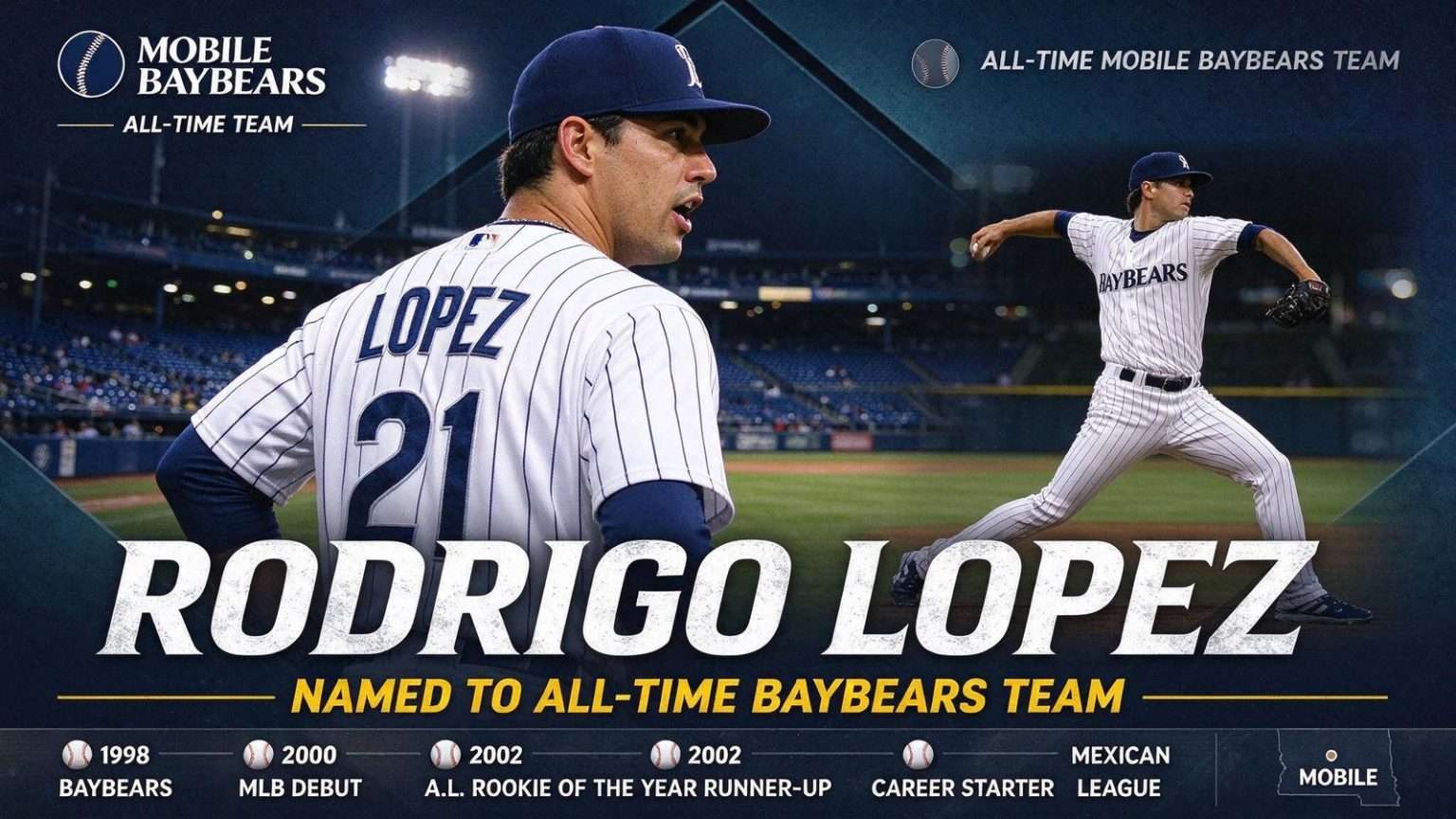
As the Mobile BayBears prepare to close out a 23-year run, the franchise is looking back at the best players to wear the uniform. The club is rolling out its All-Time Mobile BayBears Team, with selections based on a player’s or coach’s overall career, not just their time in Mobile. Members are being revealed one at a time ahead of the BayBears’ final game on Sept. 2, giving fans a daily reminder of the talent that passed through Hank Aaron Stadium over two decades.
The latest honoree is pitcher Rodrigo Lopez, who joined the BayBears late in 1998 and helped them win a Southern League title, going 3-0 in four starts. The late-season arrival made his impact all the more striking: a newcomer stepping into a pennant race and delivering an unbeaten stretch of starts when the games mattered most. Championship teams in Double-A baseball are built on exactly that kind of pitching depth, and Lopez’s run through the end of the 1998 season became part of the foundation of the franchise’s first era of success.
He spent the full 1999 season in Mobile, starting 28 games and going 10-8. A full season at the Double-A level is where organizations learn what a pitcher truly is — the travel grinds, the lineups adjust to you after the first look, and every weakness in the arsenal gets tested. Lopez’s workload across 28 starts showed durability that would define his professional career, and his presence atop the rotation gave the BayBears a proven arm to lean on through the summer.
Lopez made his major league debut with the San Diego Padres in 2000, completing the climb from Mobile to the big leagues in roughly two years. The Padres were the BayBears’ major league affiliate in that era, which made the promotion a direct product of the development pipeline that ran through Mobile. For the young pitcher, the jump validated the work of two seasons in the Southern League’s demanding environments.
He joined the Baltimore Orioles in 2002, finishing second in American League Rookie of the Year voting after a 15-9 season. The campaign stands as the peak of his major league career — a full season of innings in the American League East, against some of the game’s most dangerous lineups, at an age when many pitchers are still working their way through the minors. Finishing that high in rookie voting placed him among the best first-year players in the league.
A Career Built on Durability
Lopez remained a starter in Baltimore through 2006, an era in which he logged the kind of inning totals that organizations count on from the middle of a rotation. Pitchers who hold major league rotation spots for five consecutive seasons occupy a select group; the job demands not just stuff but the ability to recover, adjust and take the ball every fifth day for years. Lopez’s Baltimore tenure established him as exactly that kind of reliable innings pitcher.
His path afterward reflected the journeyman resilience that extends many big league careers. He made 14 starts for Colorado, then returned to the majors with the Phillies in 2009 and started 33 games for the Diamondbacks in 2010 and 16 for the Cubs in 2011 before pitching four years in the Mexican League. The stops tell the story of a pitcher who kept earning opportunities — Coors Field’s unforgiving environment, a National League revival with Philadelphia, a full 33-start season in Arizona at an age when many starters have retired, and a closing chapter pitching professionally in his home country.
The All-Time BayBears Team framework, judged on overall careers rather than Mobile statistics alone, makes Lopez a fitting choice. Some honorees are selected for what they did in a BayBears uniform; Lopez is being recognized for what his Mobile seasons foretold — a career of more than a decade in the major leagues that began on the same mound fans will remember when the franchise plays its final game.
A Franchise’s Final Chapter
The BayBears’ 23-year run ends in September, closing a chapter of Mobile baseball that began when the team arrived as the Double-A affiliate of the San Diego Padres. Over more than two decades, the franchise served as the Double-A home for several major league organizations, sending dozens of players to the big leagues while anchoring a redeveloped stretch of Mobile with a ballpark named for the city’s most famous son, Hall of Famer Hank Aaron.
Double-A baseball holds a particular place in the minor league hierarchy. It is where the game’s best prospects face their first serious test — advanced enough that weaknesses get exposed, still a level where fans can watch future stars develop up close. In Mobile, that meant seasons when the roster featured players who would become household names, and the intimacy of Hank Aaron Stadium kept those futures within arm’s reach of the fans watching from the berm and the bleachers.
The Southern League itself has deep roots in the region, with franchises across the Southeast tracing histories back through generations of minor league baseball. Championships like the one Lopez helped win in 1998 carry weight in these cities because they are shared civic memories, events that brought entire communities together around a summer of winning baseball. The 1998 title remains part of what Mobile fans remember most fondly about the franchise’s early years.
The reveal of all-time team members one at a time in the franchise’s final weeks is a farewell designed for the fan base that stayed through 23 seasons. Each announcement has prompted fans to dig out old rosters, programs and photographs, trading memories of seasons past on the team’s social channels. For a community about to lose its minor league team, the series is both tribute and invitation to remember.
What Lopez’s Story Says About Minor League Baseball
Lopez’s climb through Mobile mirrors the classic arc of minor league baseball: a young pitcher arrives late in a season, contributes to a championship, spends a full year proving himself at Double-A, and reaches the major leagues soon after. The BayBears’ role in that arc — as the place where a future major league starter learned to work deep into games against professional lineups — is the kind of contribution franchises like Mobile make to the sport without ever appearing in a box score.
His second-place finish in American League Rookie of the Year voting remains one of the most notable achievements by any BayBears alumnus. Awards voting at the major league level reflects performance against the game’s best competition, and a rookie going 15-9 for Baltimore in the AL East placed him in the company of the sport’s most promising young players that year. For Mobile fans who watched him pitch in 1998 and 1999, it was proof that they had seen a future star before anyone else did.
The four years Lopez later spent in the Mexican League connected his career to a long tradition of major league players extending their professional lives in the Mexican circuits, where the competition is strong and the seasons run long. For Mexican-born players and veterans alike, the league offers a chance to keep playing meaningful baseball in front of passionate crowds, and Lopez’s success there added a final professional chapter after more than a decade in the United States.
The End of an Era in Mobile
The Sept. 2 final game will close a period in which Mobile was one of the standard stops on the Southern League map. Fans in the city watched prospects arrive, mature and move on to World Series rosters, and the ballpark on the city’s western side became a summer ritual for families across the region. Losing a Double-A franchise removes an institution that doubled as an economic engine and a community gathering place.
All-time teams and farewell seasons serve a real purpose in that transition. They give the city a structured way to say goodbye, to argue amicably about the best players of the era, and to preserve the history in print and memory before the franchise moves on. The selections based on entire careers — like Lopez’s — honor not just the seasons in Mobile but the trajectories that Mobile seasons set in motion.
For Lopez, the honor arrives while his 1998 and 1999 Mobile seasons are still within living memory of many fans who watched them. His late-season arrival two decades ago helped deliver a championship; his full-season workload the next year helped establish the franchise’s credibility; and the career that followed — Padres, Orioles, Rockies, Phillies, Diamondbacks, Cubs and the Mexican League — stands as the fullest possible answer to the question of what a BayBears season can mean.
The remaining members of the All-Time Mobile BayBears Team will be announced as the Sept. 2 finale approaches, and each name will carry its own story of summers on the Mobile Bay shore of minor league baseball. Together they will form the lasting record of 23 years of professional baseball in the city — a record that includes a championship pitcher who came, won, and went on to spend a decade in the major leagues.


