Bayou La Batre Requiring Masks for Entry to City Hall as COVID Hospitalizations Climb
Bayou La Batre Mayor Henry Barnes required masks for entry to City Hall as Mobile County reported 276 COVID-19 hospitalizations on Aug. 2, 2021.
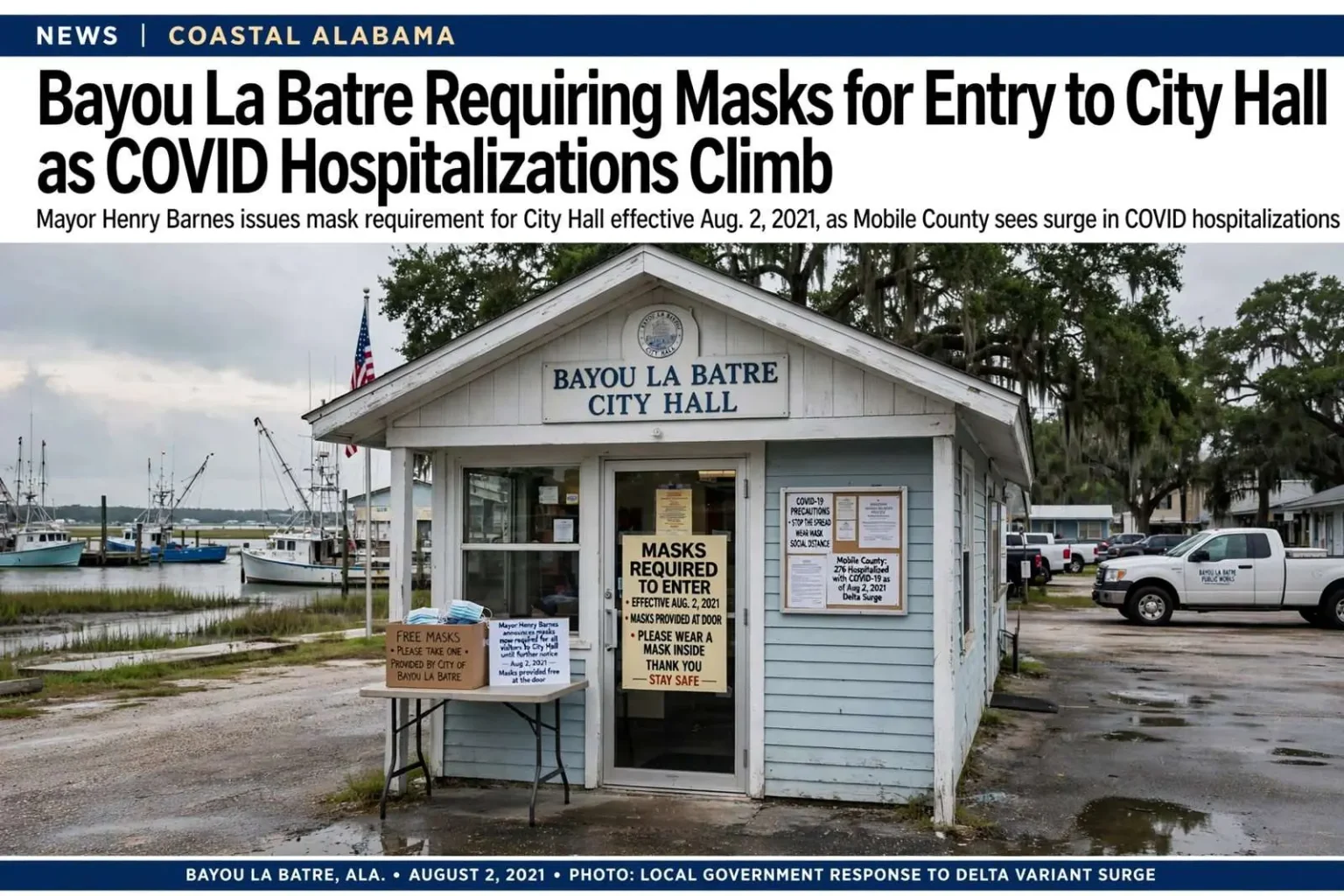
BAYOU LA BATRE, Ala. — Mayor Henry Barnes announced on Aug. 2, 2021, that masks would be required for entry to Bayou La Batre City Hall until further notice, the waterfront city’s latest step in trying to limit the spread of COVID-19 as local hospitalizations surged past earlier records set during the first year of the pandemic.
Barnes made the announcement on the city’s official Facebook page, writing, “Masks will be required to enter City Hall until further notice. Masks will be provided at the door. We apologize for the inconvenience. Thanks, stay safe.”
The policy applied broadly to anyone visiting the building for permits, court dates, meetings, and other city business. That covered a wide slice of daily life in a town of Bayou La Batre’s size, where the municipal complex functions as the central point of contact between residents and their local government. Property owners coming in for building and commercial fishing permits, residents paying utility bills, defendants appearing for municipal court dates, and attendees of public meetings would all pass through the same front entrance under the new rule.
By providing masks at the door rather than turning away visitors who arrived without one, city officials signaled that they intended to keep services running uninterrupted while still cutting down on a common transmission risk: a steady stream of people moving through a small, enclosed lobby. The approach also spared residents, many of whom work in the seafood industry or in physically demanding jobs, the burden of traveling to a neighboring town to handle paperwork they could no longer complete in person.
Bayou La Batre, a fishing community of roughly 2,000 people on the western shore of Mobile County, has long been one of the most distinctive municipalities on the Alabama Gulf Coast. The city built its economy and identity around the water, with a commercial fleet of shrimp boats and oyster vessels working out of its harbor and a cluster of seafood processing houses that supply markets across the region. That economic structure mattered during the pandemic in practical ways: processing work and crewing boats cannot be done remotely, and the close-quarters nature of seafood houses and vessel decks made public health precautions a recurring concern for the community throughout the COVID-19 era.
The mask requirement also carried weight in Bayou La Batre because of the city’s experience with disaster and recovery. The community was devastated by Hurricane Katrina in 2005 and again battered by later storms, and residents are accustomed to municipal government playing a hands-on role in protecting the town through emergencies. The pandemic was a different kind of threat, but the response pattern was familiar: local leaders issuing direct, plain-language guidance through the channels residents actually use, in this case the city’s Facebook page, which functions as the community’s de facto bulletin board.
Why the city acted when it did
The timing of the announcement was not incidental. By early August 2021, the delta variant had transformed a summer that health officials had hoped would mark a turning point into one of the most dangerous stretches of the pandemic along the Gulf Coast. The variant, which was significantly more transmissible than earlier forms of the virus, swept through communities with low vaccination rates, and coastal Alabama was among the areas where that combination proved most severe.
Across Mobile County and the rest of southwest Alabama, July had seen case counts climb steeply week over week. Hospital administrators in Mobile and Baldwin counties began warning of strained capacity, and county health officers renewed calls for residents to get vaccinated and return to basic precautions such as masking in indoor public spaces. For a small city like Bayou La Batre, where a handful of municipal employees serve as the interface between residents and everything from permits to emergency paperwork, an outbreak inside City Hall could have taken the local government offline at exactly the moment residents needed it most.
Barnes’s post struck a tone that has characterized much of the city’s pandemic communication: apologetic about the inconvenience, firm about the rule, and focused on the shared goal of keeping residents safe. There was no elaborate enforcement apparatus behind the announcement, no fines or citations outlined — just a request, backed by the practical measure of free masks at the door, that people entering the building help protect their neighbors.
The mandate came on a day when the Mobile County Health Department reported 276 county residents hospitalized with COVID-19, a figure that underscored how sharply the summer surge had intensified across the county.
Data compiled by the New York Times indicated that most Mobile-area hospitals were operating near maximum ICU bed capacity — a level not seen there in earlier waves of the pandemic. That distinction mattered. In previous surges, hospitals in the region had absorbed incoming patients by converting space, deferring elective procedures, and staffing up intensive care units as needed. By the opening days of August 2021, many of those relief valves were already in use, leaving administrators with fewer options when new patients arrived.
The pressure was felt across the hospital systems that serve Mobile County residents, including the large medical centers in the city of Mobile that treat patients referred from smaller communities across southwest Alabama and the Mississippi Gulf Coast. When intensive care units in the metro area run near capacity, the strain does not stay confined to the city limits — it reaches places like Bayou La Batre, where residents who become seriously ill depend on ambulance transport to emergency rooms miles away.
Bayou La Batre relies on a small first-responder network and limited local medical options, which made limiting virus spread especially important for the town’s vulnerable residents. There is no hospital in the city itself, meaning that any resident who developed severe COVID-19 symptoms would face a trip of significant distance for emergency care. During a surge that had pushed nearby emergency departments to their limits, response times and bed availability were not abstractions — they were the difference between timely treatment and dangerous delays.
The town’s demographic profile added to the concern. Bayou La Batre is home to a substantial population of older residents, including veterans, along with families who have lived and worked on the waterfront for generations. Age remains the single strongest risk factor for severe outcomes from COVID-19, and a community with many older residents, limited local medical infrastructure, and work environments where physical distancing is difficult represented exactly the kind of place that health officials had warned was most exposed to the delta wave.
The delta variant’s run through coastal Alabama
The delta variant had been driving a steep climb in admissions across coastal Alabama throughout July and into August 2021, with health officials across the region urging unvaccinated residents to seek shots as quickly as possible. What had begun in June as a noticeable uptick in a handful of counties became, by early August, a full-scale wave that the Alabama Department of Public Health described in increasingly urgent terms.
Public health messaging at the time emphasized a stark reality: the overwhelming majority of patients being hospitalized during the surge were unvaccinated. County health departments across the state, including the Mobile County Health Department, continued to operate vaccination clinics and mobile outreach, and providers emphasized that even as cases spread, vaccination remained the most effective protection against severe illness, hospitalization and death.
Officials also pointed to the layered protections that remained available even to those who had not been vaccinated — masking indoors, avoiding crowds, and staying home when sick — as tools that could slow transmission while the vaccination campaign continued. Municipal mask requirements like the one adopted in Bayou La Batre fit squarely into that guidance, applying the state-level advice at the scale of a single public building where the city could directly control the environment.
The surge also revived familiar debates across Alabama about the proper role of local government during a public health emergency. Statewide, masks had been the subject of extended political controversy, and many municipalities had stepped back from mandates by mid-2021. The decision by Bayou La Batre’s leadership to reinstate a mask requirement for its own facilities reflected a more localized calculus: in a small city where the hospital is far away and the first-responder network is thin, the cost of an outbreak among city staff and visitors was measured in a currency residents understood well.
For now, the requirement remained in place “until further notice,” with city officials making clear they would keep the rule as long as conditions warranted. Residents with business at City Hall were advised to expect the mask requirement at the door, where masks were being provided free of charge to anyone who arrived without one.