Bear Point Drainage Study Maps Flood Risk, Recommends $5 Million in Orange Beach Fixes
Engineers with Thompson Engineering presented a drainage basin study and stormwater master plan for Orange Beach's Bear Point neighborhood, mapping flood-prone areas and recommending roughly $5 million in priority improvements.
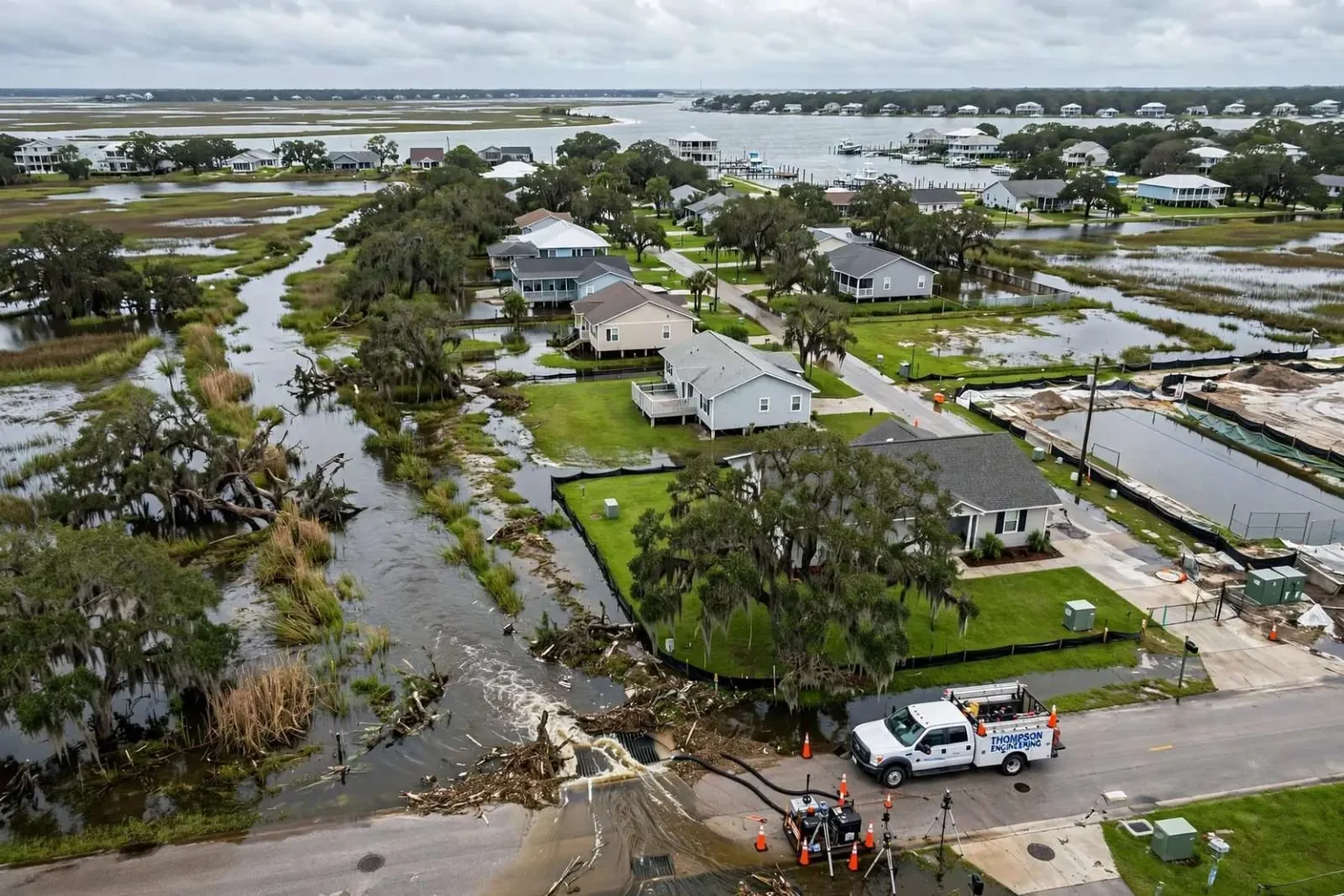
ORANGE BEACH, Ala. — Orange Beach is taking direct aim at the flooding that has long troubled the Bear Point neighborhood, and city leaders now have a detailed roadmap for how to fix it.
At a recent City Council meeting, Marshall Hayden, the hydraulic and hydrologic engineering group leader at Thompson Engineering, presented the findings of a comprehensive drainage basin study and stormwater master plan for the area. The effort, which has been in development for about a year and a half, is designed to help municipal leaders map the neighborhood’s drainage systems and address long-standing flooding risks.
Mapping a 280-acre drainage basin
To build an accurate model of the roughly 280-acre drainage area, Thompson Engineering used aerial lidar to map local topography. The team also completed an extensive field survey documenting hundreds of existing stormwater assets, including inlets, manholes, pump stations and miles of underground conduits and pipelines.
That physical data was fed into a hydraulic and hydrologic model that analyzes how the drainage system performs under both current and future storm scenarios. The model weighs the combined effects of rainfall, topography, land use, soil conditions and impervious surfaces such as roads and rooftops.
To pair the technical data with lived experience, engineers also hosted a community outreach survey on an internal GIS platform, allowing residents to map ground-level observations and pinpoint the spots where flooding hits hardest.
Where the water goes wrong
The modeling and resident feedback highlighted several recurring problems: homes sitting in low-elevation “bowls” with inadequate drainage, ineffective pumps, ponding on open lots, and conduits that are either clogged or simply undersized for the volume of water they must carry.
What the master plan recommends
To ease those issues and strengthen the neighborhood’s resilience, the master plan lays out a mix of structural and non-structural improvements, including:
- Upgrading existing pump stations and installing new ones
- Regulatory updates and ditch improvements
- Improving primary outfalls and pipeline capacity
- Flow diversions to protect at-risk homes
- Detention ponds and green infrastructure solutions
The total estimated cost for the priority solutions recommended for immediate design is approximately $5 million.
How the study was funded
Funding for the drainage basin study and master plan was split between two sources. The Gulf Coast Ecosystem Restoration Council, in partnership with the Alabama Department of Conservation and Natural Resources, covered 80% of the cost, while the City of Orange Beach contributed the remaining 20% as a local match.
The Gulf Coast Ecosystem Restoration Council was created by the federal RESTORE Act of 2012, which directs 80% of the Clean Water Act civil penalties paid in connection with the 2010 Deepwater Horizon oil spill to ecological and economic restoration in the five Gulf states: Alabama, Florida, Louisiana, Mississippi and Texas.