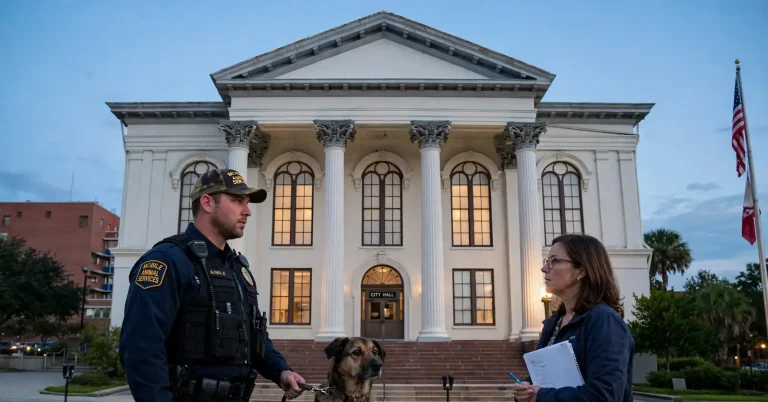
Behind the Headset: Mobile County 911 Dispatchers Share What Saves the Most Time in an Emergency
During National Public Safety Telecommunicators Week, Mobile County 911 dispatchers explain why knowing your location matters and how new tools help find.
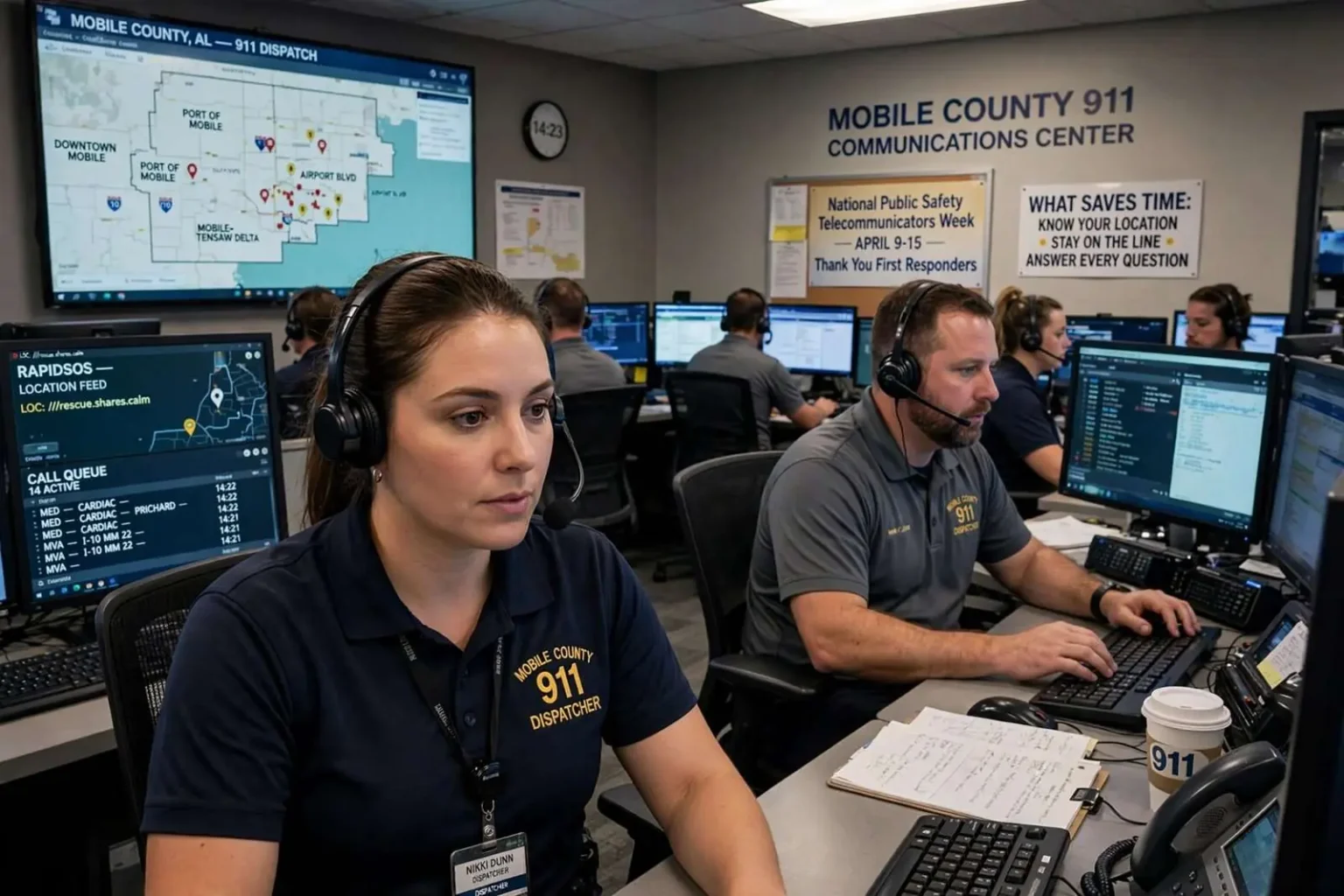
MOBILE COUNTY, Ala. — By mid-April 2023, the Mobile County 911 dispatch center had already answered more than 87,000 calls for the year. Behind each one is a dispatcher whose first question — “What’s the address of your emergency?” — can make the difference between a fast rescue and a costly delay. In honor of National Public Safety Telecommunicators Week, local dispatchers are pulling back the curtain on how calls actually work and what callers can do to get help faster.
The volume figure puts the scale of the operation in perspective. Eighty-seven thousand calls in three and a half months works out to hundreds of emergencies, accidents, medical calls, and false alarms every single day, each one answered by a call taker who must decide in seconds what kind of help is needed and where. The center serves Alabama’s second-largest county, from the downtown core and the port district to the Washington County line, routing police, fire, and medical resources across a jurisdiction of more than 1,200 square miles.
National Public Safety Telecommunicators Week, observed each April, is the industry’s annual acknowledgment that dispatchers are first responders in their own right — the first voice a caller hears and often the difference between life and death in the minutes before help arrives. In Mobile County, the recognition comes with an unusual degree of candor about how the system works and where callers can help it work better.
The Biggest Misconception: They Can’t Always Find You
Dispatcher Nikki Dunn says many callers assume the center automatically knows exactly where they are. With cell phones, that’s far from guaranteed — a wireless call can hit any tower in any location, so dispatchers often have only an estimate until the caller fills in the details.
“We have to have you to help us to find out where you are,” Dunn explained. She urges callers to stay attentive, answer every question, and be patient when information gets repeated. A second agency may ask for the same location or phone number again — deliberately, she said, to confirm the details in case the call drops.
The misconception is understandable. Decades of movies and television have trained the public to picture a glowing map on a dispatcher’s screen pinpointing every caller. In reality, wireless location technology delivers an approximate position that may be accurate to a few blocks or off by a mile, depending on terrain, tower geometry, and the caller’s phone. Indoor callers, drivers on the interstate, and people on the water present the hardest cases, and dispatchers must triangulate between the data they receive and the answers the caller provides.
The repetition callers sometimes find exasperating is a designed safeguard. When a 911 call is transferred between agencies — police to fire to EMS, or from one jurisdiction’s center to another — each receiving dispatcher verifies the address and callback number independently. If the connection fails mid-call, that confirmation is the only thread dispatchers hold: a last-known location and a number they can dial back. Callers who hang up in frustration cost rescuers those seconds.
New Tools Pinpointing Callers
Technology is closing the gap. The center uses a program called What3Words alongside the RapidSOS platform: with a caller’s permission, dispatchers can send a link to their phone that returns three unique words corresponding to a precise location anywhere on the globe — useful for callers who don’t know where they are or who are in places without a street address.
What3Words has divided the planet into a grid of three-meter squares, each assigned a unique combination of three everyday words. For a hiker lost in the Mobile-Tensaw Delta, a driver stranded on a rural stretch of highway, or a boater on the bay, the system converts “I don’t know where I am” into a coordinate-level fix that responders can navigate to directly. RapidSOS, meanwhile, provides the platform layer that connects emergency centers to smartphone location data, medical profiles, and other device information that older 911 infrastructure was never built to receive.
Together, the tools represent the leading edge of the transition to next-generation 911 — the long-running national upgrade that replaces the voice-and-phone-number architecture of the last century with an internet-based system capable of receiving data, not just calls. Mobile County’s adoption of both platforms puts it ahead of many jurisdictions its size in that transition.
Text-to-911 is already available in Mobile County, and dispatchers are working to bring video-to-911 online, which would let callers send footage of a scene through a link so the center can size up what resources are needed before responders arrive.
The implications of live video are substantial. A caller at a multi-vehicle crash on I-10 could show dispatchers how many vehicles and patients are involved before the first engine leaves the station. A homeowner reporting a structure fire could show the side of the building involved, letting commanders pre-position resources. And a caller hiding during an intrusion could send images without speaking, when a voice on the line would give away their position.
Text-to-911, for its part, has quietly become a lifeline for callers who cannot speak safely. Domestic violence victims with an abuser in the room, hearing-impaired callers, and people in areas with signal too weak for voice calls all have a channel that reaches the same dispatchers. Officials caution the familiar rule still applies: a voice call, when possible, remains faster, because it is live and two-way from the first second.
What Callers Can Do
The message from the people behind the headsets during Telecommunicators Week is simple: know your location, stay on the line, and answer the questions. “It saves time,” Dunn said. “It gets you help faster.”
That advice breaks down into habits any caller can build before an emergency ever happens. Knowing your location means more than your home address; it means noticing cross streets when you drive, mile markers on the interstate, the name of the parking lot you are in, and the address of places you visit regularly. In a county that stretches from dense urban neighborhoods to delta wilderness, the difference between “I’m on Highway 98 somewhere south of Fairhope” and a cross-street number can be measured in minutes that matter.
Staying on the line matters even when a caller feels they have said everything. Dispatchers continue collecting information while responders roll — updating a suspect’s direction of travel, monitoring a patient’s breathing, or talking a caller through CPR or bleeding control until medics arrive. The call taker is simultaneously gathering intelligence and delivering aid, and callers who remain engaged become part of the response rather than just its trigger.
Answering the questions — even the ones that seem irrelevant — is how experienced dispatchers work. Asking about the number of people involved, the presence of weapons, medications in the home, or whether a door is locked all feeds decisions being made at that moment: how many units to send, whether lights and sirens are warranted, which hospital to steer toward. Nothing a dispatcher asks is idle curiosity.
The men and women who take those calls work around the clock in a job the public mostly sees only from its worst days. Eighty-seven thousand calls in a single year, each answered by someone trained to extract calm information from chaos, is a volume of crisis management few professions approach. The week’s recognition asks Mobile County residents to meet the effort halfway: the technology is improving, the training is constant, and the single largest variable in how fast help arrives remains the person holding the phone.
A clear address, a patient voice, and a few minutes of cooperation — that, dispatchers say, is the whole formula. Everything else they can handle.
Behind the Headset
It is worth pausing on what the job actually involves. A dispatcher handling a routine afternoon might juggle a cardiac arrest in Prichard, a two-car collision on Airport Boulevard, and an officer requesting backup, all on separate radio channels while fielding the next call in the queue. Training for that environment takes months, and the learning never really stops, because the technology, the protocols, and the geography of the county’s emergencies all keep changing.
The emotional demands are less visible. Dispatchers hear the worst moments of strangers’ lives and must remain composed through every one of them, then take the next call without pause. Agencies across the country have begun treating that cumulative strain as a workplace-safety issue in its own right, adding peer support and counseling resources for telecommunicators — a recognition that arrived long overdue in a profession whose practitioners were legally classified as clerical workers in many states until recently.
Mobile County’s dispatchers have also shouldered the region’s share of large-scale emergencies, from hurricane evacuations to multi-agency responses on the water, and each such event refines the playbooks they work from. The center’s investment in tools like RapidSOS and What3Words reflects lessons drawn from those events: when callers cannot describe where they are, technology has to fill the gap.
For now, the gap-closing is a partnership. The center supplies the mapping, the platforms, and the trained ears; callers supply the details only they know. Dispatchers say the callers who understand that partnership — who answer, confirm, and stay on the line — are the ones who see help arrive soonest. During Telecommunicators Week and after, that remains the one instruction they would have every resident of Mobile County memorize before they ever need it.