
Better Business Bureau Plans Free Community Shred Day in Downtown Mobile
The Better Business Bureau's free Community Shred Day runs Friday, May 20, 9 a.m. to noon at the James Seals Community Center in downtown Mobile.
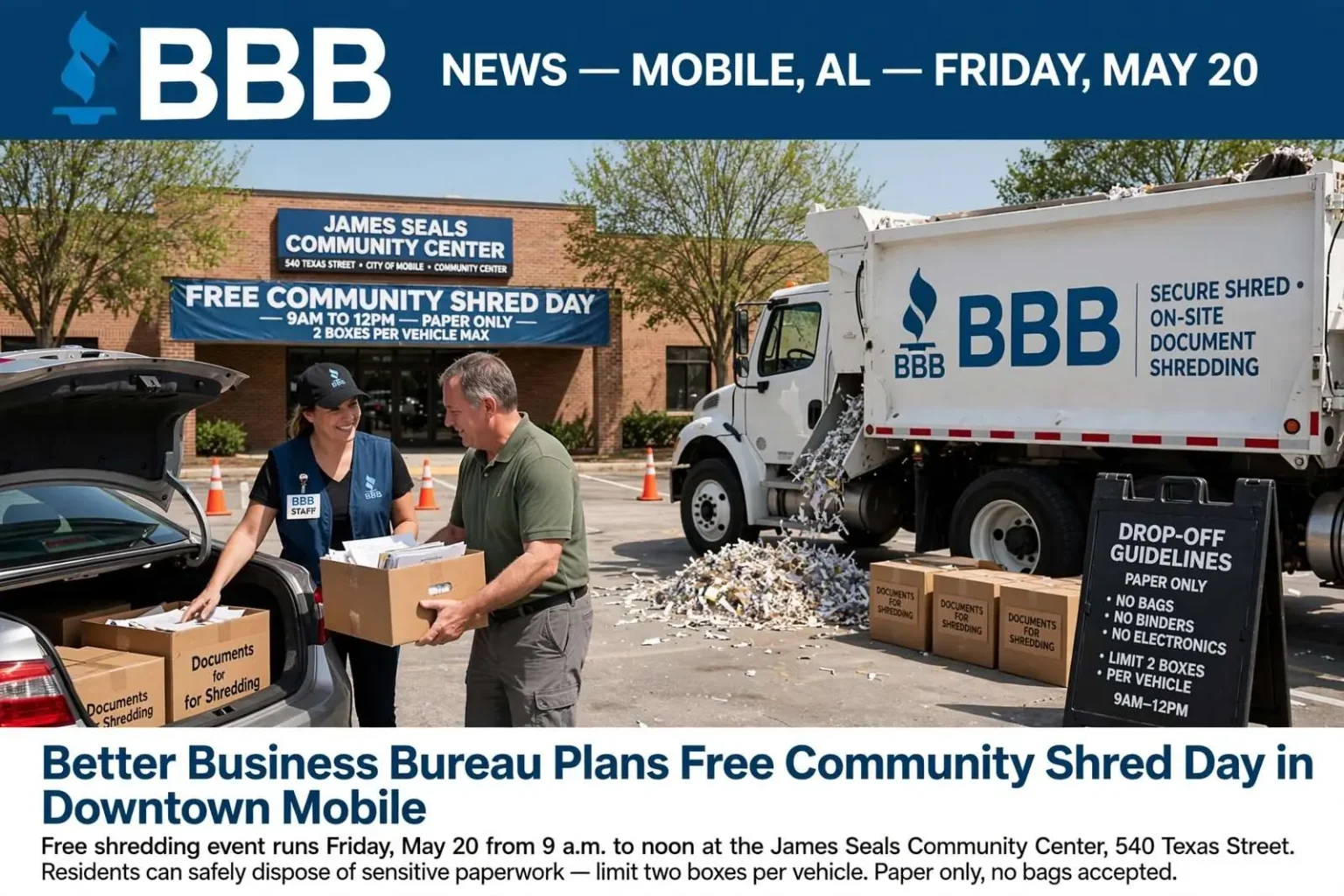
The Better Business Bureau is giving residents of the Port City a chance to safely dispose of sensitive paperwork this spring with a free Community Shred Day in downtown Mobile. The event runs Friday, May 20 from 9 a.m. until noon at the James Seals Community Center, located at 540 Texas Street. Organizers are accepting paper only, with a limit of two boxes per vehicle. Bags will not be accepted. Shredding old bank statements, medical bills and other documents bearing personal information is one of the simplest ways to guard against identity theft, and events like this one keep that paper out of household trash where it could be stolen. The morning window is designed to let residents drop off documents on the way to work or errands, with the shredding handled on-site so no one has to wonder where their paper ends up.
The Better Business Bureau has built community shred days into its consumer-protection work across the country, and for good reason: identity theft begins, in a great many cases, with a document thrown away intact. A bank statement in a garbage can, a medical bill in a curbside recycling bin, an insurance explanation of benefits in a bag headed for the landfill — each carries a name, an account number, a date of birth, or an address that a thief can use. Shredding reduces those documents to confetti before they leave the owner’s hands, and commercial shred events do in seconds what home shredders do in minutes, with cross-cut machines that process a box of paper far faster than any household device.
The rules for the Mobile event are practical rather than arbitrary. The two-box limit per vehicle keeps the line moving through a three-hour window and lets organizers accommodate every car that arrives. Paper only means no binders with metal, no plastic sleeves, no electronics or media — the shredding equipment is built for loose paper, and non-paper items jam it. Bags will not be accepted because loose paper feeds directly into the shredder’s hopper, while bags have to be opened and emptied by hand, slowing the process and creating handling risks. Residents who want to participate should pack their documents in cardboard boxes or similar containers that can go straight to the truck.
What Documents to Shred — and What to Keep
The paperwork most worth shredding is anything bearing personal identifying information: bank and credit card statements, canceled checks, tax documents past their retention window, medical bills and insurance statements, pay stubs, pre-approved credit offers, and anything showing a Social Security number. Consumer guidance from identity-protection agencies and the BBB has long made the point that garbage is a primary source for identity thieves, a practice known as dumpster diving, and that shredding is the simplest countermeasure available to any household. Pre-approved credit card offers deserve particular attention, because a thief who intercepts one can open an account in someone else’s name with little more than the form itself.
Not everything should go into the shred box, however. Documents that prove identity or legal standing — birth certificates, Social Security cards, passports, current tax returns within their retention period, property deeds, vehicle titles, wills, and insurance policies — should be kept, ideally stored securely. The general rule consumers follow is to keep tax-related records for the period the IRS recommends, keep documents that back up active accounts until the account closes plus a reasonable window, and shred the rest once it is no longer needed. Shred days work best for the accumulated backlog: the years of statements and bills that piled up in a file drawer or a closet, kept out of habit and no longer serving any purpose.
Businesses and professionals accumulate even more paper than households, and while this event is aimed at residents, the same principle applies on a larger scale. Commercial shredding services exist for volume disposal, and organizations that handle client information are often bound by privacy obligations to destroy documents securely. For a resident deciding what to bring on May 20, the test is simple: if a stranger seeing the document could use what is on it, the document belongs in the box.
The James Seals Community Center Setting
The event site, the James Seals Community Center at 540 Texas Street, is one of the City of Mobile’s community centers, located in the Maysville area just southeast of downtown. City community centers serve their neighborhoods with recreation programs, senior activities, and meeting space, and their parking lots are practical venues for drive-through events like shred days — easy to reach from central Mobile, with room for vehicles to queue and for the shred truck to operate. Residents coming from downtown, Midtown, or the communities along Government Street and Texas Street will find the site a short drive from the city center, and the morning timing keeps the event clear of afternoon traffic.
The mechanics of a shred day are simple enough that most participants spend less time in line than they expect. A commercial shred truck parks on site, its document hopper positioned where vehicles pull up; participants hand their boxes to event staff or the operator, and the paper goes directly into the machine, where it is cross-cut into unreadable strips and fragments. The shredded material is then recycled — the fiber re-enters the paper supply stream, which means the documents are both destroyed and put to use. Because participants watch their paper go into the truck, the event provides the certainty that home disposal never does: there is no stage at which the documents sit unattended in a bin or a bag.
The identity-theft problem these events address remains substantial. Stolen personal information fuels account fraud, tax refund fraud, and new-account fraud, and recovering from any of them costs the victim time, paperwork, and in some cases money. Federal protections limit liability for unauthorized charges when they are reported promptly, but the burden of discovering and disputing fraudulent activity falls on the consumer, which makes prevention — shredding, monitoring accounts, guarding documents — the cheaper strategy by far. Consumer agencies have long promoted shred days as one of the few free, immediate actions a resident can take that meaningfully reduces risk.
Why Free Shredding Matters Locally
For many households, the alternative to a free shred event is a home shredder, an annual fee for a commercial service, or — most commonly — the trash. A home shredder handles a modest volume and jams or overheats when confronted with years of accumulated statements, and commercial destruction services charge by the pound or the box. That gap between what safety requires and what it costs is what free events like this one close. A resident who would never pay to shred two boxes of old files will happily drive them to a community center on a Friday morning, and the backlog that has sat in a closet for years is destroyed in minutes.
The BBB’s role in consumer protection frames the event. The Better Business Bureau’s regional operations serve the Gulf Coast from Panama City through south Alabama, rating businesses, mediating consumer complaints, and running consumer-education programs — of which identity-protection events are a core part. Shred days give the organization direct contact with the residents it serves, and they put the Bureau’s guidance about document disposal into action rather than leaving it as a pamphlet’s advice. For attendees, the event is also a chance to ask BBB staff about scams and consumer questions, since the people who show up with boxes of old mail are exactly the people most exposed to fraud.
Residents planning to participate should note the details as announced: Friday, May 20, from 9 a.m. until noon; the James Seals Community Center at 540 Texas Street in Mobile; paper only; two boxes maximum per vehicle; no bags. Documents should be loose or boxed rather than bundled, since staples and small paper clips generally pass through industrial shredders but large clips and binders do not. The event ends at noon or when the truck’s capacity is reached, so early arrival is the safer plan for anyone with a full load. For a household that has been meaning to deal with its paper backlog for years, the event converts a chore into a quick morning errand — and sends that paperwork to the shredder instead of the trash can where identity thieves look for it.
Shred days also serve a secondary purpose that participants often discover on site: the exercise of sorting. Gathering documents for shredding forces a review of everything a household has kept, and that review regularly turns up papers that need action rather than destruction — a statement with an unrecognized charge, an insurance notice never answered, a bill long unpaid. Consumer educators suggest treating the sort as an audit: shred what is obsolete, file what still matters, and act on what has been ignored. A box of old paper is, in effect, a record of the household’s financial life, and the hour spent going through it before the event is often as valuable as the shredding itself.
Mobile’s shred event fits into a broader calendar of consumer-protection outreach in the region, where BBB chapters and partner agencies rotate through free paper-shredding events across the year, timed around national consumer-protection observances and tax season, when households are already handling sensitive documents. Residents who miss this one can expect future opportunities, though the backlog rule applies to any of them: bring only what genuinely carries personal information, because a shred truck’s capacity is best spent on the documents that could actually hurt you if they fell into the wrong hands.