
Better Business Bureau Study Reveals Widespread Moving Company Scams
A Better Business Bureau investigation found 13,000 annual complaints about moving companies, including price gouging and property theft.
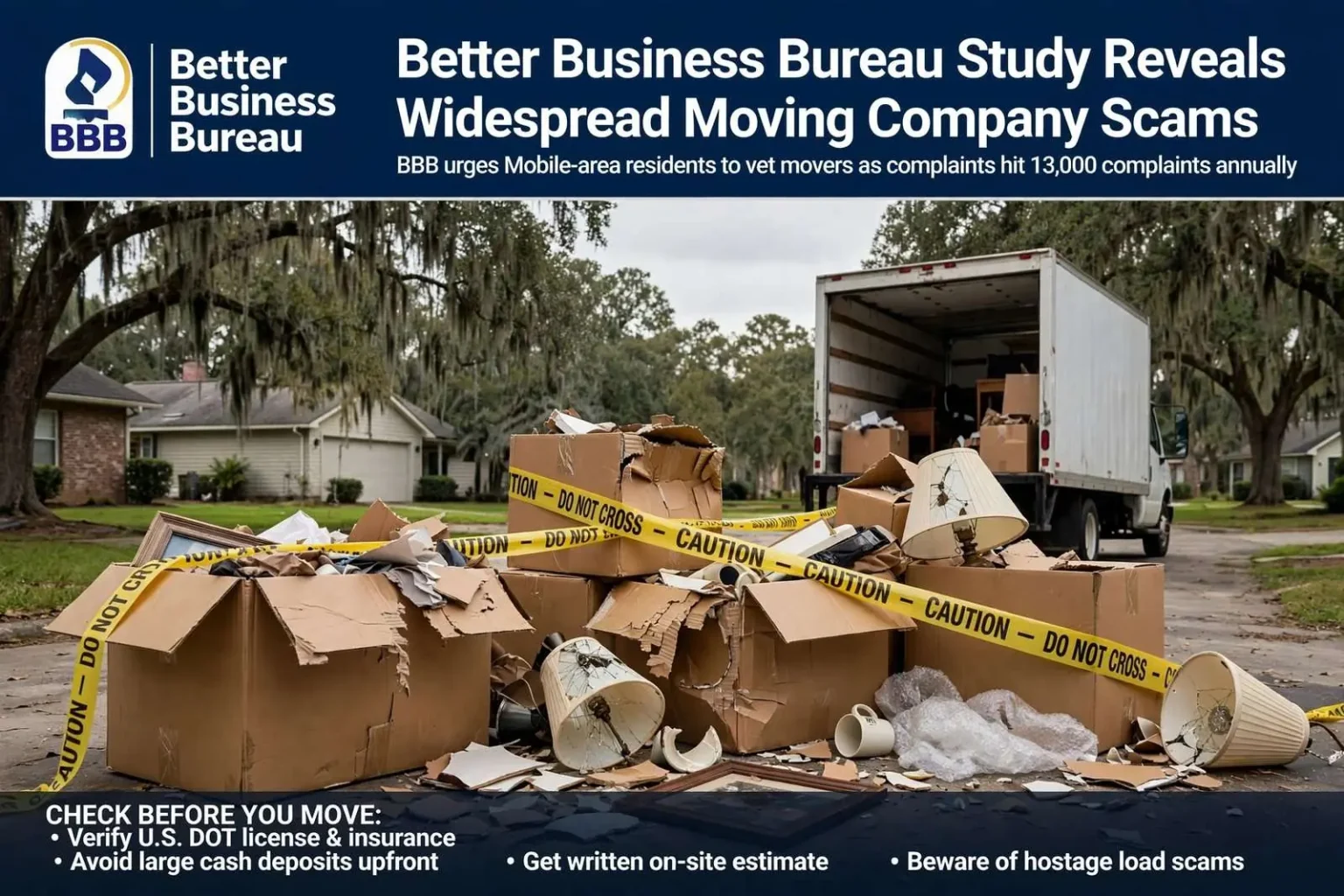
The Better Business Bureau is urging Mobile-area residents to carefully investigate any moving company before handing over their belongings, after a new investigative study found that scams in the moving industry remain widespread, particularly for interstate relocations. The warning arrives at the height of the moving season, when families across the Gulf Coast are packing up for new jobs, new homes and new school districts, and when the dishonest operators who follow the demand are most active.
Monde Donaldson with the BBB’s Mobile office noted that the bureau receives roughly 13,000 complaints and negative reviews about movers annually. Among the most common problems cited were price gouging, theft of belongings and destruction of property. That volume of complaints puts moving companies consistently among the most-complained-about categories the bureau tracks, a standing that surprises consumers who assume a licensed truck and a signed contract guarantee a smooth move.
How the Scams Work
The study found that some consumers who hired dishonest moving companies reported being charged many times the initially quoted price, subjected to delivery windows that stretched unreasonably long and told their belongings were being held hostage pending additional fees not disclosed at the outset. By the time goods did arrive, they were often damaged. The pattern is well known to regulators: a low-ball estimate secures the contract, and once the truck is loaded, the price doubles or triples because the mover knows the customer’s options are limited.
Hostage loads are the most distressing version of the scheme. Federal law prohibits movers from holding household goods to force payment of charges beyond the contract, but consumers whose possessions are sitting in a warehouse in another state often pay rather than fight, especially when the shipment includes furniture they cannot replace and paperwork they never read closely. Investigators say the scam thrives on timing — families who must be out of a home by a deadline have little leverage once the truck pulls away.
Allowing a stranger to drive off with everything a person owns ranks among the most stressful aspects of any long-distance move, the BBB noted. That stress has been amplified this year as the COVID-19 pandemic has prompted many families to relocate, sometimes on short notice and without the time to thoroughly vet a moving company. Pandemic-era moves have been driven by job changes, remote work flexibility, school decisions and financial pressure, and each of those forces has pushed households to book movers faster than they otherwise would.
The Licensing Rule Consumers Should Check First
The BBB advises consumers to verify that a moving company is properly licensed through the Federal Motor Carrier Safety Administration, to request on-site estimates rather than relying on phone or online quotes and to never pay a large deposit upfront. The federal licensing requirement is the single most important check for an interstate move: every legitimate mover crossing state lines carries a U.S. DOT number, and consumers can look that number up in the agency’s database to confirm the company is registered, insured and has a record of the complaints filed against it.
On-site estimates exist because phone and online quotes are where the manipulation starts. A low quote given over the phone can be based on deliberately underestimated weight or omitted charges, and the final bill — calculated after the truck is loaded — comes as a shock. An estimator who walks through the home sees the piano, the safe and the garage full of boxes, and a binding written estimate based on that walkthrough is far harder to inflate later. Consumers are also advised to get any promise of a price, pickup date or delivery window in writing, because the contract is the document that governs the move.
Red Flags That Separate Movers From Schemes
Alongside the BBB’s core advice, the study’s findings point to the warning signs that recur in scam reports. Demands for large cash deposits or payment in full before the move, refusal to provide a written estimate, no local address or physical office, answers by phone that give only a generic company name and trucks marked with unbranded rentals are all common features of the operations behind the complaint volume. Legitimate movers, by contrast, accept credit card payment, dispatch from identified facilities and provide inventory sheets that list what goes on the truck.
Price gouging after loading, theft and destruction of property — the three problems most often cited in the complaints the Mobile office receives — tend to appear together in the worst cases. That is one reason the bureau urges consumers to read reviews and complaint histories before signing rather than after, and to photograph belongings before packing so that damage claims can be documented if a dispute follows the move.
Why Mobile Movers Face Elevated Risk
The Mobile area’s position on the Gulf Coast adds particular urgency to the bureau’s warning. The region sees steady population movement in both directions — military families connected to the area’s defense installations, workers tied to the shipbuilding and industrial sectors, retirees relocating to and from coastal communities and hurricane-season relocations that can compress a household’s move into a few days. Interstate moves in any of those categories put residents squarely in the market where the study found scams most prevalent, because state-to-state relocations fall under federal jurisdiction and the long haul gives dishonest operators their window.
The pandemic has compounded the problem in ways the study singles out. Households relocating on short notice are less likely to compare companies, less likely to insist on in-person estimates and more willing to accept whatever date and price a mover offers. Movers themselves have also been strained by demand, and the squeeze has produced a wider spread between reputable companies operating at capacity and fly-by-night outfits appearing to take the overflow — often operating with rented trucks and no federal registration at all.
What Regulators Can and Cannot Do
Consumers sometimes assume that a government agency will police their move if it goes wrong, and the reality is more limited. For interstate shipments, the Federal Motor Carrier Safety Administration sets the rules movers must follow — written estimates, prompt delivery, dispute procedures for loss and damage — but it does not adjudicate individual billing disputes. State courts and small-claims venues handle many of the fights over inflated invoices, and arbitration clauses in moving contracts can add another layer to a dispute. The practical lesson the BBB draws from that landscape is preventive: the complaint file is full of consumers who skipped verification, and far fewer who checked a U.S. DOT number and still lost their load.
Insurance is a related gap worth understanding before moving day. Standard released-value coverage on household goods moves pays only a token amount per pound, and many households discover the limits of that coverage only after property is damaged or missing. Full-value protection costs more but replaces or repairs damaged items at current value, and homeowners or renters insurance sometimes extends limited coverage for a move. The BBB’s study found destruction of property among the most common complaints, which makes the insurance decision part of the vetting rather than an afterthought.
Reporting When Something Goes Wrong
Residents who encounter a potential scam are encouraged to report it at BBB.org/ScamTracker. The bureau’s tracking system feeds complaint data to law enforcement and regulators, and the patterns it reveals are what allow the BBB to publish studies like this one. Consumers with interstate moves also have recourse through the Federal Motor Carrier Safety Administration, which handles complaints against registered movers and can pursue unlicensed operators, and through state consumer protection channels for moves that stay within Alabama.
For families planning a move in the months ahead, the bureau’s advice distills to a short checklist: verify the company’s federal registration and insurance, insist on an on-site or video walkthrough estimate, get every promise in writing, avoid large upfront deposits, and read the contract before the truck arrives rather than after. The BBB notes that most moves complete without incident — but the 13,000 complaints and reviews filed each year about movers are a reminder that the industry’s worst operators depend on customers who skip exactly those steps.
The BBB’s Mobile office, which serves consumers across southwest Alabama, says the goal of the study is not to scare families away from hiring movers but to push the vetting to the front of the process. A moving contract signed after a careful check of licensing, estimates and references is the strongest protection a household has against the hostage loads, surprise invoices and damaged goods that fill the complaint file — and the time to do it, the bureau stresses, is before the deposit is paid, not after the truck is loaded.