Big Gigantic Brings Livetronica to Soul Kitchen
Colorado duo Big Gigantic brought its blend of electronic beats, live saxophone and drums to Mobile's Soul Kitchen on Saturday, November 17, 2012, for a ni.
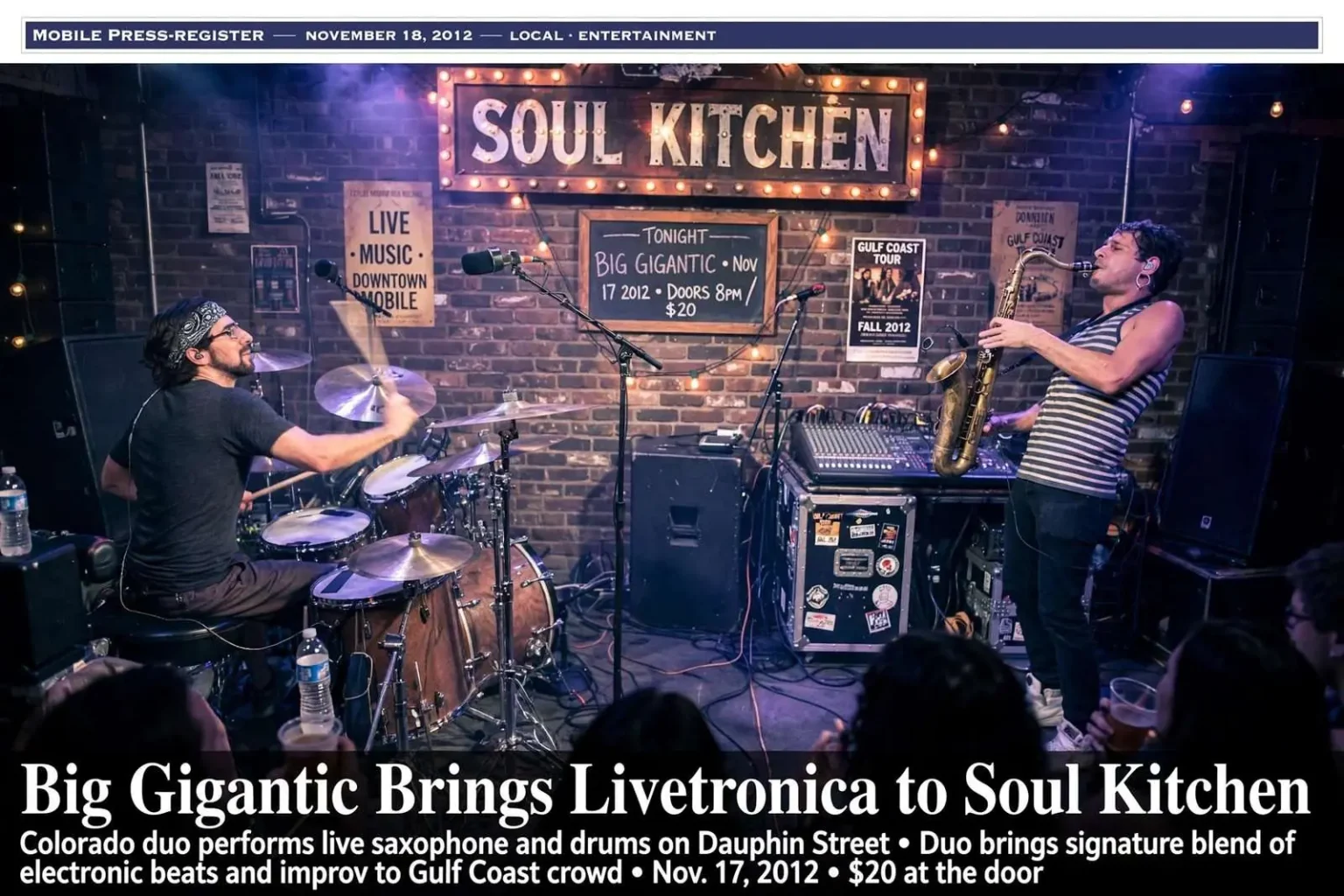
Colorado duo Big Gigantic brought its blend of electronic beats, live saxophone and drums to Mobile’s Soul Kitchen on Saturday, November 17, 2012, for a night of what the band calls “livetronica.” The stop put one of the most distinctive acts on the national jam and electronic circuit in front of a Gulf Coast crowd at a venue that had quickly become the center of gravity for touring live music in downtown Mobile.
The group is the project of Dominic Lalli and Jeremy Salken. Lalli holds a master’s degree from the Manhattan School of Music, and the pair has built a reputation for high-energy festival performances that fuse improvised saxophone and live drumming with produced electronic textures. That combination set Big Gigantic apart at a moment when laptop-based electronic music dominated clubs and festivals: instead of reproducing tracks, the duo reworked its songs in real time, with Lalli’s horn lines soaring over Salken’s hard-hitting kit work and a light show that had become a signature part of the band’s draw.
The livetronica movement the band helped popularize grew out of the jam-scene tradition of improvisation, but aimed squarely at the dance floor. Acts in the genre adopted the production techniques and tempo range of electronic dance music while insisting on live instrumentation, and the approach won over audiences who wanted the physical energy of a rock show with the grooves of a DJ set. By the fall of 2012, Big Gigantic had spent years on the road building exactly that reputation, with its instrument-driven take on dubstep, hip-hop, and house beats earning slots on major festival lineups across the country.
Lalli’s conservatory background gave the band’s improvisations a melodic depth unusual in electronic settings. Trained as a jazz saxophonist before turning to electronic production, he approached the band’s tracks the way a jazz soloist approaches a rhythm section, treating the programmed beats as a foundation for extended playing rather than a fixed recording. Salken’s acoustic drumming completed the hybrid, giving the duo’s performances a percussive punch that separated them from acts performing entirely behind laptops.
The Soul Kitchen and Mobile’s Live Music Scene
Doors opened at 8 p.m., with day-of-show tickets at $20. The pricing and timing followed the standard club-show rhythm: an early evening for opening acts, a late-night headlining set, and an affordable ticket that made the show accessible to the college crowd and touring-age fans who followed the band’s circuit. Fans coming downtown for the Saturday-night performance could choose from the bars and restaurants along Dauphin Street before the show, a routine that had become part of the appeal of seeing national acts in Mobile.
The Soul Kitchen, a cornerstone of Mobile’s live-music scene, hosted the show as part of a busy fall concert calendar on the Gulf Coast. The venue on Dauphin Street offered the size and sound system that mid-level national touring acts needed, filling the gap between the region’s smallest bars and the large theaters and amphitheaters. Its booking calendar brought a steady mix of rock, jam, hip-hop, country, and electronic artists through downtown, giving Mobile music fans a reason to stay in the city rather than drive to New Orleans or Pensacola for touring shows.
That role mattered for downtown Mobile’s revival. Through the 2000s and early 2010s, the LoDa entertainment district built its weekend economy around venues, restaurants, and bars within walking distance of one another, and a strong club calendar kept visitors coming on nights when the city’s theaters and event halls were dark. A band like Big Gigantic, with a young audience that traveled for shows, brought exactly the kind of traffic the district’s businesses counted on.
A Busy Fall on the Gulf Coast Circuit
The Saturday show fell in the middle of the fall touring season, when national acts crisscrossed the Southeast between festival seasons and holiday breaks. For Gulf Coast fans, the stretch from September through November traditionally brought a dense run of club shows, with New Orleans and the Florida Panhandle markets overlapping Mobile’s booking calendars. Big Gigantic’s stop gave Alabama fans of electronic and jam music a rare chance to see a national headliner of the genre without a long drive.
The duo’s growing catalog gave the Mobile crowd plenty of familiar material. By late 2012 the band had several independent releases behind it, and its songs circulated widely through free downloads, an approach the group used aggressively to build its audience in the era when electronic music spread online. Melodies set against heavy bass made the band’s tracks instantly recognizable to the club crowd, and the live versions stretched those songs into extended journeys that rewarded the fans who knew every transition.
Big Gigantic’s visit also reflected a shift in how electronic music reached secondary markets. As the festival boom of the early 2010s spread electronic acts beyond the major cities, clubs across the Southeast began booking producers and live-electronic bands that previously played only in large metro markets. Mobile’s venues participated in that expansion, and the Soul Kitchen’s willingness to book a saxophone-and-drums electronic duo showed the range its calendar covered in a single season.
Why the Duo’s Formula Worked Live
Part of Big Gigantic’s appeal was that no two shows sounded alike. Because the band built its sets around improvisation, fans followed the group from city to city to hear different interpretations of familiar songs, a fan culture the band inherited from the jam scene it grew out of. The duo’s shows also leaned on visuals, with light production synchronized to the music that turned a club set into a full sensory experience, and the band’s appetite for blending genres meant a single night might move from dubstep drops to jazz-influenced horn solos to hip-hop cadences without pausing.
The duo’s Colorado roots tied it to a mountain-state music scene that had become one of the most fertile in the country for the fusion of electronic music and live instrumentation. Denver and Boulder audiences embraced genre-blurring acts in the early 2010s, and bands from that scene toured nationally with a work ethic that kept them on the road nearly year-round. By November 2012, Big Gigantic’s relentless touring had built a national following that could fill clubs in markets far smaller than the festivals the band headlined.
For Mobile, the show fit the Soul Kitchen’s identity as the place where touring music happened downtown. The venue had established itself as the stop regional tours added between New Orleans and the Panhandle, and its room gave fans sightlines and sound that held up across genres, from singer-songwriters to bass-heavy electronic acts. A livetronica show tested that system’s low end as hard as any genre the club booked, and the November 17 date gave local fans a measure of how the room handled it.
The night delivered what the band’s reputation promised: live saxophone and drums locked to electronic beats at a volume and energy that filled the Dauphin Street venue. Doors had opened at 8 p.m. and day-of-show tickets ran $20, keeping the show accessible on a Saturday night when downtown Mobile’s entertainment district was in full swing. The performance added another name to a fall calendar that showed how much touring music passed through the Gulf Coast, and it left Mobile’s electronic and jam audiences waiting for the duo’s next pass through the region.
The Broader Electronic Music Wave of 2012
The timing of the Mobile show placed it squarely in the era when electronic dance music crossed into the American mainstream. Festival stages built for rock bands were reprogramming around DJs and electronic producers, and college-age audiences drove the change. Bands like Big Gigantic occupied a valuable middle ground in that shift, offering audiences raised on rock bands a way into electronic music through the familiar presence of live musicians on stage, and offering dance audiences improvisation that no recorded set could provide.
That crossover gave the duo reach beyond a single scene. Horn-led electronic music drew jazz listeners curious about the genre, jam-band followers who tracked improvisation from show to show, and electronic fans drawn by the low-end production. Venues benefited from the same breadth, since a Big Gigantic crowd mixed longtime club regulars with first-time concertgoers, and the band’s dance-floor orientation kept the room moving from the first song to the last.
For the fans who filled the Dauphin Street venue, it was the rare chance to hear electronic music made in the room rather than played from a laptop, and for the venue it was another confirmation that Mobile audiences would come out for national acts of nearly any genre. The show ended the way the band’s nights typically did, with the crowd on its feet and the duo extending the set past its planned close, saving the heaviest grooves for the final stretch.
The November 17, 2012, date captured that moment on a small scale in Mobile. A Colorado duo with a conservatory-trained saxophonist, an electronic production rig, and a national touring schedule came to a Gulf Coast club room, drew a crowd on a Saturday night, and demonstrated how far the livetronica wave had carried by the fall of 2012.