Longtime Mobile Film Office Director Eva Golson Inducted Into Southern PR Hall of Fame
The Birmingham News may outsource its printing operation in a move that could affect more than 100 jobs, Mobile Press-Register subscribers are being billed added sales taxes, and longtime Mobile Film Office director Eva Golson has been inducted into a statewide public relations hall of fame.
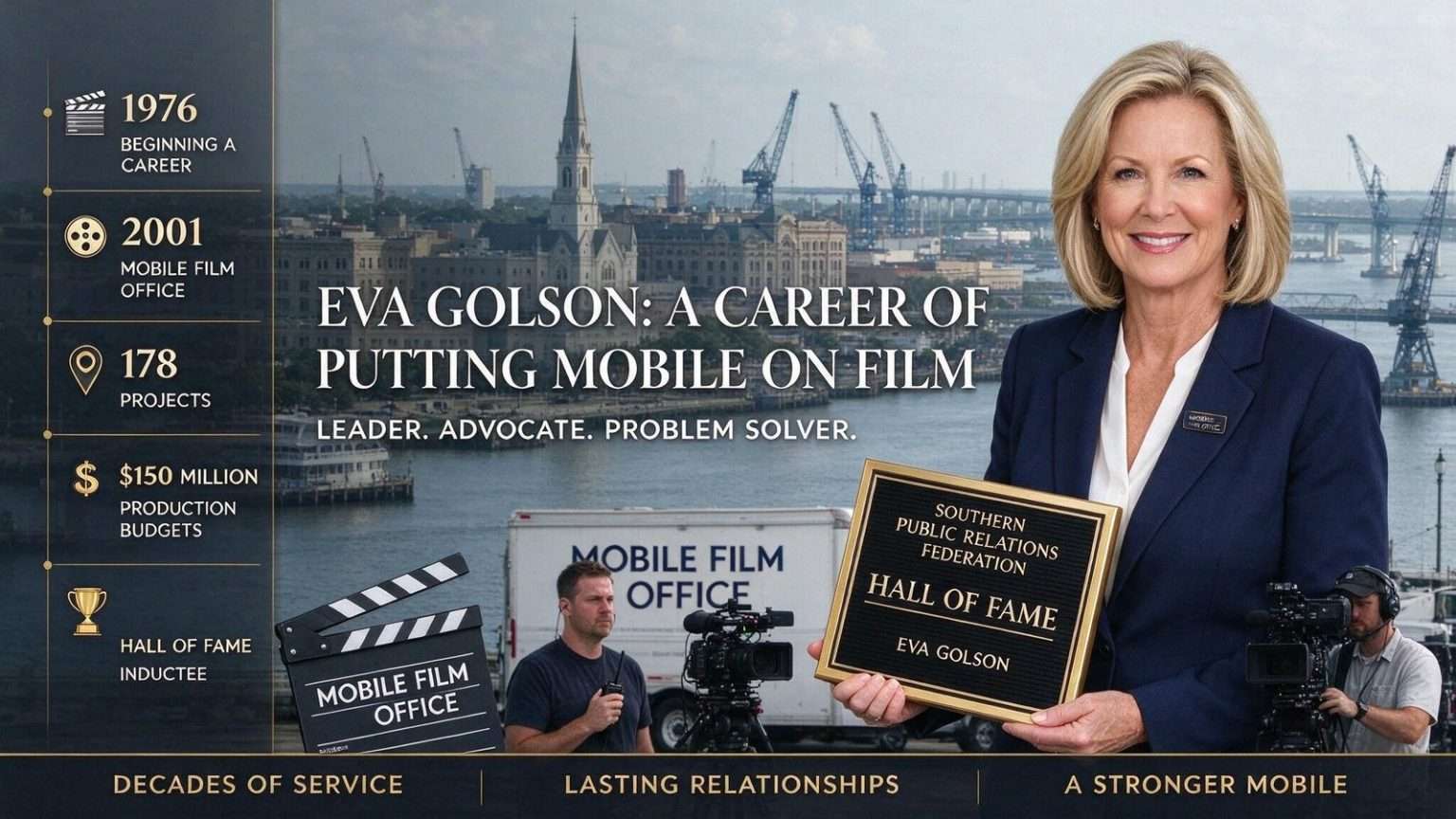
Longtime Mobile Film Office director Eva Golson has been inducted into the Southern Public Relations Federation’s Hall of Fame, an honor recognizing her decades of work promoting the region as a filming destination.
Golson has led the Mobile Film Office since it was established in 2001, but her efforts to bring film and television production to the Azalea City stretch back much further, to 1976. In the decades between, she has been the constant presence behind nearly every camera crew, location scout and studio executive who has come to town — the person producers call first, and the reason many of them call Mobile at all.
By the Numbers: A Production Record
The results of that advocacy are measurable. Since Golson began promoting Mobile as a production location, the area has hosted 178 movies, television series, music videos, documentaries and commercials, according to figures tied to her tenure. Each of those projects meant crews checking into local hotels, renting equipment, hiring local hands and eating in local restaurants — the kind of spending that leaves a city long after the credits roll.
She was also a driving force behind the creation of the state’s film incentive package, which was designed to make Alabama more competitive for larger-budget productions by offering financial incentives to filmmakers. Before such programs existed, Mobile and Alabama generally watched productions choose neighboring states that offered rebates and credits; the incentive package changed that arithmetic and gave film offices across the state a real tool to close deals.
Since that incentive program was enacted, Mobile has attracted productions with a combined budget of more than $150 million, cementing the city’s reputation as the state’s leading destination for film and television work. For a metro area of Mobile’s size, sustaining that level of production activity requires exactly the kind of institutional memory, location relationships and professional persistence that a long-tenured film office provides.
A Career of Recognition
Golson’s honors extend well beyond this latest recognition. She is a member of the Public Relations Council of Alabama’s Mobile Chapter as well as the Southern Public Relations Federation, and was named the Public Relations Council of Alabama’s Practitioner of the Year in 1980. She is also enshrined in the Alabama Tourism Hall of Fame, a nod to the ways her film work and the region’s visitor economy feed each other.
Golson received her Southern Public Relations Federation Hall of Fame induction on Aug. 5 during a ceremony held in Starkville, Mississippi. The federation draws its membership from across the Gulf South, and its Hall of Fame recognizes practitioners whose careers have defined the profession in the region — a fitting stage for a woman whose real work has been one long public relations campaign on behalf of Mobile itself.
Colleagues describe her role as equal parts recruiter, diplomat and troubleshooter. Film production is an industry of tight schedules and impossible requests: a historic porch that must look like 1963, a downtown street that must close by morning, a marina that must look empty for a single shot. The film office’s job is to make those requests possible, and four decades of relationships with property owners, city departments and state agencies are what make the yeses possible.
Why It Matters for Mobile’s Economy
Local officials and business leaders have often pointed to the film office’s work as a rare bright spot for economic diversification in a region historically anchored by shipping, manufacturing and the paper industry. Mobile’s port and its industrial employers remain the backbone of the local economy, but production spending arrives in a different form — dispersed across small businesses, skilled trades and creative professionals who might otherwise take their talents elsewhere.
The film office’s model has also proven durable. Incentive programs and production trends shift with state budgets and industry fashion, but a location’s appeal to filmmakers rests on consistent foundations: distinctive architecture, water and wetlands within easy reach, workable weather most of the year, and a film office that answers the phone. Those assets do not depreciate, and Golson’s career has been spent making sure producers know about them.
The Hall of Fame induction also spotlights the profession itself. Public relations work in a film office is a specialized craft: marketing a city’s locations to an industry that can shoot anywhere, managing publicity for productions that often prefer secrecy, and translating between the needs of Hollywood crews and the expectations of a hometown. Golson’s recognition by her professional peers — alongside her earlier Practitioner of the Year award from the state association — reflects mastery of that craft over a career that began when Mobile’s film presence was close to nothing at all.
Her reach has extended beyond the city limits as well. As one of the state’s most experienced film officials, she has been part of the broader conversation that shaped Alabama’s approach to the industry, from the early argument that production jobs were worth pursuing to the specifics of the incentive legislation that followed. Film offices in smaller communities across Alabama have looked to Mobile’s operation as the working example of what a sustained effort can build.
The Long Game
The numbers Golson’s tenure produced — 178 projects and more than $150 million in production budgets since the incentives were enacted — represent one thing above all: persistence. An industry that could choose anywhere chose Mobile repeatedly across four decades, and that kind of loyalty is earned one production at a time, one solved problem at a time, one location owner convinced to host a crew at a time.
It is also a story about what one professional can accomplish inside an institution. The Mobile Film Office has operated since 2001 under a single director, giving the city a continuity of representation that few markets its size can match. Producers hiring in Mobile know exactly who they will be dealing with, and that predictability is worth real money in an industry where surprises cost thousands of dollars an hour.
As the industry itself changes — with streaming services commissioning more content and production spreading to mid-sized cities — the groundwork Golson has laid positions Mobile to keep competing. The Hall of Fame recognition from the Southern Public Relations Federation formally acknowledges what the production log has shown for decades: that the woman who has run Mobile’s film office since it opened built something lasting, one project at a time, from an office that did not exist before she took it over.
The Aug. 5 ceremony in Starkville brought together public relations professionals from across the region to honor a class of inductees whose careers shaped how their communities are seen. For Mobile, the occasion doubled as an audit of its film economy — and the balance sheet read favorably. One hundred seventy-eight productions, a state incentive law she helped inspire, and a tourism hall of fame plaque already on the shelf: the Hall of Fame ring was simply the latest entry in a career spent putting the Azalea City on film.
The story of Mobile’s film office begins well before its formal founding. When Golson started advocating for the city as a production location in 1976, the idea that a Gulf Coast metro could compete for film work was met with skepticism — the industry’s attention belonged to California, New York and a handful of established Southern hubs. Building credibility meant starting small: landing commercials and industrial films, shepherding the occasional documentary crew, and making sure that every production that did come left with a reason to return.
Over time that reputation compounded. Location scouts talk to each other, and a city that solves problems becomes a city that gets recommended. By the time the film office formally opened its doors in 2001 with Golson at its head, she was not learning the job — she was formalizing a practice she had already refined over twenty-five years.
The incentive package she championed completed the toolkit. Locations and relationships draw scouts, but budgets decide bookings, and Alabama’s rebates and credits gave the state a financial argument to match its physical ones. Mobile, with its inventory of historic districts, working waterfront, antebellum neighborhoods and nearby beaches and swamps, was positioned better than any other Alabama city to convert that argument into signed contracts — and the $150 million in combined production budgets that followed the incentives’ enactment shows exactly that.
The Hall of Fame honor closes a loop on a career that began before the industry believed in the Gulf Coast and continued long after the Gulf Coast proved itself. For the film office, the recognition is institutional as well as personal: it signals to producers that the city’s film operation is led by someone her own profession regards as being at the top of its field, a credential that will matter the next time a scout weighs Mobile against a dozen other Southern cities.