Body Found in Perdido Bay Identified as Missing Boater Brandon Nicholson
The Escambia County Sheriff's Office identified a body found in Perdido Bay as Brandon Nicholson, missing since leaving by jon boat after Hurricane Sally.
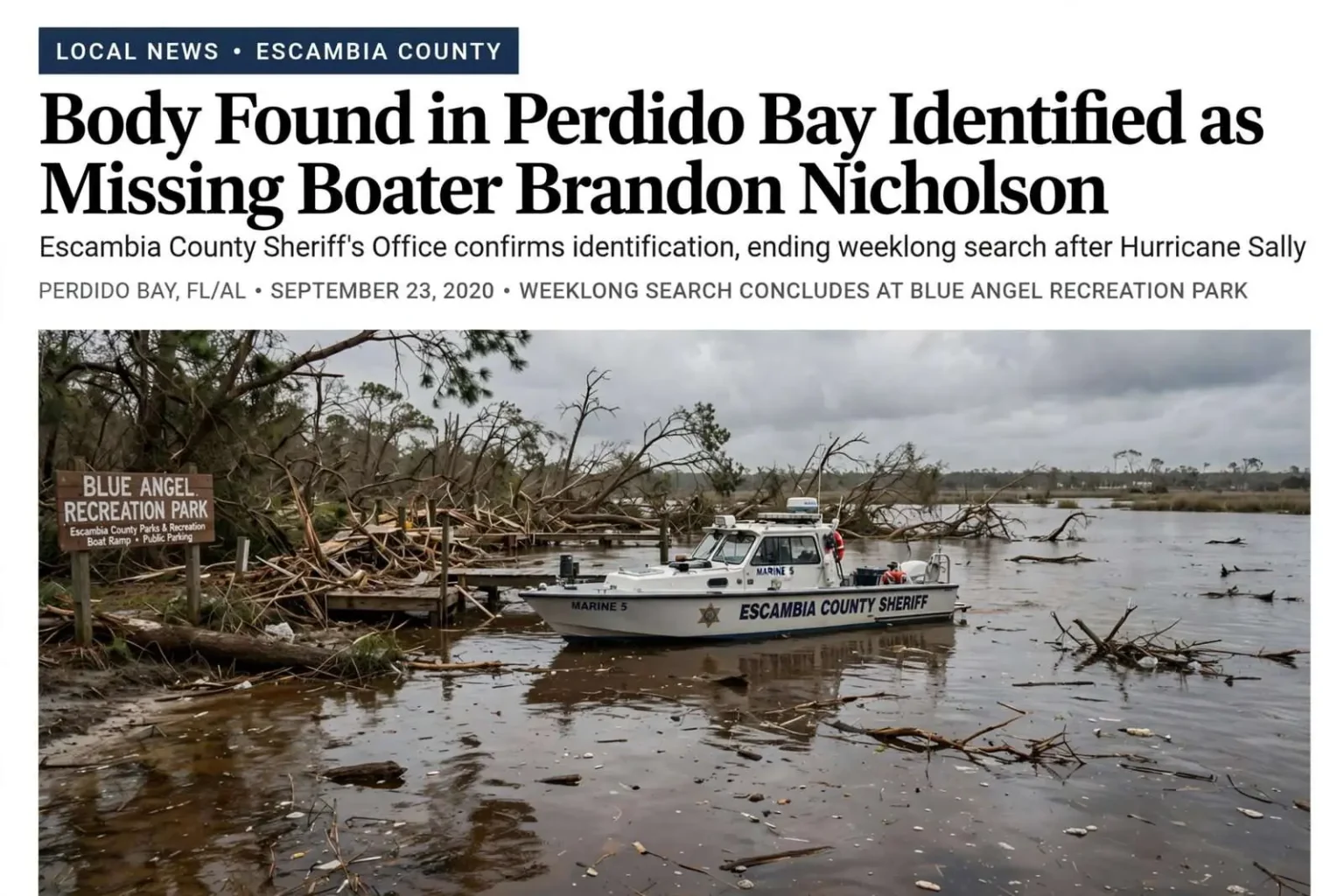
A body recovered in Perdido Bay near Blue Angel Recreation Park was identified by the Escambia County Sheriff’s Office as Brandon Nicholson, the area boater who had been missing since mid-September, closing out a weeklong search that stretched across the storm-wrecked waters of the Florida-Alabama line.
Deputies confirmed the identification after the discovery, bringing an end to a search that had gone on for days while the region was still reeling from Hurricane Sally. The recovery near Blue Angel Recreation Park, on the Perdido Bay shoreline, came after an extensive effort by deputies and volunteer rescuers who had combed the bay and surrounding waters since Nicholson first vanished.
Nicholson was last seen around 10:30 a.m. on September 16 on his boat near the 500 block of Riola Place, just hours after Hurricane Sally came ashore along the Gulf Coast. The timing placed his disappearance squarely in the most dangerous window of the storm’s aftermath, when swollen waterways, scattered debris and damaged docks made even familiar waters hazardous.
A Pontoon Boat Adrift, A Jon Boat and a Choice
According to his family, Nicholson had been at his mother’s house in the storm’s aftermath when a pontoon boat broke loose and drifted away. He set out on a jon boat to go after it and never returned.
The circumstances were the kind that first responders warn about after every major hurricane. In the hours and days after landfall, waterways are littered with debris and their banks are lined with damaged vessels, and the instinct to secure property, in this case a family boat set adrift by the storm, draws people onto the water in small craft that are no match for post-storm conditions. A jon boat, a small flat-bottomed vessel prized for fishing in calm waters, offers little protection against chop, floating hazards and currents running stronger than they look.
Sally made landfall along the Gulf Coast as a slow-moving Category 2 storm, and its crawl ashore pushed enormous volumes of water into the bays, bayous and rivers on both sides of the state line. Storm surge and days of rain left docks destroyed, boats sunk or scattered, and shorelines littered with wreckage. In the Perdido Bay area, where homes and camps line the water, the aftermath was a landscape of floating debris and broken infrastructure.
The Search
When Nicholson failed to return, the response grew quickly. Deputies with the Escambia County Sheriff’s Office led the effort, joined by volunteer rescuers who know the bay’s coves, channels and backwaters. Searchers worked the waters around Riola Place and expanded outward as the days passed, operating among the same debris fields that had made the water dangerous in the first place.
A weeklong search of a bay system the size of Perdido Bay is a grinding undertaking. Post-storm conditions complicate every phase: fuel and staging areas can be damaged, launch sites are cluttered with wreckage, and visibility beneath the surface, always limited in the bay’s tannin-stained water, is further degraded by sediment the storm stirred up. Volunteer boaters with local knowledge often prove essential in such searches, covering tributaries and shoreline stretches while official teams work the main waterways.
The discovery of the body near Blue Angel Recreation Park, a public park and boat ramp area on the bay’s northern shore, came at the end of that week of effort. Deputies confirmed the identification as Nicholson, and the news was delivered to a family that had spent seven days holding out hope while searchers worked the water.
A Family’s Loss
Nicholson leaves behind his wife Stephanie and two children. Family members described him as a selfless, caring man who always put others first, the person they called the rock of the family.
Those descriptions matched the act that cost him his life. Nicholson went out onto storm-damaged water not for himself, but to recover a boat that had drifted from his mother’s property, the kind of errand a dependable family member takes on without hesitation. The irony that a man trying to retrieve one boat lost his life in another was not lost on anyone who followed the story.
Friends and neighbors in the tight-knit communities along Riola Place and the Perdido Bay shoreline rallied around the family, as they had during the search, in the way Gulf Coast communities do when a storm claims one of their own.
Hurricane Sally’s Slow, Destructive Path
Sally was a storm that earned its reputation through persistence more than raw power. After strengthening in the Gulf of Mexico, it came ashore near the Alabama-Florida line and then slowed to a crawl, hammering coastal communities with hours of relentless rain and wind rather than the brief blow of a faster storm. Rainfall totals in some areas measured in feet rather than inches, and the flooding that followed stretched far inland. Bridges and highways across the region were damaged, hundreds of thousands of residents lost power, and the cleanup continued for months.
The waterways took some of the worst of it. Perdido Bay, which gathers the flows of the Perdido River and a web of tributaries before emptying into the Gulf, rose dramatically and carried a churning load of storm debris. Boats broke loose from damaged lifts and slips across the region, some sinking where they sat and others drifting for miles before running aground. In the days after landfall, marine officers and homeowners alike reported vessels in trees, on roads and piled against ruined docks.
That debris field was the environment Nicholson entered when he launched his jon boat the morning after landfall, and it was the environment searchers had to navigate for the next week.
The Dangers of Post-Storm Waters
Safety officials repeat the same guidance after every coastal storm: stay off the water until conditions are assessed, and never go out alone or in a small craft to recover property. The warnings exist because the hazards after a hurricane are layered. Submerged objects, from broken pilings to sunken boats to pieces of roofing, lurk just beneath a surface that looks calm. Currents remain abnormal for days as floodwater drains through the system. And the debris that floats on the surface can disable a small boat’s motor in an instant, leaving its operator adrift among hazards with no easy way back.
The loss of a pontoon boat, meanwhile, is a property problem, and no boat is worth a life. Marine deputies respond to loose-vessel reports after storms, and insurers handle the losses; the vessels that drift away are usually found or replaced. The arithmetic changes entirely when a person goes out after one, which is why agencies plead with residents to call rather than launch.
Nicholson’s disappearance became one more entry in a pattern that repeats after Gulf storms: residents venturing onto damaged waterways in the first days after landfall, and some of them not coming back. Emergency managers note that the toll from a hurricane’s aftermath, drownings, electrocutions, chainsaw and generator accidents, often rivals or exceeds the toll from the storm itself.
How Water Searches Work
When a boater goes missing, sheriff’s offices typically coordinate a search using marine units, side-scan sonar, and in many cases volunteers with airboats and shallow-draft craft. The search area is built from the last known position and the prevailing currents, then expanded day by day. Wind direction, tide stage and freshwater inflow all move floating objects and influence where a search concentrates, and in a bay as branching as Perdido, the territory grows quickly.
Volunteers play a delicate role in these operations. Their local knowledge of channels, camps and coves is invaluable, but search commanders work to keep the effort organized, because uncoordinated boats can churn the water, disturb evidence and put more people at risk. In the week after Nicholson disappeared, that balance of official resources and community effort played out across the bay each day until the search ended near Blue Angel Recreation Park.
Remembering a Neighbor
For the communities along Perdido Bay, the story closed with grief and gratitude tangled together: grief for a husband and father gone, gratitude for the neighbors and deputies who spent a week searching. Nicholson’s family described a man whose selflessness defined him, and the circumstances of his death, going after his mother’s boat while the region was still digging out, told the same story his family told.
His death also stands as the human warning inside the storm’s aftermath, a reminder that the dangers of a hurricane do not end when the wind stops. The waters that define life along Perdido Bay, the same waters that make the area a paradise for boaters and anglers in ordinary times, demand respect in the days after a storm, and the safest choice is almost always to wait, to ask for help, and to let property go rather than follow it onto the water.