
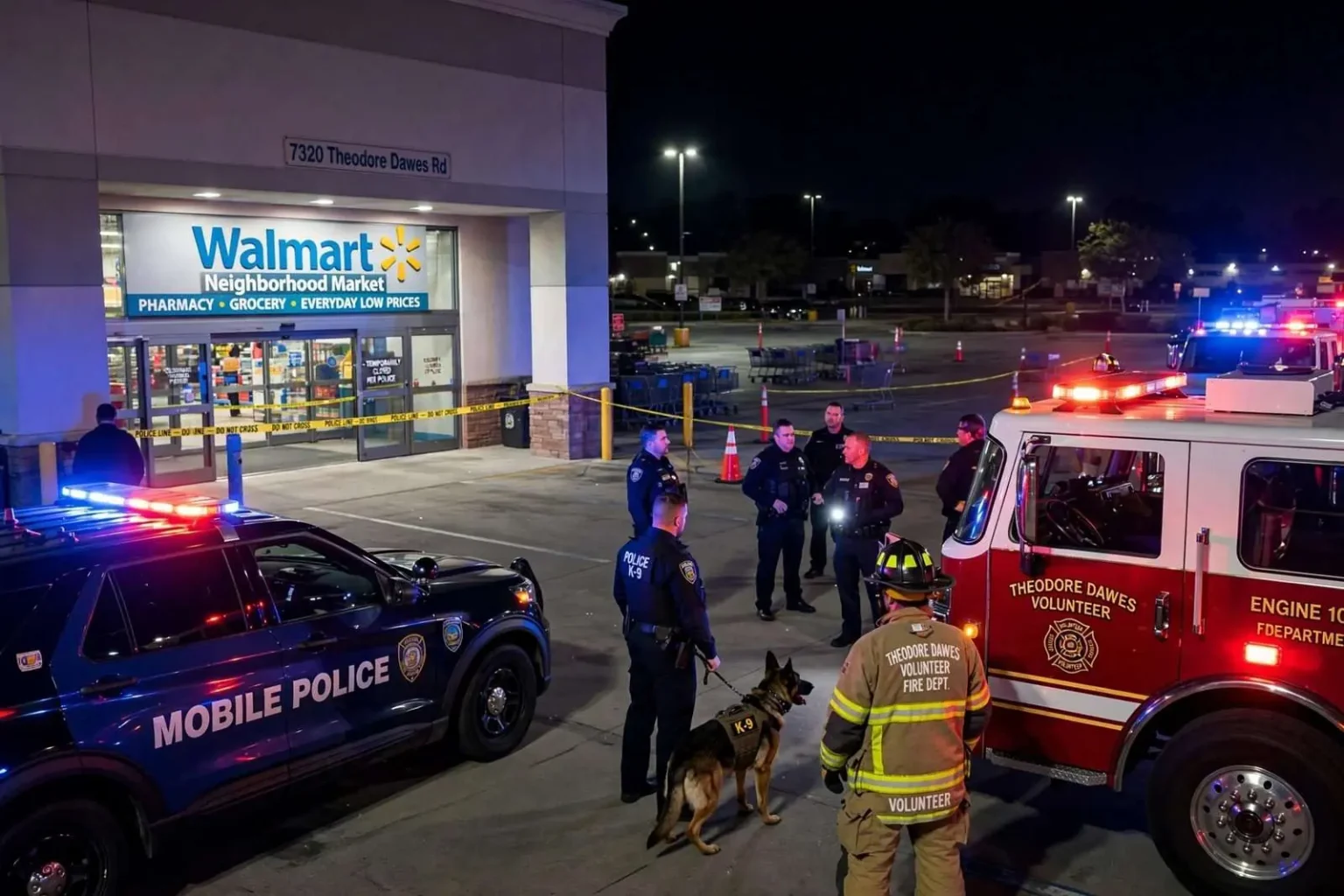
Emergency crews responded to a bomb threat at the Theodore Dawes Neighborhood Walmart on Friday evening, sweeping the store before employees were allowed back inside. The threat involved the store at 7320 Theodore Dawes Road, in the Theodore community of Mobile County just south of the city limits. The Theodore Dawes Volunteer Fire Department confirmed its crews were on scene, and Mobile police also responded and investigated the incident. By about 9:10 p.m., after a search of the building with bomb-sniffing dogs, workers were cleared to return to the store, and authorities did not immediately say whether anyone had been taken into custody or whether the threat was deemed credible.
The response followed the standard protocol that governs bomb threats at retail establishments across the country. When a threat arrives, by phone, note or other means, the store’s management evacuates customers and staff, and law enforcement treats the report as genuine until proven otherwise. Officers establish a perimeter, keep bystanders and traffic away from the building, and bring in specialized resources for the search. The dogs used in the sweep are trained to detect explosive materials, and the methodical clearance of a big-box store, aisle by aisle, stockroom by stockroom, takes time, which is why the all-clear came more than two hours after the initial response began.
How a bomb threat response works
Bomb threat responses at commercial locations are coordinated among multiple agencies by design. Police handle the investigation and the search, fire departments stand by for any actual ignition or structural hazard, and store security manages the evacuation and accounts for employees. In the Theodore case, the presence of both Mobile police and the Theodore Dawes Volunteer Fire Department reflected that division of labor. bomb-sniffing K-9 teams, often drawn from a city police department, county sheriff’s office or neighboring agency, are the decisive resource in determining whether a threat corresponds to a real device, and their sweep of the 7320 Theodore Dawes Road store ended the immediate emergency.
For the employees and customers involved, the experience is disruptive but brief in the scheme of such events. Friday evening is among the busiest windows for a neighborhood Walmart, and an evacuation sends shoppers into the parking lot mid-errand while officers hold the entrances. The all-clear at 9:10 p.m. allowed workers back inside, and the store could resume the ordinary business of restocking and ringing up groceries. Retail corporations maintain standing procedures for exactly this scenario, and store staff drill on evacuation routes and threat reporting the way schools do.
Theodore’s public safety network
The incident also highlighted the role of volunteer fire departments in unincorporated Mobile County. Theodore sits outside the city limits, and neighborhoods there depend on volunteer-based departments for fire protection, with the Theodore Dawes Volunteer Fire Department serving its section of the community. These departments respond to everything from house fires to vehicle wrecks to, as in this case, standby roles during police operations, and their funding through county fire fees and fundraising is a perennial civic issue in the communities they serve. Their presence at a bomb threat response underscores how much of the region’s first-response work falls on volunteers.
Mobile police, for their part, handle a steady volume of threat reports across the county’s largest city and its surroundings, and the investigative questions that follow an all-clear are standard: Where did the threat originate, who made it, and what evidence exists to identify them. Making a bomb threat is a felony under Alabama law, and investigators pursue phone records, store surveillance and witness accounts to trace reports that disrupt businesses. The absence of immediate information about arrests or credibility, as authorities indicated Friday night, is typical of the hours after a sweep, when the evidence collection is just beginning.
The evening at the Theodore Dawes Neighborhood Walmart ended the way the community would hope: a threat reported, a building emptied and searched, dogs run through the aisles, and employees cleared to return by 9:10 p.m. with no injuries reported. Whether the threat proves to be a hoax or something more will be answered by the police investigation that continued after the store’s lights came back on, and the residents of Theodore were left with the reassuring picture of their volunteer fire department and city police handling an unsettling Friday night in the manner the region has come to expect.
Bomb threats against retail stores occupy a particular place in American public safety, occurring often enough that every large retailer maintains procedures and rarely involving an actual device. The motives behind such threats range from pranks and grudges to attempts to disrupt business or, in rare organized cases, to clear a store for theft. Law enforcement agencies respond uniformly to all of them because the cost of ignoring a genuine threat is catastrophic, and the resulting protocol, evacuate, search, clear or escalate, protects the public regardless of the caller’s intent. The Friday night response at the Theodore Dawes store fit that pattern precisely, with the community spared any confirmation of actual danger.
The economics of these disruptions fall quietly on the store and its neighbors. An evacuated Walmart on a Friday evening means lost sales, idle staff and a parking lot of interrupted families, and the impact spreads to the surrounding commercial strip along Theodore Dawes Road as traffic is diverted and curiosity slows passing business. Stores generally reopen the same night after an all-clear, as this one did, and the disruption fades from public attention even while the police investigation continues. Retailers absorb the cost without fanfare, treating it as part of operating hundreds of locations that anyone can call, visit or threaten.
What happens after the all-clear
The investigation that follows a bomb threat is where the accountability lives. Investigators will attempt to trace the origin of the threat, whether it came by phone, in writing or through a third party, using phone records, store surveillance footage and interviews with employees and witnesses. Under Alabama law, falsely reporting a bomb or other destructive device is a serious crime, and prosecutions are pursued both to punish individual offenders and to deter the next caller. When a threat is made during business hours with dozens of customers present, courts treat the potential for panic and injury as an aggravating reality, not a hypothetical one.
Store employees are the first line of defense in these incidents, and their training covers how to recognize a threat, how to report it accurately and how to move customers out without creating panic. Walmart’s scale means that protocols are standardized across thousands of stores, and the Theodore Dawes staff’s evacuation of the building, completed before police and fire units finished their work, reflected that preparation. The two-hour interval between response and all-clear is a normal duration for a store of that size, and the use of bomb-sniffing dogs represents the most thorough search method available short of a full technical sweep by bomb technicians.
For the Theodore community, the episode closed without injury and without confirmed danger, which is the outcome every such response hopes for. The store at 7320 Theodore Dawes Road reopened its registers, the volunteer fire department’s crews went back in service, and Mobile police retained the open questions for the days ahead. Friday evening’s events serve as a quiet reminder of the machinery that stands behind an ordinary shopping trip: the evacuations that go smoothly, the dogs that find nothing, and the investigations that continue after everyone has gone home.
The Theodore community, strung along Theodore Dawes Road and the surrounding corridors south of Mobile, has grown from a rural crossroads into a suburban stretch of Mobile County, and its public safety resources have grown with it while remaining volunteer-rooted. The Theodore Dawes Volunteer Fire Department is one of several volunteer agencies protecting the unincorporated county, each funded through a mix of county fire fee revenue and community support. Residents often know their local department by its station on the main road, its members’ familiarity with the neighborhoods and, on nights like this one, the presence of its trucks at an incident that has nothing to do with fire.
The partnership between volunteer firefighters and municipal police in such incidents is a practical necessity in a county where jurisdictions interlock. Mobile’s city limits reach deep into the county’s populated areas, and the Mobile Police Department provides investigative resources that small communities could not maintain alone, from K-9 teams to detectives who work threat cases. County-wide mutual aid means a Friday night bomb threat draws whichever agencies are closest and relevant, and the Theodore response showed that system functioning as designed: fire on scene for standby and safety, police investigating, and a search that concluded with an all-clear rather than an evacuation radius expanding.
The broader pattern of threats
Nationally, bomb threats against retail and public buildings have evolved with technology, as caller ID, voice-over-internet services and digital communications have changed both how threats are made and how they are traced. Many threats now arrive through channels that can be traced within hours, and prosecutions have followed threats made from other states and even other countries. The lesson that investigators and retailers alike emphasize is that the cost of a threat is never zero: hundreds of people are evacuated, dozens of emergency personnel are committed, and the businesses and schools involved lose hours of normal operation, all before anyone knows whether the report was real.
Communities like Theodore absorb these episodes with a certain practiced calm, and the public information flow after an incident reflects that: the initial reports, the agencies confirming their roles, the all-clear announced with a timestamp, and the caveats about arrests and credibility that leave room for the investigation to work. Residents checking social media on a Friday night saw the essential facts quickly, and the absence of sensational developments was itself the story’s conclusion. A store that emptied at dusk was back in business before the night ended, and the only lasting trace was in the records of the departments that responded.
The bomb threat at the Theodore Dawes Neighborhood Walmart stands, in the end, as a case study in how unremarkable such incidents are when the response works: a real threat report met with a real protocol, a parking lot full of waiting customers, dogs in the aisles, an all-clear at 9:10 p.m., and an investigation that continues out of public view. The Theodore Dawes Volunteer Fire Department’s crews and Mobile’s police handled their parts of a Friday evening that no one would have scheduled and everyone handled.