Bond Set at $375,000 for Man Charged in Fatal July 4th Shooting in Prichard
A $375,000 bond was set for Michael Edwards, charged with murdering Cleavland L. Goodwin in a July 4 shooting in Prichard.
A $375,000 bond was set for the man accused of killing a Prichard man on the morning of July 4, according to the Mobile County District Attorney’s Office. The holiday morning shooting added a name to the year’s homicide toll in Mobile County and left a Prichard family grieving on a date that is supposed to mark celebration, a contrast that residents of the city have come to know grimly.
Michael Edwards was arrested and charged with murder after Prichard police found Cleavland L. Goodwin, 38, suffering from gunshot wounds. Goodwin was pronounced dead at the scene by emergency medical crews, who responded to the morning call along with police. The arrest followed the initial investigation into the shooting, and the bond setting moved the case into the court process that will determine its outcome.
Bond of $375,000 in a murder case reflects how Alabama courts calibrate pretrial release against the gravity of the charge. Murder carries the most serious penalties in the state’s criminal code short of capital offenses, and judges weigh the nature of the allegation, the defendant’s circumstances and community safety when setting an amount a defendant must post to be released while awaiting trial.
How the shooting unfolded
Investigators said Goodwin was shot after getting into an argument with a woman. Police said Edwards allegedly joined the confrontation, and that is when shots were fired. The account investigators assembled in the hours after the shooting traced a path from a dispute to a fatal volley of gunfire — a sequence familiar to police departments across the country, where arguments that escalate in moments account for a large share of homicides.
Prichard police responded to the scene on the morning of July 4 and found Goodwin suffering from gunshot wounds. Emergency medical crews pronounced him dead at the scene, meaning the effort to save him ended where the investigation began. Detectives then took over the work of reconstructing the encounter, identifying witnesses and locating the suspect, which led to Edwards’s arrest and murder charge.
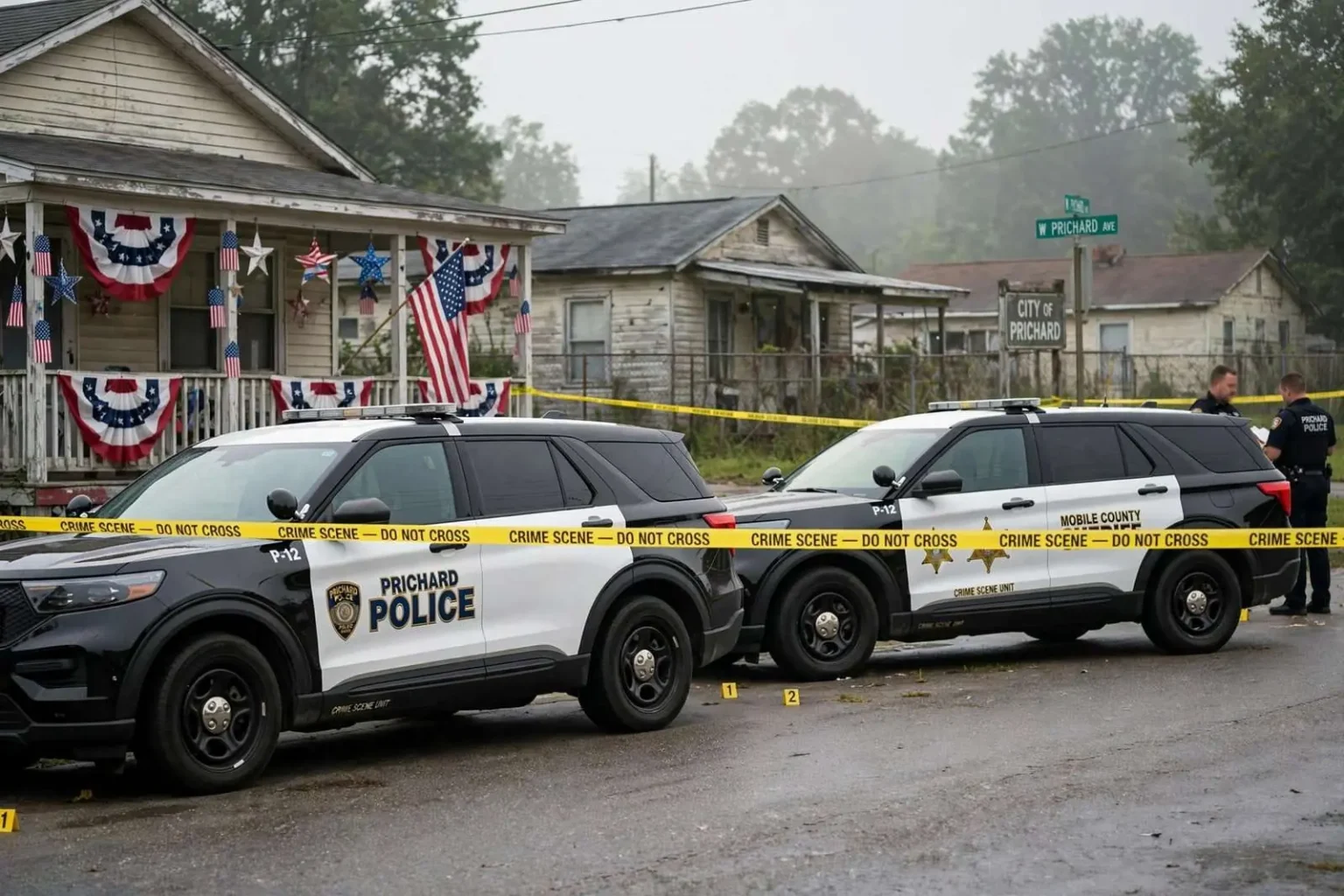
The Mobile County Sheriff’s Office Crime Scene Unit is assisting Prichard police with the ongoing investigation. Crime scene units bring specialized evidence work — documentation, photography, collection of physical evidence — that smaller municipal departments rely on partners to provide, and the assistance from the sheriff’s office gave Prichard detectives additional technical capacity in the case.
Prichard and the pattern of violence
Prichard, a city of roughly 20,000 residents north of Mobile, has struggled for years with violent crime rates well above national averages, a burden that falls on a city with a smaller police force and a thin tax base. Its police department investigates a steady drumbeat of shootings and homicides each year, often with assistance from county and federal partners, and July 4 — a holiday that across the country produces spikes in gunfire, both celebratory and criminal — was no exception.
The holiday timing gave the shooting a particular weight. Independence Day weekends traditionally bring an increase in shootings to cities across Alabama and the nation, as gatherings, alcohol and heat combine with old disputes, and police departments typically staff up for the period. A fatal shooting on the morning of the holiday itself underscored the pattern that Prichard’s officers and residents know too well.
Goodwin’s death registered in the community as the holiday’s celebrations began. Homicide victims in cities like Prichard leave behind families who navigate grief in the public eye — case announcements, court dates and news coverage that replay the circumstances — and 38-year-old victims are, in the arithmetic of urban violence, among the ages most often claimed.
The arrest and bond process
The Mobile County District Attorney’s Office confirmed the bond setting, which places the office in its prosecutorial role from the earliest stage of the case. In Alabama’s system, arrests in murder cases are followed quickly by initial court appearances, where bond is addressed, and the district attorney’s office weighs in on the amounts and conditions it believes are appropriate given the evidence gathered so far.
A bond of $375,000 serves both procedural and practical purposes. It is high enough to ensure the defendant’s appearance at trial and to signal the seriousness of the charge, while defendants who can meet it are released under the court’s supervision pending further proceedings. Murder defendants who post bond in Alabama face standard conditions — no contact with witnesses, no weapons, check-ins as ordered — and violations return them to custody.
The charge itself, murder, accuses Edwards of causing Goodwin’s death under circumstances Alabama law defines with specificity. What prosecutors must ultimately prove, and what defenses may argue, will emerge through the court process — preliminary hearings, evidence disclosures and, if the case proceeds, trial. The account released so far describes an argument, a joining of the confrontation, and gunfire; how those facts translate into legal elements is the work of the months ahead.
The investigation’s continuing work
The assistance of the Mobile County Sheriff’s Office Crime Scene Unit signals that evidence collection was still a live part of the case after the arrest. Crime scene processing in a shooting case involves documenting the scene in detail, collecting cartridge casings and any other physical evidence, and building the record that ballistics and forensic analysis will later draw on. That work continues even after a suspect is in custody, because prosecutors build murder cases on evidence as much as on accounts.
Witness interviews shape the case too. An argument that escalated on a holiday morning likely had witnesses — people nearby when the dispute began or when the shots were fired — and detectives’ interviews with them establish the sequence that the district attorney’s office will rely on. The account police released, describing an argument between Goodwin and a woman and Edwards allegedly joining it, represents the early consolidation of that witness work.
Prichard police have not announced additional arrests or charges in the case. Investigations of this kind remain open until prosecutors and detectives are satisfied that the evidence is complete, and the department has periodically revisited cases as new information arrives. The ongoing status means details released so far are provisional, subject to refinement as the case moves toward the courtroom.
What the case means for the community
For Prichard residents, the shooting and its aftermath are part of a familiar cycle: a killing, an arrest, a bond, and then the long pace of the courts. Community advocates in the city and across Mobile County have pressed for years for more intervention resources — violence interruption, youth programs, economic investment — arguing that policing alone cannot break the pattern that produces scenes like the one on July 4.
The case also illustrates the collaborative structure of Mobile County law enforcement. A municipal department detecting the case, a county crime scene unit processing it, and the district attorney’s office prosecuting it — the division of labor lets a small city department pursue a murder case with resources it could not maintain alone, and it is the structure through which most of the county’s homicide cases pass.
Goodwin’s family, meanwhile, faces the calendar that follows every homicide: court dates that stretch across months and years, hearings where the accused appears, and the slow work of the justice system toward resolution. The $375,000 bond set in the case is the first formal step of that process — a number entered in the record of a holiday morning shooting that took the life of a 38-year-old Prichard man and began a murder case that will unfold in Mobile County’s courts in the months ahead.
July 4th and the summer violence curve
The July 4 morning shooting fits a seasonal curve that police departments plan around every year. Summer months consistently bring elevated violence to cities across Alabama, as school is out, gatherings multiply, and disputes that might smolder in colder months find outdoor audiences and ready audiences. Holidays intensify the pattern — July 4 above all, when the night sky fills with gunfire that mixes with, and sometimes masks, the real thing.
Prichard’s officers work that curve with a department that has had to do more with less for years. The city has cycled through leadership and policing strategies as it contends with the violence, and mutual assistance from the Mobile County Sheriff’s Office — like the crime scene support in this case — is part of how the department manages major cases. The morning of July 4 tested that structure in real time: a fatal shooting on a holiday, a victim pronounced at the scene, and a homicide investigation underway while the city’s holiday proceeded.
Residents of the neighborhoods where such shootings occur carry the heaviest share of the burden. Witnesses weigh cooperation against fear; families grieve in communities where everyone knows the victim’s relatives; and the cumulative effect of years of homicide totals shapes how residents move through their own streets. That is the context in which every case like this one lands, and it is the context community advocates cite when they argue for prevention alongside prosecution.
The court process ahead
From the bond setting, the case moves through the machinery of the Alabama court system. Murder cases in Mobile County begin in district court with a preliminary proceeding, then proceed to grand jury review, and, on indictment, to circuit court for trial. Each stage takes months, and murder cases often take longer — evidence analysis, witness availability and scheduling all stretch the timeline.
The district attorney’s office will carry the case forward with the evidence gathered by Prichard police and the sheriff’s crime scene unit. Prosecutors’ early confirmation of the bond amount reflects the office’s involvement from the start; the office reviews homicides for charging decisions, bond recommendations and eventual trial preparation, and its statements to the public during that period are measured accordingly.
What the public record holds now is the outline: Cleavland L. Goodwin, 38, shot and pronounced dead at the scene in Prichard on the morning of July 4; an argument with a woman, then a confrontation joined by Michael Edwards, then gunfire; an arrest and a murder charge; a $375,000 bond; and an investigation supported by the Mobile County Sheriff’s Office Crime Scene Unit that continues. The rest belongs to the courts, on the calendar that follows every homicide in Mobile County.