Bond Set for Four Charged With Murder in Fatal Prichard Shooting
Bond ranging from $150,000 to $250,000 was set for four suspects charged with murdering Randal Taylor on Henry Road in Prichard.
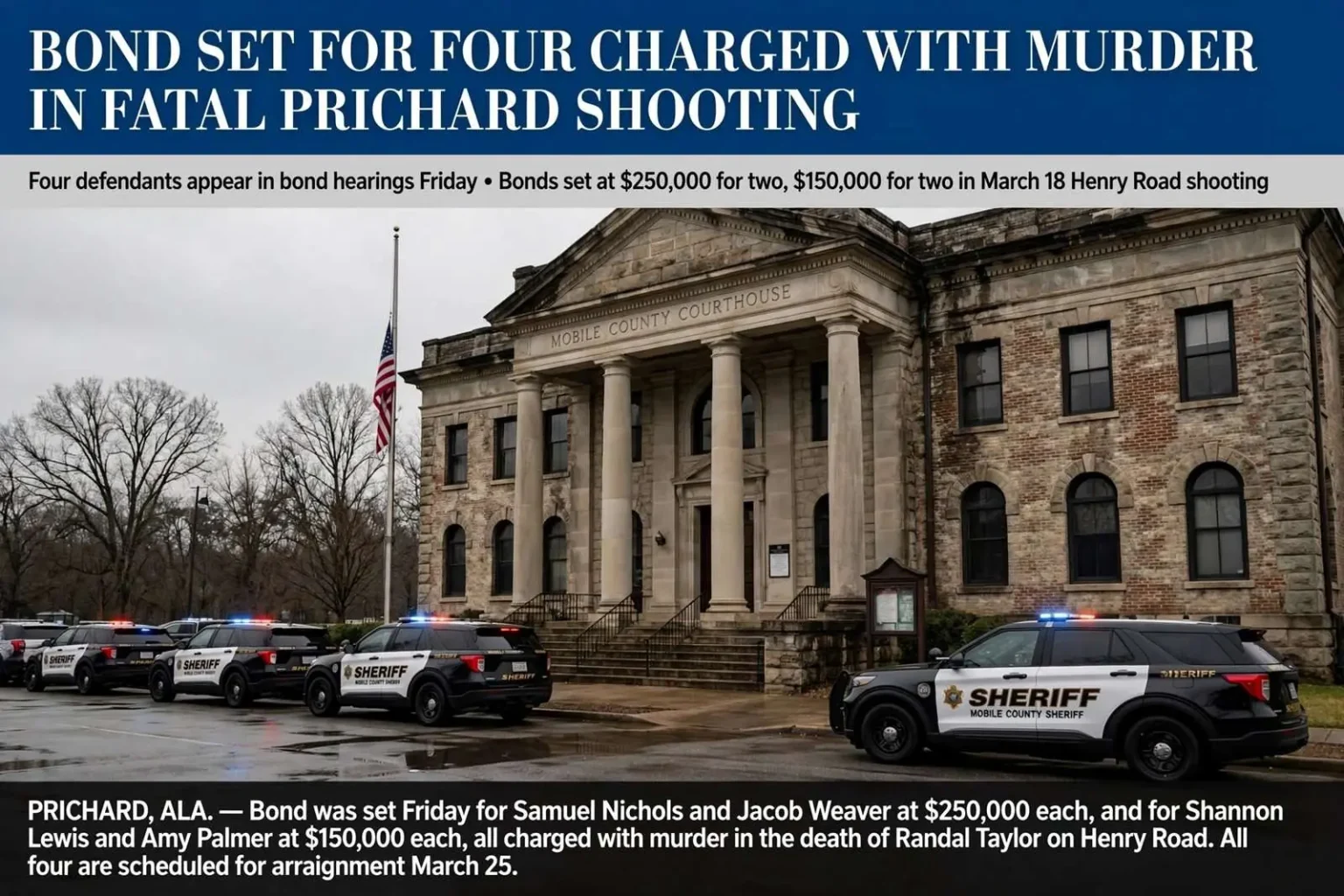
Bond hearings were held Friday for the four people charged with murder in a fatal shooting earlier this week in Prichard, according to the Mobile County District Attorney’s Office.
Bond was set at $250,000 each for Samuel Nichols and Jacob Weaver, and $150,000 each for Shannon Lewis and Amy Palmer.
All four are charged with murder in the death of Randal Taylor, who was fatally shot Wednesday, March 18, on Henry Road in Prichard.
The defendants are due back in court March 25 for arraignment, where each will be formally presented with the charge and asked to enter a plea.
The Hearings and the Amounts Set
Bond hearings serve a specific and early purpose in the criminal process: they determine whether a defendant can be released from jail while awaiting trial, and under what conditions. In Alabama, most defendants charged with a felony are entitled to have bond considered, though judges weigh the seriousness of the alleged offense, the evidence presented, any prior record and the question of whether the defendant poses a danger to the community or a flight risk.
The amounts set Friday varied among the four defendants, with Nichols and Weaver each facing bonds of $250,000 and Lewis and Palmer each set at $150,000. Those differences typically reflect distinctions judges identify between defendants — in alleged roles, in criminal history or in circumstances of the case — rather than a single across-the-board figure. The Mobile County District Attorney’s Office participated in the hearings, as it does in bond proceedings for serious charges in the county.
A bond amount is not a sentence, and it does not presume guilt or innocence. It is a financial guarantee meant to ensure that a defendant released before trial returns for every court date. Defendants who cannot post the full amount may work with a bonding company, which posts the bond in exchange for a fee, or remain in custody at Mobile County’s Metro Jail while the case moves forward.
The Fatal Shooting on Henry Road
The charge stems from the shooting death of Randal Taylor on Wednesday, March 18, on Henry Road in Prichard. Prichard police responded to the scene that day, and the investigation into the killing moved with unusual speed from a death investigation to the filing of murder charges against four people within days.
Multiple arrests in a single homicide usually indicate that investigators concluded more than one person was involved in the events surrounding the death — a determination that can come from witness statements, physical evidence or both. Under Alabama law, a person can be charged with murder not only for doing the shooting but for participating in the underlying events that led to a death, which is how several defendants can face the same charge from one incident.
Prichard, a city of roughly 20,000 residents in Mobile County just north of downtown Mobile, has long contended with violent crime concentrated in its residential neighborhoods. The Prichard Police Department investigates homicides with support from regional partners, and the Mobile County District Attorney’s Office prosecutes the cases that result. Taylor’s death added to the toll of gun violence the city has recorded, and the quick arrests offered investigators a path to answers for his family.
What Happens at Arraignment
The March 25 arraignment is the next formal step. At arraignment, defendants appear before a judge, hear the charge read and enter a plea of guilty or not guilty — or, in some cases, stand mute while the court enters a not-guilty plea on their behalf. Almost all defendants charged with serious crimes initially plead not guilty, preserving every option while their attorneys review the evidence.
Arraignment also sets the schedule for what follows: motions, hearings and, eventually, trial. In murder cases, that process typically unfolds over many months. Prosecutors must disclose the evidence they intend to use, defense attorneys file motions that can range from challenges to the arrest to requests for additional investigation, and the court manages a calendar shared with every other case in the county system.
For the family of Randal Taylor, the pace of the court process can be difficult. The hearings that matter to prosecutors and judges are often brief affairs that pass in minutes, while for a victim’s family each appearance represents another step in a long wait for resolution. Advocates for victims’ families in Mobile County regularly note that the judicial system’s schedule rarely matches the emotional timeline of grief.
How Murder Cases Proceed in Mobile County
After arraignment, a murder case in Mobile County Circuit Court moves through a series of predictable stages. The discovery process gives the defense access to the state’s evidence — police reports, witness statements, forensic results and any recorded interviews. Motions filed during this period can shape what a jury ultimately hears, from questions about how evidence was collected to the admissibility of statements made by the defendants.
The District Attorney’s Office will decide whether to present the case to a grand jury if the charges were filed by complaint or affidavit rather than by indictment. In Alabama, a grand jury’s true bill of indictment is required before a felony case can proceed to trial in circuit court. Grand jury proceedings are one-sided by design — the state presents evidence, and the panel decides whether probable cause exists to formally charge.
If the case reaches trial, prosecutors will carry the burden of proving guilt beyond a reasonable doubt, the highest standard in American law. Jury selection, testimony and deliberation in a four-defendant murder trial can stretch for weeks, and judges must work to ensure that each defendant’s representation is not compromised by the shared proceedings. Many multi-defendant cases are resolved before trial through plea agreements, which the state may offer in exchange for testimony or pleaded reductions.
The Meaning of the Bond Amounts
Bond figures of $150,000 and $250,000 place these defendants in the range commonly set for murder charges in Alabama, where the amounts for serious violent felonies routinely reach six figures. For most families, raising that sum without a bonding company is impossible; a bail bond business typically charges a nonrefundable fee — often around 10 to 15 percent of the bond — to secure release.
Judges also attach conditions to release in cases of this kind: no contact with witnesses or the victim’s family, regular check-ins with the court, and surrender of passports or firearms where applicable. Violating those conditions can send a defendant back to jail and result in additional charges. Defendants who are released remain under the court’s supervision until the case concludes.
The different amounts among the four defendants will also shape their situations differently. A defendant facing $250,000 has a higher financial bar to release than one set at $150,000, and defense attorneys may file motions asking the court to revisit bond if circumstances change — a client’s employment, family situation or health can all factor into such requests.
Prichard and the Weight of Violence
The March 18 shooting on Henry Road landed in a community that knows the cost of gun violence well. Prichard’s leaders have repeatedly pointed to economic development, youth programs and improved policing as the city’s answers to violent crime, and community organizations in the city have worked for years to interrupt the cycles that feed it. Each homicide leaves a family mourning and a neighborhood on alert, and the city’s small size means the losses register close to home.
Residents of Prichard often follow these cases closely, from arrest to trial, because outcomes matter to the community’s sense of security. Quick arrests, as happened here within days of the shooting, tend to reassure neighbors that the investigation is moving; the slower rhythms of the court system that follow test that patience. Local news coverage and courthouse watchers in Mobile County track murder cases for years, and the March 25 arraignment will be the first public accounting of where each defendant stands.
For now, the case sits at the beginning of that long road: four defendants, four bond amounts, one charge apiece, and a court date set for late March. Whatever the outcome months from now, the fact that four people stand accused in connection with a single death underscores how much was at stake on Henry Road the day Randal Taylor was killed.
Awaiting the Next Step
Between now and the arraignment, the four defendants will remain in custody unless bond is posted, and their attorneys will begin the work of reviewing what evidence the state has gathered. Family members of the defendants, like the family of the victim, face a legal process that will unfold on the court’s schedule rather than their own. The Mobile County District Attorney’s Office has not indicated whether additional arrests are expected or whether the investigation remains open, and prosecutors typically decline to discuss the evidence in pending cases outside the courtroom. What is public so far is the charge, the bonds and the calendar — and for a community still absorbing the loss of Randal Taylor, that calendar now marks the dates to watch as the case moves toward trial.