Boy Scouts partner with Feeding the Gulf Coast for 13th year of Scouting for Food
The Mobile Area Council, Boy Scouts of America has partnered with Feeding the Gulf Coast for 13 years to collect food donations across four counties.
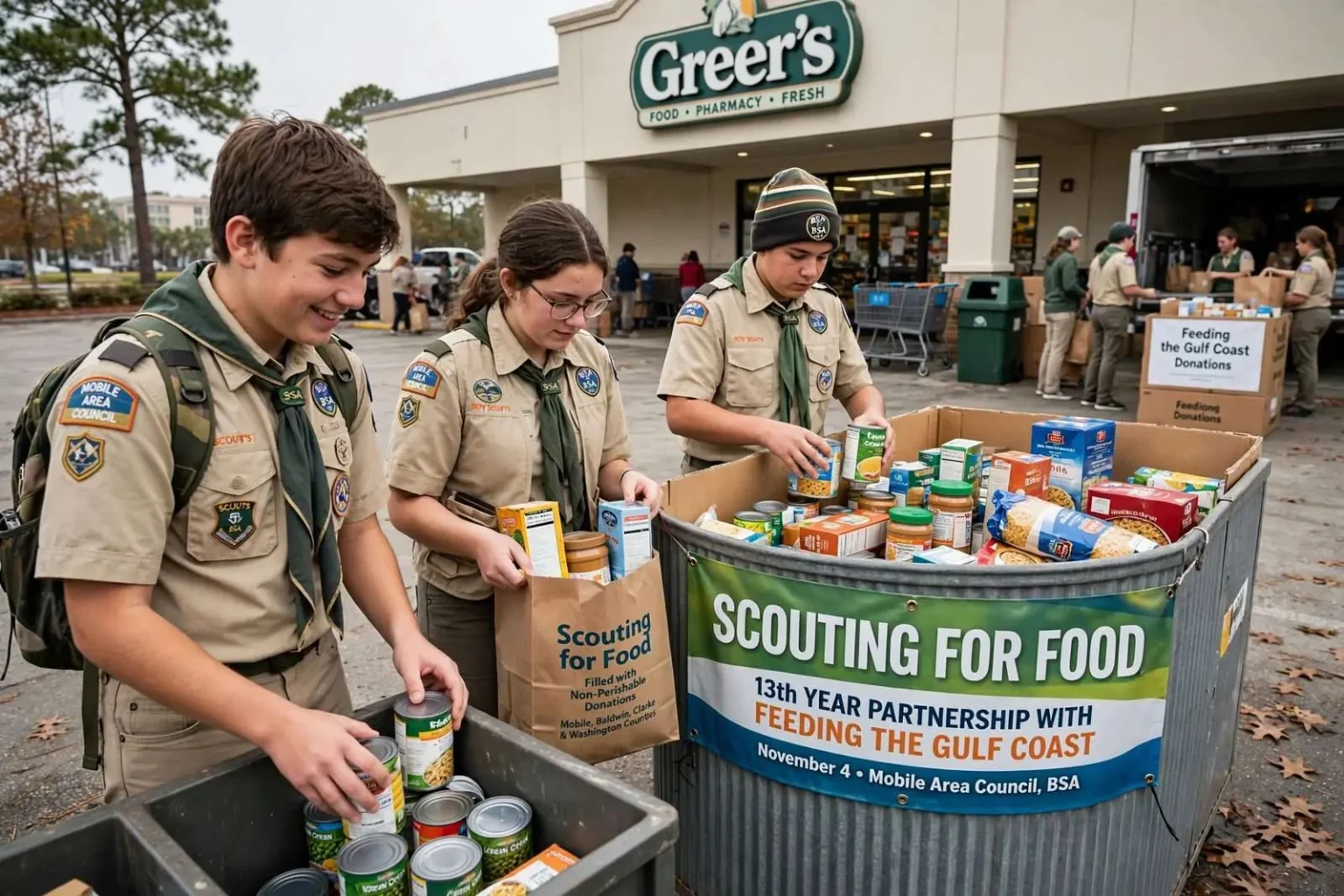
The Mobile Area Council, Boy Scouts of America is partnering with Feeding the Gulf Coast for the 13th consecutive year to fight hunger through its annual Scouting for Food event, one of the largest single-day food drives on the Gulf Coast. The campaign puts hundreds of local Scouts to work across two weekends each fall, collecting shelf-stable groceries that food banks rely on as the holiday season approaches and demand for assistance climbs.
Scouts delivered grocery bags in participating neighborhoods across Mobile, Baldwin, Clarke and Washington counties to collect non-perishable food donations on Saturday, Oct. 28. The bag drop covered thousands of homes in urban, suburban and rural parts of the four-county region, with each bag carrying instructions for residents on what to donate and when to leave it out. Households that received a bag were asked to fill it with canned goods, dry pasta, peanut butter, cereal and other non-perishable staples.
This Saturday, Nov. 4, the scouts will pick up the donations and deliver them to participating Greer’s locations. The food will go to Feeding the Gulf Coast to distribute to families in need. The grocery chain’s stores serve as collection points for the effort, consolidating what individual Scouts gather on their routes so the food bank can retrieve large volumes in a small number of stops — a logistics step that makes a neighborhood-by-neighborhood drive practical at regional scale.
A Lesson in the Scout Law
“The Mobile Area Council, Boy Scouts of America, greatly enjoys helping the community and giving back,” said William Bryant Jr., Scout Executive and CEO of the Mobile Area Council, Boy Scouts of America. “The Scout Law states to help others at all times, and our scouts display that through Scouting for Food and many other service activities.”
The quote captures the dual purpose that has kept the drive running for more than a decade. Scouting for Food is at once a service project and a teaching tool: Cubs, Scouts BSA members and Venturers spend a November morning walking their own streets, knocking on doors and hauling donations, an experience organizers say gives young people a concrete connection to hunger in their own communities rather than an abstract awareness of it. Many participating units return year after year to the same neighborhoods, and some families that donate do so because the same Scout has collected from their porch for several autumns running.
The 13-year run of the partnership with Feeding the Gulf Coast has made the drive a fixture of the regional charity calendar. Feeding the Gulf Coast, the food bank serving south Alabama and neighboring portions of the central Gulf Coast, distributes millions of meals annually through a network of pantries, soup kitchens and shelters, and seasonal drives like Scouting for Food arrive at a critical moment — the weeks between Thanksgiving and the winter holidays, when pantry shelves drawn down through summer and fall need restocking the most.
How to Donate
Those who did not receive a grocery bag but want to donate can drop off non-perishable items at any participating Greer’s location. Organizers emphasize that shelf-stable, unopened items in good condition are most useful, and that donations collected at the stores join everything the Scouts gather door to door.
Residents who missed the pickup weekend but still want to contribute have that standing option through the drive’s collection window, and the food bank accepts contributions year-round for those who miss the campaign entirely. For the Scouts themselves, the final tally from the four-county collection will close out another year of what has become the Mobile Area Council’s signature community service project — a tradition now in its second decade of turning porch steps into collection points for Gulf Coast families in need.
Hunger on the Gulf Coast
The drive takes place against a backdrop of persistent food insecurity in south Alabama. Feeding the Gulf Coast’s service area includes counties where a meaningful share of households report skipping meals or relying on assistance programs, and coastal Alabama’s economy — shaped by tourism cycles, seasonal work and hurricane exposure — produces swings in demand that food banks must absorb without much warning. Canned proteins, peanut butter, rice, pasta and shelf-stable milk are among the most requested items, because they can form the base of complete meals without refrigeration.
Scouting for Food is a national Scouting tradition with roots going back decades, but its local impact depends entirely on the density of participation. The Mobile Area Council’s footprint across Mobile, Baldwin, Clarke and Washington counties includes neighborhoods as varied as midtown Mobile’s historic districts, the growing suburbs of Eastern Shore communities like Daphne and Fairhope, and the small towns of the piney woods in Clarke and Washington counties. That spread means the drive reaches rural families who may live far from a fixed pantry, making the two-weekend structure — drop, then collect — essential to coverage.
Greer’s role as collection hub reflects the grocer’s longtime presence in the market. The regional chain has operated stores across the Gulf Coast for generations and has made community food drives a recurring feature of its community engagement. By hosting the donation points, the stores give donors a convenient destination during normal shopping trips and give the food bank a single, refrigerated-and-dock-equipped pickup location per store rather than hundreds of residential stops.
What Happens to the Food
Once collected, the donations move through Feeding the Gulf Coast’s distribution system. Food bank staff and volunteers sort and inspect the items, box them by category and route them to partner agencies — church pantries, community ministries, senior centers and after-school programs — across the service area. Non-perishable goods collected in a Mobile County neighborhood may end up on a pantry shelf in Washington County within days, depending on where need is greatest, which is why organizers ask for unopened, unexpired items that can be handled at volume.
The timing of the Nov. 4 pickup is deliberate. Food banks nationally see demand peak between Thanksgiving and the new year, and the Scouting for Food haul lands just as that surge begins. For the 13th straight year, the effort links the Scout Law’s promise to help others at all times with a measurable, regionwide outcome — shelves restocked and meals on tables across south Alabama heading into the holidays.
For the Scouts involved, the drive also counts toward advancement and service requirements that run through the Scouting program. Units across the council build their November schedules around the collection weekend, and participation in Scouting for Food is a common thread in the service records of Eagle Scout candidates throughout the area. Organizers have long described the event as the council’s single largest coordinated service activity, bringing together packs and troops that otherwise operate independently across a four-county territory.
The two-weekend format has proven durable for practical reasons. Door-to-door solicitation on a single weekend would ask donors to gather groceries on short notice, and it would leave Scouts collecting and delivering on the same day — a logistical squeeze for units with limited adult drivers and cargo capacity. Splitting the effort gives households a full week to fill their bags and lets the collection day focus purely on pickup and delivery, with Greer’s stores absorbing the volume as the drive’s central funnel.
Community food drives of this kind also carry an economic logic for the food bank itself. Every pound of food donated locally is product Feeding the Gulf Coast does not have to purchase or divert from bulk sourcing, stretching the organization’s budget further at a time of year when freight and holiday distribution costs climb. Food drives likewise supply variety — the brand-name and donated items that pantry clients often cannot get through standard bulk channels — which is why food bankers consistently describe local drives as complementing, not duplicating, their wholesale supply pipelines.
As the Nov. 4 pickup approaches, participating units will be watching the weather — a familiar variable for a drive that runs outdoors across four counties — but the structure leaves room for makeup collections where storms interfere. Residents with questions about whether their neighborhood is included, or about which items are most needed, can find details through the council’s announcements and at participating Greer’s stores, where donation collection continues for households that missed the bag drop.
Thirteen years in, the partnership between the Mobile Area Council and Feeding the Gulf Coast has become one of those quiet institutions that the region can measure in a simple way: every November, thousands of porch steps across south Alabama hold a grocery bag, and by the end of a Scout’s Saturday morning, most of them are empty — emptied into store collection points, then onto food bank pallets, then onto the tables of Gulf Coast families who need them.