
BP Says Its Mobile Spill Response Pumped Millions Into Local Real Estate, Labor and Vendors
BP says its Deepwater Horizon response effort based in Mobile has employed thousands of local workers and leaned heavily on local vendors.
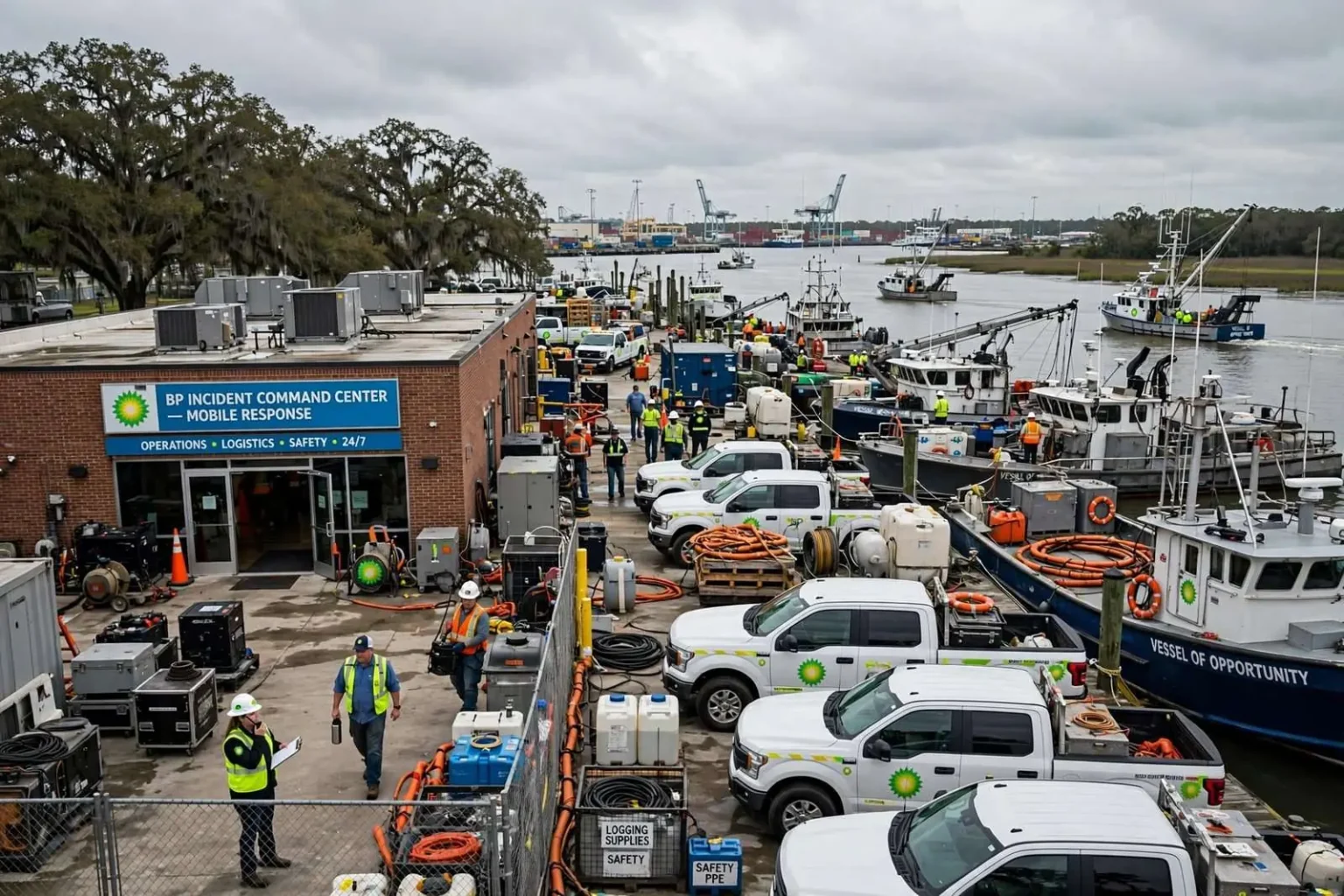
BP told local business leaders this week that its Deepwater Horizon spill-response operations based in Mobile have leaned heavily on local real estate, transportation, vendors and labor, offering some of the company’s most detailed public accounting yet of how the cleanup effort has rippled through the local economy. The figures, shared with an audience of business and civic leaders, sketch the scale of an operation that has quietly become one of the largest economic activities in the area — one nobody wanted, but one that is paying wages and invoices across South Alabama every week the response continues.
According to figures BP provided, the company purchased a building in the Mobile area to serve as an incident command center and spent more than 95,000 labor hours getting that space operational. A facility of that kind does not simply open its doors: turning an ordinary commercial building into the working nerve center of a disaster response means rewiring for expanded communications, installing secure workspaces, bringing in furniture, computers, radios and map systems, and staffing it around the clock. The labor-hour figure captures the combined effort of contractors, electricians, technology workers and BP personnel who converted the space into a 24-hour coordination hub for an operation stretching from Mobile Bay to the Louisiana coast.
BP also said it has been spending roughly $125,000 a week just to transport response personnel around the region — a figure that hints at the scale of the logistics operation required to keep thousands of workers moving between staging areas, the coastline and command posts. The transportation bill covers chartered buses, shuttles, vessels and vehicle fleets that move crews from hotels and staging sites to dockside operations, and it recurs every week regardless of how much oil is actually being recovered on a given day.
More than 5,000 local workers
BP said more than 5,000 area residents have been put to work through the response, spanning a range of roles: staffing the incident command center, crewing vessels of opportunity — the program that pays local boat owners and fishermen to assist with response work — deploying containment boom, running onshore cleanup crews, and operating skimming operations offshore.
The vessels-of-opportunity program has been among the most closely watched pieces of the response because it directly reaches the people whose livelihoods were hit first. Commercial fishermen, charter captains and oyster harvesters whose fishing grounds were closed by the spill have been able to put their boats to work as lookouts, boom tenders and skimming support, drawing day rates for themselves and their crews. For a seafood industry that suddenly had no product to bring to dock, the program turned boats that were sitting idle into working assets again.
Onshore, the hiring has reached further into the community than many residents expected. Cleanup crews, safety monitors, logistics clerks, warehouse staff and drivers have all been drawn from the local labor pool, either directly or through contractors layered between BP and the workers. The boom deployment effort alone — unrolling, anchoring and maintaining miles of floating containment barrier along bays, bayous and beachfronts — is repetitive, physically demanding work that requires large crews and constant maintenance, since boom must be cleaned, repositioned and replaced as tides and weather move it.
What the numbers mean for the economy
The company’s figures were framed as evidence that, whatever frustrations residents and business owners have voiced about the broader claims process, the spill response itself has functioned as a significant, if unwelcome, local employer and buyer of local services. The distinction BP was drawing is an important one in coastal Alabama. Claims payments — the checks meant to compensate businesses for lost income — have been slow, contested and widely criticized, leaving shrimpers, hotel operators and restaurateurs frustrated. Spending on the response, by contrast, flows immediately: a boat owner hired for a week of boom work is paid, a hotel renting rooms to response crews is paid, a gas station selling fuel to a vehicle fleet is paid.
That spending reaches sectors of the economy that visitors and even locals rarely associate with an oil spill. Real estate brokers arranged the leases and the purchase of the command facility. Heavy equipment dealers, industrial suppliers, laundries, catering companies and security firms have all found work in the response’s supply chain. In a region where tourism and seafood anchor the economy, the response has temporarily created a third pillar made of cleanup wages and logistics contracts — an artificial economy that everyone involved understands cannot and should not last.
The wages flowing into the community have been visible in everyday ways. Restaurants near staging areas have served shift workers at odd hours. Rental housing has tightened in some neighborhoods as out-of-town specialists and contractors arrive. Boat ramps and marinas that normally host fishing traffic have been busy with response vessels instead. Business leaders hearing BP’s presentation were weighing exactly these effects — real money flowing now against the longer-term question of what the spill does to the region’s brand and its seafood and tourism seasons.
The claims-process backdrop
BP has faced sustained criticism over the pace and fairness of its damage-claims payments to businesses along the Gulf Coast, a separate track from the response-related spending BP highlighted in Mobile. Business owners who filed claims have described long waits, repeated documentation demands and uncertainty about whether their losses qualify, while the spill itself continued to shut down fishing waters and scare off coastal visitors. The frustration has played out at public meetings and in the press, and it forms the political backdrop against which BP’s local-spending message landed.
Company officials have walked a careful line in presentations like this one. The response-spending figures are meant to show good faith — that BP is investing in the communities most affected and hiring locally wherever possible. Critics respond that response work is a legal obligation, not a gift, and that wages paid to clean up a disaster do not offset the losses of businesses whose customers disappeared. Both things can be true at once, which is precisely what makes the public accounting of these numbers so sensitive.
For the workers and vendors in the room, though, the arithmetic is more immediate. A deckhand earning response wages can pay a rent that a closed oyster season could not cover. A fabricator supplying boom anchors has kept employees on payroll through a season that would otherwise have been lean. The economic story of the spill in Mobile is therefore not a single narrative of loss or rescue, but a tangle of both running side by side.
How the response is organized
The structure BP described to business leaders mirrors the standard architecture of a major incident response under the national system for oil spill coordination. An incident command center serves as the single point where operations, planning, logistics and finance sections coordinate, pulling together BP employees, government observers from state and federal agencies, and hundreds of contractors. Decisions about where skimmers work offshore, where boom is placed in the bays and where cleanup crews report each morning all flow from that one facility, which is why the building itself — and the 95,000 labor hours spent readying it — became such a central piece of the Mobile operation.
Mobile’s role in the response grew out of geography. The city’s port, its industrial waterfront, its concentration of marine contractors and its position within driving distance of the hardest-hit coastline made it a natural staging ground. Vessels load out from area docks, workers board buses before dawn for the trip to the coast, and supply trucks move south on the interstate in a daily rhythm that has reshaped traffic patterns at the State Docks and along the working waterfront.
The scale also explains the transportation figure. An incident command operation coordinating thousands of workers cannot rely on personal commuting; crews rotate in shifts around the clock, many from out of town and without their own vehicles in the area, and boats leaving on tide-dependent schedules cannot wait for a late van. Hence a recurring weekly bill of roughly $125,000 simply to move people — a cost line that would have been unimaginable in Mobile before the spill and that has now become routine bookkeeping.
What comes next
It remains to be seen how long the current scale of local hiring and spending will continue as cleanup work evolves. Response operations naturally rise and fall with conditions: skimming depends on where oil is found, shoreline crews follow the tide of incoming contamination, and boom comes down as waters reopen. Each de-escalation trims the workforce and the contracts, and every worker hired into the response knows the job has an ending written into its purpose. The hope among business leaders is that the wind-down is gradual enough for workers and vendors to adjust; the fear among the same people is that a fast drop in response activity will leave a hole just as the region is still calculating what the spill cost it in tourism and seafood sales.
For now, the incident command operation in Mobile stands as one of the more visible economic byproducts of the spill response in South Alabama. The purchased building, the thousands of local hires, the chartered buses and the vessels-of-opportunity fleets together represent a massive, temporary injection into the local economy — one that BP presented to business leaders as proof of its local commitment, and one that those leaders received with a mixture of appreciation for the wages and lingering frustration over the losses the wages cannot replace.
What happens after the response stands down will shape the region far longer than the response itself. The fishermen who crewed recovery vessels will return to waters whose productivity is still uncertain. The hotels that filled with response workers will court tourists back to beaches that may or may not draw them. The vendors who built spill-response capacity will look for other customers or close it down. The figures BP shared this week capture where the economy stands in the middle of the crisis; the next set of numbers, whenever they are tallied, will tell the harder story of what Mobile and the coast were left with once the boom came ashore for the last time.