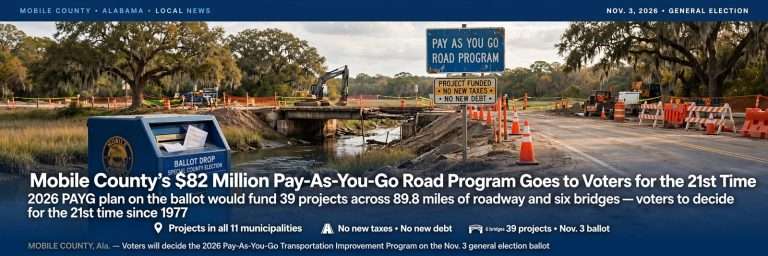
BP to Invest $16 Million in Coastal Alabama Tourism Recovery After Oil Spill
Governor Robert Bentley announced BP would spend $16 million over two years to promote tourism in Baldwin and Mobile counties after the oil spill.
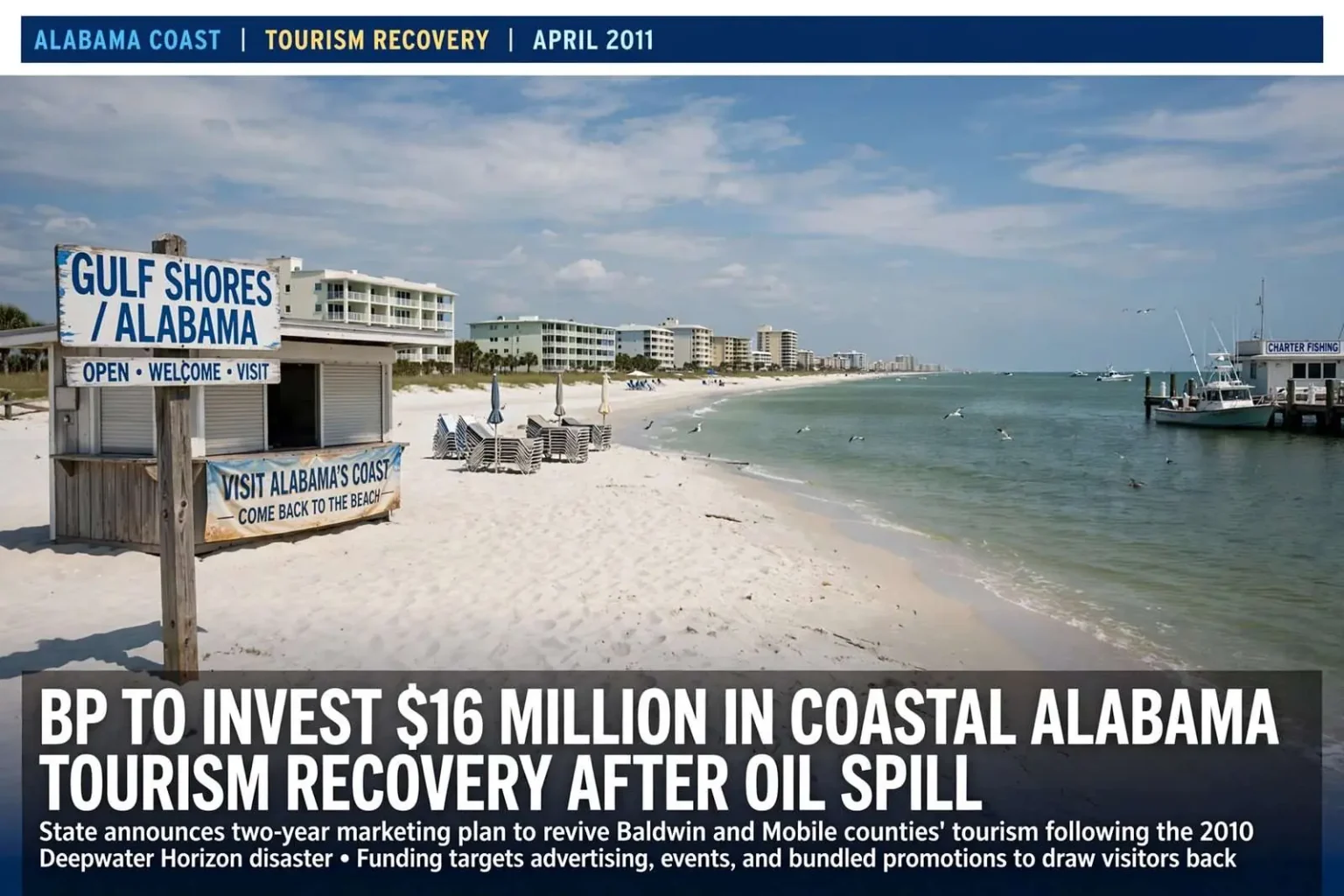
In April 2011, Governor Robert Bentley announced that BP would spend $16 million over two years on tourism promotion projects in coastal Alabama, marking a significant step in the region’s economic recovery following the devastating 2010 Deepwater Horizon oil spill. The announcement represented one of the most tangible recovery measures to reach the Gulf Coast in the year after the spill, directing BP money straight into the industry that had absorbed some of the disaster’s steepest economic losses.
The Deepwater Horizon disaster began with the April 20, 2010 explosion of the drilling rig in the Gulf of Mexico and developed into the largest marine oil spill in history. As oil moved toward the northern Gulf coastline through the summer of 2010, images of oiled beaches and closures spread nationally, and would-be visitors canceled trips across the region — including along Alabama’s beaches, which had spent decades building one of the state’s most important tourism economies. By the time Bentley made the announcement, coastal businesses had endured a season of lost bookings, empty condominiums, and quiet restaurants.
The funding was specifically designated for Baldwin and Mobile counties, the two coastal Alabama counties that suffered the steepest tourism losses in the wake of the spill. The grant aimed to draw visitors back to the Gulf Coast through a combination of advertising campaigns, bundled attraction and event tickets, and concert promotions. Together, those approaches attacked the problem from several directions at once: advertising to rebuild the region’s image, packaged deals to lower the cost of a visit, and events to give travelers a reason to come.
“Alabama was hardest hit of all the Gulf Coast states by last year’s BP Oil Spill,” Bentley said in announcing the approved projects. “Alabama will use these funds to promote tourism to our Gulf Coast communities so that we can begin to recoup the losses suffered since the disaster.”
Targeting the Hardest-Hit Counties
Baldwin and Mobile counties anchor Alabama’s coastal tourism economy. Baldwin County alone takes in Gulf Shores and Orange Beach, the sugar-sand beach communities that draw the bulk of the state’s leisure visitors, along with Fairhope, Foley, and the growing corridor along the Baldwin County portion of the Eastern Shore. Mobile County brings the historic downtown district, the USS Alabama Battleship Memorial Park, Bellingrath Gardens, and the convention traffic that fills the city’s downtown venues.
The spill’s economic shadow fell across all of them. Beach rentals in south Baldwin County saw waves of cancellations in the summer of 2010, charter fishing operators sat at the docks during closures, and attractions inland felt the pullback as fewer visitors came to the coast at all. State and local officials spent much of the year pressing BP for compensation and recovery dollars, and the tourism promotion grant announced by Bentley was part of that broader reckoning.
The $16 million commitment, spread over two years, gave the region something it had lacked since the spill: a sustained, funded marketing campaign rather than a one-time burst of advertising. Tourism officials have long argued that recovery marketing works only when it is sustained — travelers book trips months in advance, and a single season of ads cannot rebuild a year of lost momentum.
Administration and Oversight
Lee Sentell, Director of the Alabama Tourism Department, was tasked with administering the grant funds. The Alabama Coastal Development Commission was charged with developing, implementing, and planning the tourism promotion program while advising Sentell on how best to deploy the resources.
The arrangement put the state’s tourism agency in charge of the money while giving a coastal commission — a body whose members came from the affected communities themselves — a decisive voice in how it was spent. The structure reflected a lesson learned from earlier disaster recovery efforts: recovery dollars spent without local input often miss the mark, while projects chosen by people who know the local industry tend to deliver more lasting value.
Sentell emphasized that the commission took a careful, methodical approach to selecting projects. “We received numerous requests and spent many weeks working through them to ensure that the event or project met the terms of our tourism agreement and would be the best use of the funds to bring more tourists to Mobile and Baldwin Counties,” he said, adding that a regional advertising strategy would benefit both counties.
That regional framing mattered. While the beaches of south Baldwin County generate the largest share of Alabama’s tourism revenue, officials have long worked to spread visitors across the coast — sending beachgoers to Bellingrath Gardens, the history museums of Mobile, and the shops of Fairhope, and directing convention and business traffic toward the coast’s full range of offerings. A two-county advertising strategy aimed to make the recovery a shared one rather than leaving individual communities to market themselves alone.
The Advisory Commission
The Alabama Coastal Development Commission that vetted and approved the projects included representatives from across the coastal region’s tourism and business sectors. Members included Marion Laney of the West Bay and Gulf Coast Tourism Council, William E. Barrick of Bellingrath Gardens, Baldwin County Probate Judge Tim Russell, Herb Malone of the Alabama Gulf Coast Convention and Visitors Bureau, Melissa Morrissette of the Mobile Area Association of Realtors, and Sheila Hodges of Meyer Real Estate.
The composition told the story of the region’s visitor economy in miniature. Barrick led Bellingrath Gardens, the 65-acre estate attraction along the Fowl River that has drawn generations of visitors to its azaleas, roses, and Christmas lights. Malone headed the Gulf Coast Convention and Visitors Bureau in Gulf Shores, the front line of the beach market that took the most visible hit from spill-related cancellations. Hodges’ Meyer Real Estate was one of the largest vacation rental operations on the coast, a sector that saw bookings evaporate in the weeks after the spill began.
Russell, the Baldwin County probate judge, brought county government’s perspective, while Morrissette represented the real estate industry on the Mobile side of the bay and Laney spoke for tourism councils serving the western reaches of the coast. Together, the members spanned attractions, rentals, lodging, government, and marketing — the stakeholders with the most direct stakes in getting visitors back.
A body drawn that broadly also served a public-confidence purpose. In the months after the spill, coastal residents watched closely how every BP dollar was spent, wary of funds that might be consumed by administration or diverted from the hardest-hit communities. A commission of local industry leaders publicly vetting each project gave the process a measure of transparency that officials hoped would sustain support for the broader recovery effort.
What the Money Bought
The approved mix of advertising campaigns, bundled tickets, and concert promotions reflected the tactics tourism officials consider most effective after a perception crisis. Advertising campaigns work on the fundamental problem — convincing travelers the beaches and communities are open, clean, and welcoming. Bundled attraction and event tickets lower the cost of a trip and push visitors toward more stops, spreading dollars across businesses that might otherwise see none. Concert promotions create news and give travelers a dated reason to book now rather than someday.
Each funded project had to clear the terms of the tourism agreement, a bar Sentell described as the commission’s guiding test: would it bring more tourists to Mobile and Baldwin counties? Requests outnumbered the available funds, and the weeks of vetting produced a slate of projects the members believed would move the visitor numbers most directly.
The timing was as important as the amount. The approved funds were expected to be dispersed through early 2012, providing a sustained boost to the region’s tourism marketing efforts during a critical period of recovery. That schedule carried the campaign through the 2011 peak season, the fall event calendar, and the critical spring-booking window when families plan their summer vacations — the stretch during which a lost season is either won back or repeated.
Tourism’s Stakes on the Alabama Coast
Tourism ranks among Alabama’s largest industries, and the coast generates an outsized share of it. Baldwin County’s beach communities alone account for a large portion of the state’s lodging tax collections, and the industry supports thousands of jobs — from hotel and restaurant workers to charter captains, attractions staff, and the real estate and rental offices that manage the coast’s vacation inventory. When visitors stay away, the losses ripple quickly through paychecks and municipal budgets that depend on lodging and sales tax receipts.
That is why state officials framed the BP grant as economic recovery rather than marketing as usual. Bentley, who took office in January 2011 after campaigning on jobs and economic growth, made the coastal recovery a visible priority in his first year, and the tourism announcement gave his administration a concrete, funded answer to the question of how the coast would climb back.
The grant also complemented the other recovery channels running in parallel — BP’s compensation claims process for businesses and individuals, early restoration discussions between the company and the Gulf states, and local fundraising and promotion efforts. Marketing dollars could not restore a lost summer, but they could shorten the distance back to normal booking levels, and faster recovery meant smaller cumulative losses for the region’s economy.
For the businesses along the coast — from the condominium towers of Gulf Shores to the restaurants of Dauphin Street — the announcement was a signal that the state intended to fight for the visitor base, and that the resources to do it were finally in hand.
A Test Case for Gulf Recovery
The Alabama tourism grant became an early template for how BP money could be deployed at the state and regional level, ahead of the much larger restoration funds that would flow to the Gulf Coast in the years that followed. The spill’s aftermath ultimately produced billions of dollars in settlements and restoration commitments under the Clean Water Act and related agreements, but those dollars moved slowly through legal processes. The tourism promotion grant, by contrast, reached the ground quickly and did its work within a two-year window — exactly the kind of speed that businesses fighting for survival needed.
Tourism officials in other Gulf states pursued similar promotion campaigns with spill-related funds, and the collective effect was a region-wide effort to reclaim the image of Gulf beaches in the national imagination. Alabama’s portion, channeled through Sentell’s department and the coastal commission, kept the state competitive within that effort rather than ceding the recovery to better-funded neighbors.
The commission model also left a lasting mark. Bringing attraction directors, rental operators, tourism councils, and county government to one table to vet projects became the working pattern for subsequent rounds of coastal funding, deepening the relationships between Mobile and Baldwin County interests that would carry into later restoration planning.
Looking Back From the Recovery
Measured against the fear that gripped the coast in 2010 — the worry that visitors would never come back in the same numbers — the recovery that followed the 2011 season stood as a validation of the promotion strategy. Bookings returned, attractions drew crowds, and the coast’s visitor economy resumed the growth that had made it one of Alabama’s most reliable economic engines.
The $16 million commitment did not accomplish that alone. It worked alongside the resilience of coastal operators, the loyalty of returning visitors, and the natural draw of 32 miles of beaches, a historic port city, and the attractions in between. But officials involved at the time consistently credited the funded campaigns with shortening the recovery — with getting the message out, early and repeatedly, that Alabama’s Gulf Coast was open for business.
For the two counties named in the grant, the April 2011 announcement remains a marker in the spill’s timeline: the moment recovery shifted from waiting on compensation to actively marketing the coast’s way back. The funds were expected to be dispersed through early 2012, and by the time the last of them was spent, the hardest-hit counties were well into the work of rebuilding the visitor base that sustains them — one advertising campaign, bundled ticket, and concert at a time.