
Breeding Herd of Manatees Spotted Mating in Dog River Near Mobile
A breeding herd of 8 to 10 manatees has been spotted mating in Dog River near Mobile, Alabama, including a tagged manatee named Bama first tracked in 2009.
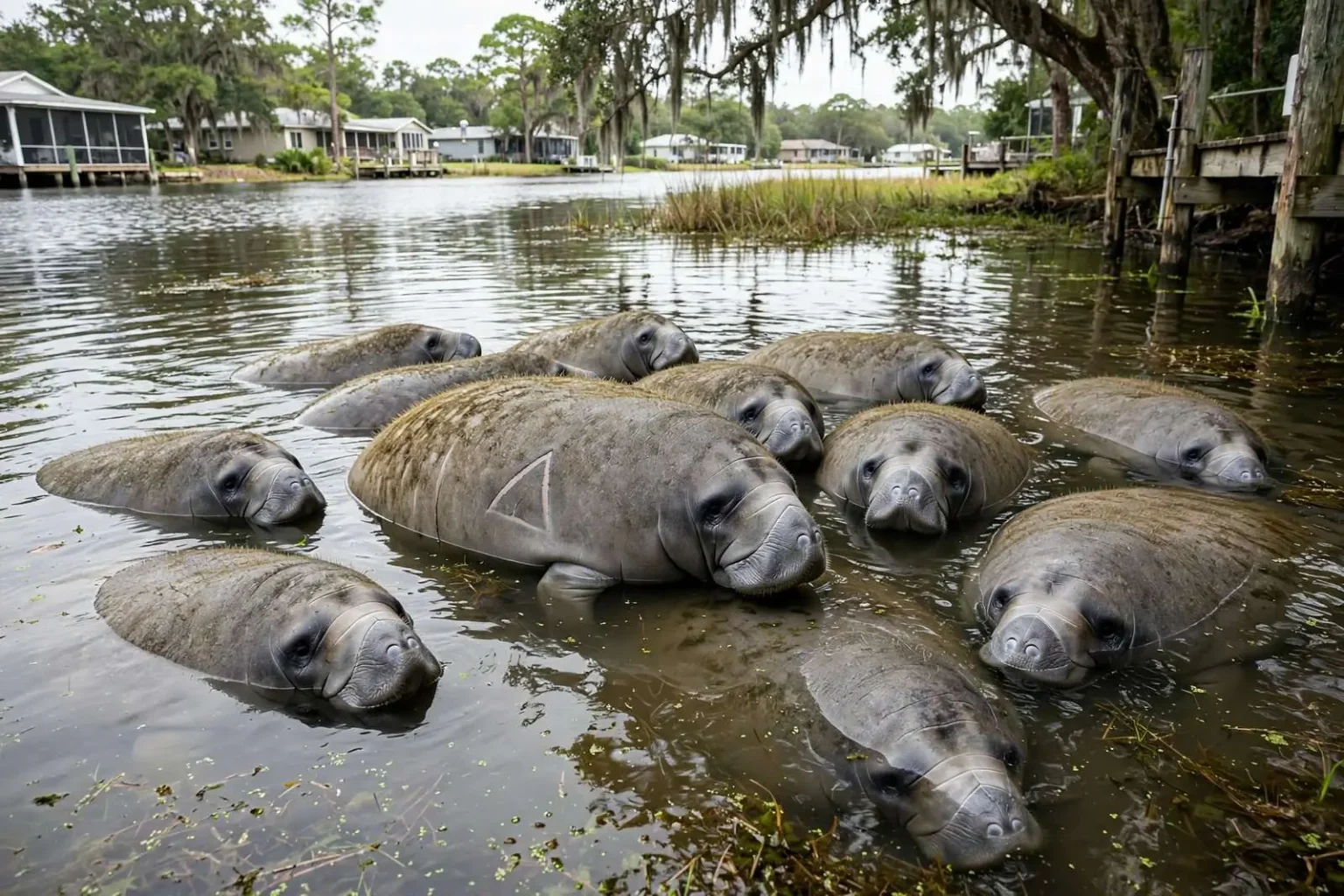
Residents along Dog River in Mobile have been treated to an unusual sight this season: a breeding herd of eight to 10 manatees that has settled into the waterway and stuck around far longer than the gentle marine mammals typically do. The group’s extended stay has turned the creek into a living classroom for the neighborhood and a useful data point for the scientists tracking manatee movements along the Gulf Coast.
Stephanie Eades Williamson, who has lived on Dog River for more than 19 years, says the Manatee Sighting Network helped her identify the group as a breeding herd. “Usually they are just traveling through and we see maybe four or five at a time,” Williamson said. “This is different — in large numbers as well as how much time they are spending.”
Manatees do pass through Mobile Bay’s tributaries regularly, but lingering groups are a different phenomenon. A breeding herd behaves differently from traveling animals: it stays put, moves slowly in a tight area and draws attention to itself simply by being visible day after day. For riverside residents accustomed to brief glimpses of one or two manatees, a weeks-long residency by a group of nearly a dozen is genuinely new.
A well-known manatee named Bama
Elizabeth Hieb with the Manatee Sighting Network says the organization believes the herd centers on a focal female surrounded by male suitors, a classic mating formation. In manatee breeding behavior, a female in estrus is followed by several males for days at a time, and the group moves together through the waters she chooses until the mating period passes.
Based on photos and videos submitted by residents, the network identified the focal female as a well-known manatee named Bama. “Bama has a really distinct triangular scar on her left side,” Hieb said. “We know her quite well. She is the first manatee that our program ever tagged in Alabama waters back in 2009.”
That history gives the Dog River gathering a significance beyond a single neighborhood’s excitement. Bama has been part of Alabama’s manatee research record since the network’s earliest tagging work in state waters, and identifying her at the center of a breeding herd links years of monitoring data to a real, observable event in a Mobile waterway.
Why the sighting matters
Manatees remain a conservation concern across their range, and Alabama sits at the edge of it. The animals migrate into the state’s coastal waters, bays and rivers during the warm months, feeding on the vegetation that grows in places like Mobile Bay’s tributaries. Documented breeding activity in an Alabama river strengthens the case that the state’s waters are not merely a corridor but usable habitat.
The Dog River group also demonstrates the value of resident reporting. The identification of Bama came from photos and videos submitted by people who live on the water, not from scientists on the scene. Networks like the Manatee Sighting Network depend on exactly that flow of observations from the public to track animals that spend much of their time below the surface.
About the Manatee Sighting Network
The Manatee Sighting Network, based at the Dauphin Island Sea Lab, tracks manatee sightings across Alabama and the Mississippi Gulf Coast, collecting reports from boaters, residents and shoreline visitors. The organization’s database has built a picture of how manatees use the northern Gulf Coast, a region that was long considered marginal habitat but has hosted more manatee activity as researchers have looked for it.
Elizabeth Hieb and the network’s staff turn each report into data: location, date, group size and, when photos allow, the identity of individual animals. Scars from boat strikes, which most adult manatees carry, serve as natural identifiers, allowing researchers to recognize the same animal year after year. Bama’s triangular scar on her left side has made her one of the program’s most recognizable individuals since 2009.
That long record matters for conservation. Knowing which waterways manatees use, when they arrive and how long they stay helps agencies protect warm-water refuges, manage boat traffic and respond when animals are injured. Every confirmed sighting, including the Dog River breeding herd, adds to that picture.
What to do if you spot a manatee
The Manatee Sighting Network encourages anyone who sees a manatee to report it and give the animal space. Reports can be made by calling the 24-hour line at 1-866-493-5803, submitting a form at manatee.disl.org, or emailing [email protected]. The same phone line should be used to report injured, stranded or deceased manatees in Alabama and Mississippi.
For residents watching the Dog River herd, the guidance is simple: observe from a distance. Manatees are protected by law, and harassment, feeding, chasing or blocking their movement is prohibited. Boaters in the area should slow down, post a lookout and follow posted speed zones, since boat strikes are the leading human threat to the species. A group of animals occupied with breeding should be left entirely to their business.
Poiler-free observation still produces valuable science. A photo taken from the shore or a dock, showing scar patterns or distinguishing features, is exactly the material the network used to identify Bama, and every additional report from Dog River and surrounding waters helps confirm how long the herd stays and where it goes next.
Dog River and its watershed
Dog River flows into the western side of Mobile Bay, draining a watershed that includes much of the city’s western neighborhoods before reaching the bay’s brackish waters. The creek and its tributaries are lined with homes and docks, which is why its wildlife draws such close attention from residents: people on the river see its changes daily.
The waterway supports the submerged vegetation and warm, sheltered waters that manatees look for during Gulf Coast summers. Mobile Bay and its rivers have appeared more often in manatee sightings in recent years, and the network’s reporting system has documented animals in locations across the Alabama coast. A breeding herd choosing to settle in Dog River suggests the habitat there met the group’s needs this season.
For the neighborhoods along the river, the herd’s residency has been a source of pride as much as curiosity. Longtime residents like Williamson, with nearly two decades on the water, provide the baseline knowledge that makes an unusual event recognizable as unusual, and their reports are what converted a neighborhood spectacle into a documented research observation.
Manatees in Alabama waters
Florida hosts the core of the West Indian manatee population, but the animals have always ranged along the northern Gulf Coast in warm months, and Alabama’s portion of that range has gained attention as sightings have accumulated. Mobile Bay’s rivers, including the Mobile-Tensaw Delta and smaller tributaries like Dog River, offer the freshwater inflow and vegetation the animals seek.
The presence of a breeding herd is a notch beyond ordinary summer sightings. Mating herds form only when conditions support reproduction, and their visibility in an urban-adjacent waterway gives Alabamians a rare chance to see the species’ life cycle up close. The fact that the focal female is a tagged Alabama pioneer from 2009 closes a loop: the program’s first tagged animal in state waters is now documented breeding in the same state.
Researchers will continue watching where the Dog River herd goes when it finally moves on. Manatees typically return to warmer waters as seasons cool, and the network’s sightings data will record the departure as carefully as the arrival. In the meantime, the residents of Dog River have a front-row seat, and the simple acts of reporting and keeping their distance are what let the science and the animals both proceed undisturbed.
How residents identified the herd
The identification process behind the Dog River herd shows how modern wildlife tracking actually works. Residents noticed the group lingering day after day, saw behaviors consistent with breeding activity, and sent photos and videos to the Manatee Sighting Network. Analysts compared the scar patterns in those images against the network’s catalog of known individuals and matched the focal female to Bama, an animal with a documented history in Alabama waters going back more than a decade.
Without resident submissions, the herd might have come and gone as an anecdote. With them, it became a data point: a confirmed breeding herd, in a named Mobile waterway, centered on a known individual, with dates and locations attached. That is the difference between people noticing manatees and science knowing about manatees, and it happened because the people on the river knew where to send what they saw.
Boater awareness during a manatee stay
For the duration of the herd’s visit, boaters on Dog River have a particular responsibility. Mating herds move slowly and stay near the surface, which makes them vulnerable to propellers, and the animals’ focus on breeding activity means they are less likely to avoid approaching boats. Slowing to posted speeds, wearing polarized sunglasses to spot the animals’ shadows and snouts, and giving any visible group a wide berth are the standard recommendations.
The same guidance applies across Mobile Bay’s waterways all summer, not only during a high-profile residency. Manatees surface to breathe every few minutes, often showing little more than a swirl and a snout, and boaters who learn those signs navigate around them naturally. The network’s outreach, and news coverage of events like the Dog River herd, is partly aimed at building exactly that everyday awareness among the region’s boaters.
Residents who want to follow the herd’s story can do so through the network’s public reporting channels, which share confirmed sightings and updates as they come in. The Dog River group’s stay is, for now, one of the more remarkable manatee stories on the Alabama coast this season, and it is still being written one resident report at a time.
What comes after the breeding season
When mating activity concludes, the herd typically disperses. The female moves on with the males following no longer, and the group resumes the solitary or small-group patterns that characterize manatee behavior most of the year. Where Bama and her suitors head next, whether deeper into the Mobile-Tensaw Delta, out through Mobile Bay or along the coast toward Mississippi and Florida, will depend on water temperature and food availability as the season progresses.
The network’s researchers will be watching for her triangular scar in future reports, adding each new sighting to the record that began with her tagging in 2009. For a program built on volunteer reports from the public, a documented breeding herd in Dog River stands as one of the clearest demonstrations yet of what that partnership between scientists and residents can accomplish on the Alabama coast.