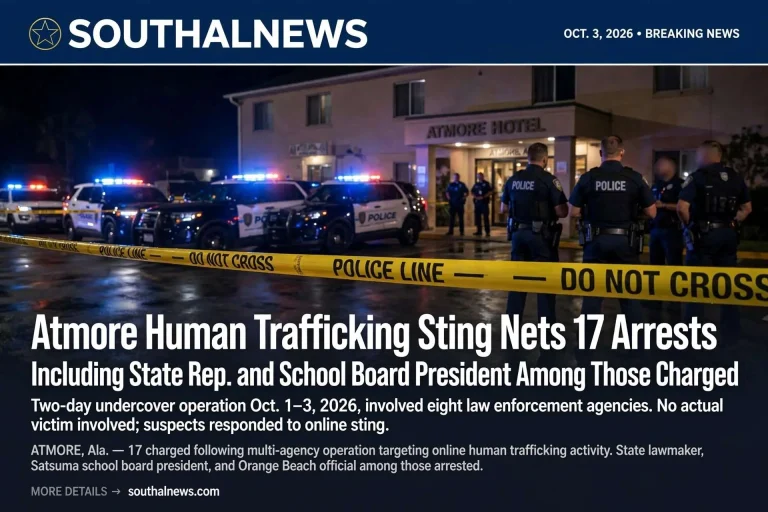
Brewton man dies in single-vehicle crash on U.S. 31
A 20-year-old Castleberry man died when his SUV left the roadway and overturned on U.S. 31 two miles north of Brewton, troopers said.
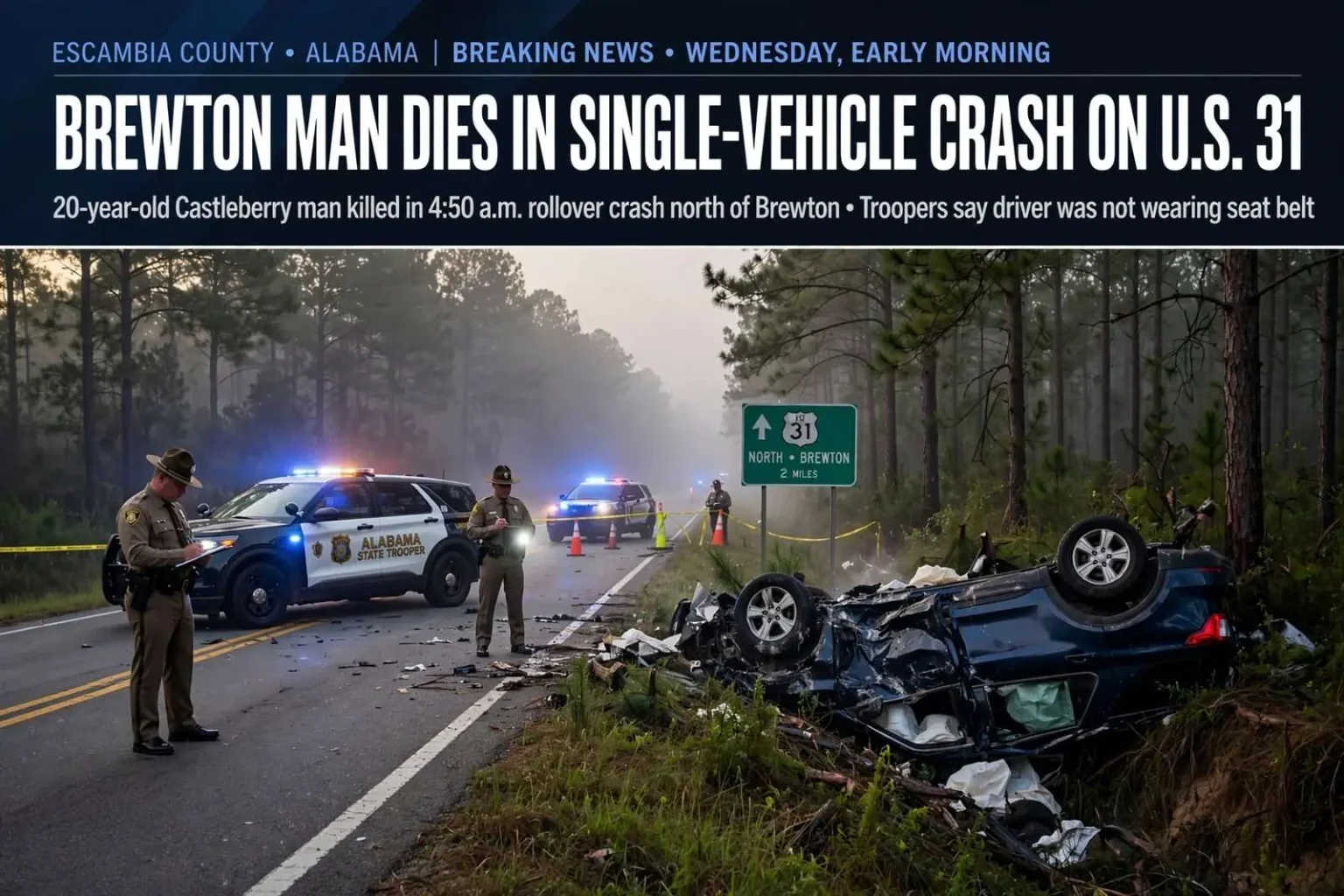
A 20-year-old Castleberry man died in an early-morning crash on U.S. 31 near Brewton, according to Alabama State Troopers. Troopers said Garrett Salter was driving an SUV that left the roadway and overturned about two miles north of Brewton around 4:50 a.m. Wednesday. Investigators said Salter was not wearing a seat belt at the time of the crash.
The wreck occurred along a stretch of U.S. 31 that runs north out of Brewton through rural Escambia County, a corridor that carries a steady mix of commuter traffic, school buses, logging trucks and through travelers between Brewton and communities to the north. At that hour of the morning, traffic on the highway is light, and darkness in the rural stretches of the route can make it difficult for drivers to judge curves, shoulders and changes in the pavement. Troopers did not immediately say what caused the SUV to leave the roadway, and the investigation remained open as officials worked to reconstruct the sequence of events.
Salter was pronounced dead at the scene. Because he was not restrained, troopers noted that the overturning of the vehicle left him with no protection against being thrown around or from the passenger compartment. Safety officials have long emphasized that rollover crashes are among the most dangerous crash types on rural highways, and that belts are the single most effective step a driver can take to stay inside the vehicle when a wreck begins.
What Troopers Do After a Fatal Wreck
Fatal crashes on state highways in Alabama are investigated by the Highway Patrol Division of the Alabama Law Enforcement Agency. When a wreck involves a death, troopers document the scene thoroughly: they measure skid marks and gouges in the pavement, photograph the final resting position of the vehicle, examine the roadway for defects or obstructions, and interview any witnesses who may have been passing through when the crash happened. Investigators also look at the vehicle itself, checking for mechanical issues that could have contributed to the driver losing control.
That work typically takes hours, and it often forces the closure of the affected roadway while it is underway. On U.S. 31 north of Brewton, there are few parallel routes, so closures in this area can push drivers onto county roads until troopers reopen the highway. The findings of the investigation are eventually compiled into a report that may be used by the Escambia County District Attorney’s Office to determine whether any charges are warranted, though in single-vehicle crashes with no other involved parties, the process often ends with the investigative report itself.
The U.S. 31 Corridor Through Escambia County
U.S. 31 is one of the oldest major highways in Alabama, running the length of the state from the Mobile area north through Montgomery and beyond. In Escambia County it serves as a primary link for Brewton, the county seat, connecting the city with East Brewton to the north and, to the south, toward Flomaton and the Florida line. The road passes through a landscape of pine timberland, small farms and scattered residences, and its traffic includes heavy trucks serving the region’s forest products industry.
Sections of the highway near Brewton combine gentle curves with driveways and side-road intersections, and the shoulder areas can drop off quickly in places. Safety engineers have noted for years that rural two-lane and multi-lane highways like this one present elevated risks when drivers run off the road at speed, because there is often little recovery room before the vehicle strikes a ditch, embankment or tree. Overturns like the one troopers described in this crash are a common outcome when a departing vehicle trips over a shoulder or ditch line.
Castleberry and the Community’s Loss
Castleberry is a small Conecuh County town just across the line from Escambia County, a community of a few hundred residents where many families have lived for generations. News of a young resident’s death on a nearby highway travels quickly in towns of that size, and the loss of a 20-year-old is felt across schools, churches and workplaces that knew him. Young drivers in the region frequently commute along U.S. 31 and nearby state routes for work and school, making the corridor a familiar part of daily life for people in both counties.
State troopers asked anyone who may have witnessed the SUV before it left the roadway, or who has information about the crash, to contact the Highway Patrol’s post that covers Escambia County. Even small details from passing drivers, such as the speed or direction of a vehicle moments before a wreck, can help investigators complete their reconstruction.
Seat Belts and Alabama Law
Alabama’s Mandatory Seat Belt Law requires the driver and front-seat passengers of a passenger vehicle to be buckled up, and violations are enforced as a secondary offense, meaning troopers must first stop a vehicle for another reason before citing a belt violation. The state has enforced some form of mandatory belt use since the 1990s, and law enforcement agencies across southwest Alabama participate in periodic high-visibility enforcement campaigns, particularly around holiday travel periods, to remind drivers of the requirement.
The reasons for the law are most visible in exactly the kind of crash troopers investigated near Brewton. When a vehicle overturns, unrestrained occupants are frequently ejected, partially or completely, and ejection dramatically raises the likelihood of fatal injury. Restrained occupants are held within the safety cage of the passenger compartment, where the structure of the vehicle absorbs much of the energy of the rollover. Traffic safety agencies in the state continue to stress that the simple act of buckling up remains the most reliable protection available in a single-vehicle run-off-road crash, regardless of the time of day or the length of the trip.
For parents and guardians in rural counties, troopers also point to the state’s child restraint requirements, which go further than the general belt law and mandate appropriate car seats and booster seats for younger children. Enforcement details and public education programs through the years have aimed at raising belt use rates in rural areas, where usage has historically lagged behind urban parts of the state.
Early-Morning Driving Risks in Rural Alabama
Crashes in the pre-dawn hours carry a distinct set of risk factors that investigators routinely weigh. Fatigue accumulates for drivers who have been on the road since the previous day or who are heading to early shifts, and the body’s natural circadian dip in alertness hits hardest in the hours before sunrise. Darkness removes the long sightlines that help drivers spot curves, animals, debris and slow-moving vehicles, and headlights illuminate only a limited distance ahead. In rural counties, deer and other wildlife are active overnight and frequently cross roadways like U.S. 31, and swerving to avoid an animal is a common trigger for run-off-road wrecks.
Weather can compound these factors in the Gulf Coast region. Fog forms readily over low-lying areas and creek bottoms in Escambia County during the warmer months, reducing visibility further, and leftover moisture from afternoon storms can leave pavement slick at dawn. Troopers do not always release a cause in the immediate aftermath of a fatal wreck, and it can take weeks for toxicology results and vehicle inspections to be completed before a final report is issued.
What Comes Next in the Investigation
Once troopers finish their field work, the case file moves through the standard review process. The vehicle is examined for brake, tire and steering problems, and records such as the SUV’s maintenance history may be checked. Investigators typically await results from the Department of Forensic Sciences before closing out the question of whether a medical condition or impairment played a role. The final crash report will classify contributing circumstances and provide the official account of the sequence of events on the highway north of Brewton.
For the family, the practical steps after such a loss involve funeral arrangements and, in time, obtaining the official crash report from ALEA for insurance and estate purposes. Troopers’ reports in fatal cases are available through the agency once the investigation is complete, and local funeral homes in the Brewton and Castleberry area routinely assist families in requesting the needed documentation.
A Recurring Pattern on Rural Roads
Single-vehicle run-off-road crashes remain one of the most common fatal crash types in Alabama’s rural counties, and Escambia County’s network of U.S. and state highways sees its share each year. Transportation safety officials continue to push countermeasures aimed directly at this pattern: rumble strips along shoulders and centerlines, better signage and delineation on curves, improved shoulder treatments, and targeted enforcement of speed and impairment during overnight hours. Federal safety grants administered through the state help fund both the engineering work and the public awareness campaigns that accompany it.
In the meantime, troopers and county sheriffs’ deputies across the region repeat the same reminders after each loss like this one: reduce speed on rural highways after dark, watch for deer in the early-morning hours, avoid driving drowsy, and make sure every occupant in the vehicle is buckled up before the trip begins. For families in Castleberry and Brewton, this week’s crash on U.S. 31 is a stark local illustration of why those reminders continue.