British True-Crime Series Spotlights Mobile County Detective’s Cold Case Breakthrough
'Evidence of Evil' spotlights how MCSO Det. J.T. Thornton identified Mary Ann Perez's remains 41 years after her 1976 murder near New Orleans.
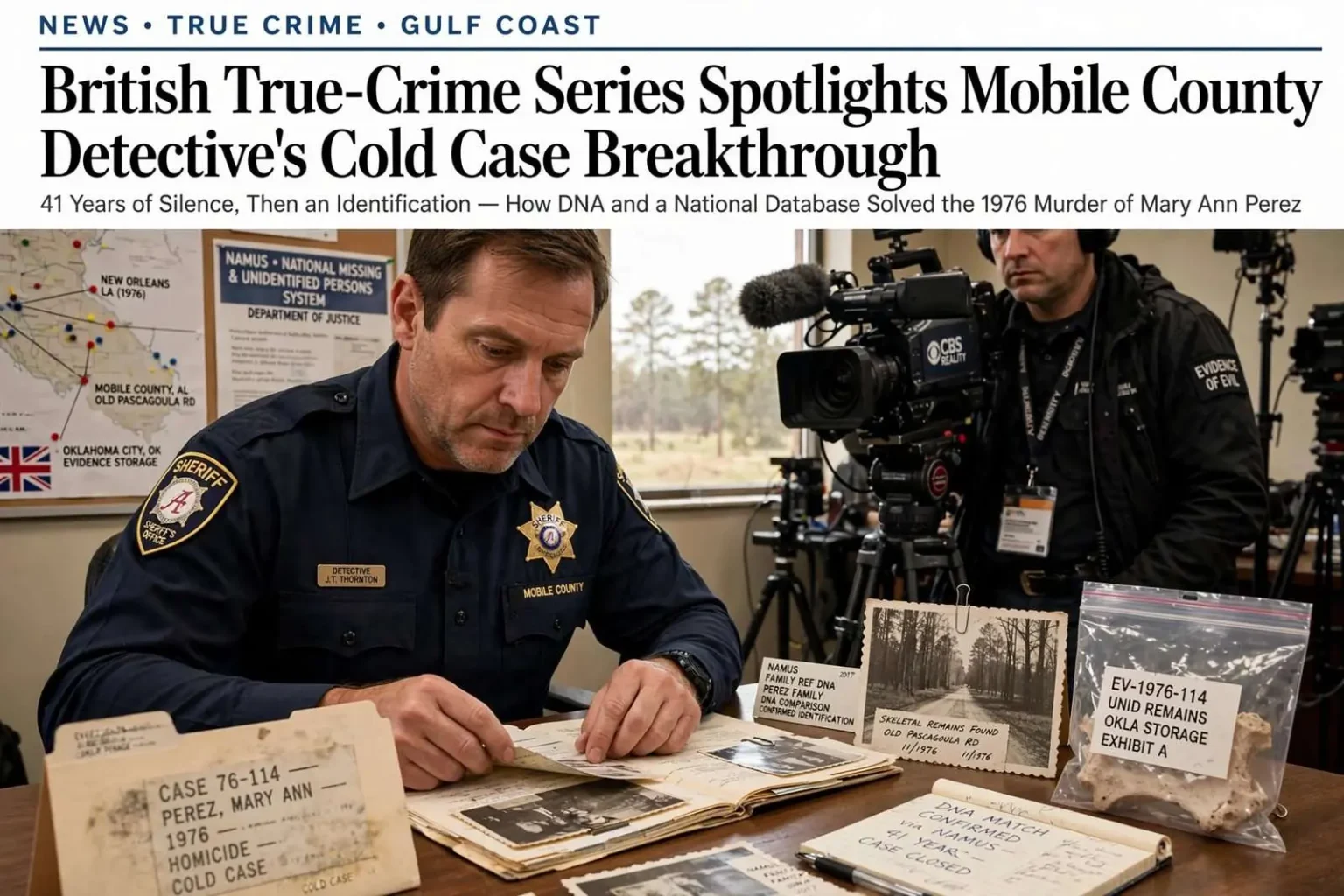
An international documentary crew came to Mobile to tell the story of a Gulf Coast cold case solved after more than four decades — the 1976 murder of Mary Ann Perez. The case was featured on “Evidence of Evil,” a series on the CBS Reality network available on Sky in the United Kingdom and across several European countries. The program brought a British production team to Mobile to interview those connected to the investigation, putting a Mobile County detective’s persistence in front of an international audience.
Producer David Harvey said the program focuses almost exclusively on crimes cracked through modern forensic techniques. The series’ format pairs the human story of victims and their families with the technical narrative of how investigators finally closed cases that had sat cold for decades — advances in DNA analysis, database matching and forensic identification that did not exist when the crimes occurred.
41 Years of Silence, Then an Identification
Perez was killed near New Orleans in March 1976. Husband-and-wife serial killers caught in Kansas later admitted to her murder but could not remember where they had disposed of the body, leaving her family without certainty for decades. That admission — a confession without a body, without a grave, without closure — left the family suspended between hope and grief for more than 40 years, unaware that the answer lay in an unmarked evidence storage facility more than a thousand miles from the Gulf Coast.
The break came when Detective J.T. Thornton of the Mobile County Sheriff’s Office re-examined skeletal remains found off Old Pascagoula Road in November 1976. Thornton connected the remains to Perez, tracked them down in Oklahoma where they had been stored and forgotten for 40 years, collected DNA samples from the Perez family, and ordered testing through the National Missing and Unidentified Persons System in Texas. The identification closed one of the region’s oldest open questions and gave the Perez family the answer that a confession decades earlier could not provide.
Thornton’s work exemplified a quiet revolution in American law enforcement. Detectives across the country have spent recent years reopening unsolved cases by revisiting old evidence files, cross-referencing missing persons reports with unidentified remains and submitting samples for DNA testing that earlier generations of investigators could only dream about. The reexamination of the remains found off Old Pascagoula Road — a rural stretch in western Mobile County near the Mississippi line — began with exactly that kind of records review.
‘No Case Need Go Unsolved.’ Harvey said the long silence surrounding the case made it a natural fit for the show, and praised the broader lesson of the identification. “It shows with modern techniques, no case need go unsolved, particularly if there are samples, bones, traces left behind,” he said. The episode was slated to air first in the UK, with plans to sell it to a U.S. cable network for a 2020 airing.
The System That Made the Identification Possible
The National Missing and Unidentified Persons System, known as NamUs, is a national information clearinghouse funded by the Department of Justice and operated from Texas that ties together the records of missing persons, unidentified remains and unexplained deaths. Before such databases existed, a set of remains found in one state and a missing woman reported in another could remain unconnected forever — the paperwork simply never crossed paths. NamUs, combined with modern DNA testing, is designed to end exactly that kind of invisible gap.
The Perez case illustrated the pipeline in full. Family reference samples — DNA collected from living relatives — allow scientists to make identifications through kinship comparison even when there is no direct sample from the missing person. Once Thornton recovered the remains from storage and obtained family samples, the laboratory work could compare the profiles and confirm what the detective’s documentary research suggested. The testing turned a box of forgotten evidence into a confirmed identification and, at last, a death certificate for a woman murdered in 1976.
The fact that the remains had been stored in Oklahoma for 40 years underscores a chronic problem in American forensics: unidentified remains are frequently held by coroners, medical examiners or universities without ever being entered into national databases. For decades, many jurisdictions had no requirement to do so, and evidence moved, was mislabeled or was simply lost. Reform efforts over the past 20 years have pushed agencies to inventory their unidentified remains and upload profiles, and cases like Perez’s are the reason advocates keep pressing.
The Serial Killers Who Confessed
The husband-and-wife team who admitted to Perez’s murder were part of a grim category of serial offenders who crossed state lines throughout the 1970s, killing across the South and Midwest and claiming victims whose bodies were frequently never found. Confessions from such killers arrived years later, often in negotiations with prosecutors after their capture, and were notoriously unreliable on the central question families cared about most: where. Offenders who killed dozens of times across many states genuinely could not reconstruct where each victim lay, and without a body, authorities had no way to verify the claims.
For the Perez family, the confession was a bitter half-answer — proof of what happened to Mary Ann, but no grave, no remains, no funeral. The identification in Mobile County changed that, connecting the confession to physical evidence and allowing the family to finally mark the loss. Investigators note that cases like this one are precisely why unidentified remains programs matter: a confession alone cannot close a case, but a match in a database can confirm it beyond doubt.
Why a British Crew Came to Mobile
True-crime programming has become one of the most reliable genres in international television, and British-produced series regularly license their episodes to American networks and streaming platforms. “Evidence of Evil” joined a crowded field of documentary series built around forensic breakthroughs, and its producers selected cases that combined a compelling victim’s story with a clear technical narrative — the moment when new science met an old case. A detective in Mobile County who tracked down 40-year-old remains in Oklahoma and matched them through a national database was exactly the kind of story the format was built for.
The international attention also reflected well on the local agency. Cold case work is unglamorous — file boxes, phone calls to distant evidence custodians, paperwork across state lines — and most of it never makes news. Sheriff’s office investigators who reopen decades-old files do so knowing the odds, and the Perez identification gave Mobile County a nationally exportable success story in a genre crowded with failures.
Old Pascagoula Road runs through the rural western edge of Mobile County, an area of woodland, fields and scattered homes near the Mississippi state line. In 1976, the discovery of skeletal remains there generated a report and an investigation, but without identification, the case went into storage — literally, in another state. The location offered no clues then, and it was only the detective’s review that connected the remains to a missing woman from the New Orleans area whose murder had been confessed to in Kansas.
The case’s journey — a Louisiana victim, a Mobile County crime scene, a confession from Kansas, evidence in Oklahoma and testing through a Texas-based system — shows how sprawling cold case investigations become. No single agency held all the pieces, and the identification required one detective willing to chase records across four states. That is the unglamorous reality behind the television version, and it is also the reason such identifications remain the exception rather than the rule.
For Gulf Coast viewers, the episode’s eventual American airing will show a familiar region through an unfamiliar lens: a British documentary crew retracing a 1976 murder from New Orleans to Mobile County, ending with a detective’s files and a DNA match. Harvey’s summary of the lesson — with modern techniques, no case need go unsolved if samples remain — is the message that cold case units across the country have been preaching, and the Perez family’s 41-year wait for an answer is the proof it works.
The Families Left Waiting
Behind every unidentified-remains case stands a family in limbo, and the Perez family’s four decades without an answer reflect an experience shared by thousands of American households. The National Institute of Justice has estimated that tens of thousands of unidentified remains sit in morgues and storage facilities across the country, matched to a comparable population of long-term missing persons — and advocates emphasize that each of those sets of remains belongs to a family still waiting for a phone call like the one the Perez family finally received.
The uncertainty compounds over time. Families of the missing describe decades of unresolved grief — unable to hold funerals, unable to settle estates, unable to stop looking over their shoulder at every unidentified-body news report. When a suspect confesses but cannot say where the victim lies, the family learns how the person died without learning where, an answer that resolves nothing. Only the recovery and identification of remains converts a missing person into a person who died, and gives the family a grave to visit.
Detectives who work these cases describe the archival phase as decisive. The Perez identification began not in a laboratory but in a records search — a detective re-reading a 1976 report and asking where the remains had gone. Evidence custodians in Oklahoma were able to locate the remains because, against the odds, they had been preserved rather than destroyed, a fact that cannot be assumed in cases of that vintage. Countless older cases involve remains that were buried without documentation, cremated or simply misplaced, closing the door on identification forever.
The Mobile County Sheriff’s Office has made cold case review a continuing priority, like agencies across the region, and the Perez identification demonstrated the value of assigning experienced investigators to old files. The office’s jurisdiction reaches from the city’s suburbs to the rural woodlands near the state line, and its case files from the 1970s contain dozens of unexplained deaths from an era when documentation was thinner and science could do far less.
As DNA technology continues to advance — from standard STR comparisons to investigative genetic genealogy, which has in recent years solved cases once thought hopeless — agencies are revisiting files with growing confidence that even minimal biological material can yield an identification. The Perez case, solved through family reference samples and a national database before genetic genealogy became widespread, will likely be followed by many more identifications of remains found on the Gulf Coast, giving other families the answer Mary Ann Perez’s family waited 41 years to hear.