Burning Tire May Have Sparked Building Fire on St. Stephens Road in Prichard
A late-night building fire in the 2300 block of St. Stephens Road in Prichard may have been sparked by a burning tire set in a doorway, an official said.
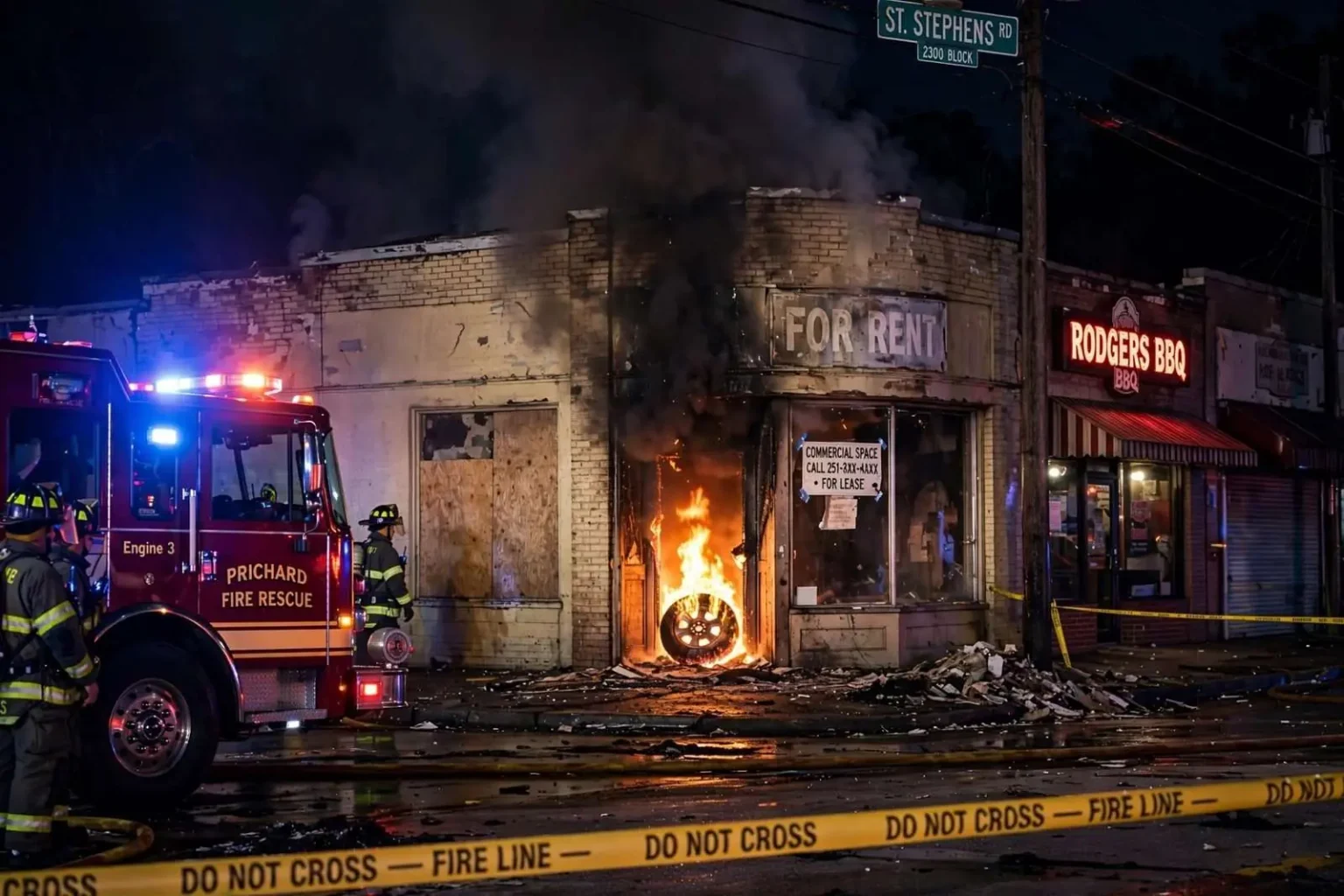
Fire investigators in Prichard are working to determine what started a late-night fire at a building on St. Stephens Road, a blaze that officials believe may have begun with a tire set alight in a doorway.
The fire was reported around 10:30 Friday night in the 2300 block of St. Stephens Road, near Rodgers BBQ, one of the better-known stops along the busy commercial corridor that runs northwest out of Mobile into Prichard. Fire crews arrived to find fire coming from the structure and worked to keep it from spreading to neighboring buildings along the strip.
An official at the scene said it appeared someone had set a tire on fire in the doorway of the vacant side of the building, possibly igniting the structure itself. The building appeared to be available for rent and was unoccupied at the time of the fire, which meant no residents were inside and no displacements resulted from the blaze.
No injuries were reported, either to civilians or to the firefighters who responded. Authorities in Prichard continue to investigate the cause of the fire, and the early indication that it may have been deliberately set has moved the case into the territory of a criminal investigation as much as a fire-scene examination.
A Late-Night Call on a Busy Corridor
St. Stephens Road is one of the main arteries of Prichard, lined for much of its length with small businesses, churches, storefronts and older commercial buildings that date back decades. Fires along the corridor draw quick responses precisely because the buildings sit close together; a fire that starts in one vacant unit can threaten occupied businesses and homes on either side within minutes.
A 10:30 p.m. report means the blaze burned into the night, when staffing is thinner and visibility is limited. Prichard firefighters, supported by mutual aid from neighboring departments when needed, faced the standard challenges of a commercial-structure fire: unknown interior layout, accumulated debris in a vacant building and the possibility of structural weakening before the fire was even reported.
Vacant buildings present particular dangers to fire crews. With no occupant to report problems early, fires can grow undetected, and squatters, stored materials and stripped wiring all add hazards. Commanders at such scenes routinely fight the fire defensively at first, knocking it down from outside until crews can safely enter.
The Tire in the Doorway
The detail that investigators highlighted — a tire set on fire in a doorway — fits a pattern that fire officials across Mobile County have seen many times. Tires burn hot and dirty, produce heavy black smoke and can ignite door frames, awnings and eaves long before anyone inside or nearby realizes how serious the fire has become. A doorway, with its wooden trim and direct path into the building’s interior, is among the most vulnerable points of any structure.
Whether the tire fire was an act of vandalism, a discarded burning tire that spread, or a deliberate attempt to set the building ablaze is the central question of the investigation. Each possibility leads to different evidence: burn patterns on and around the threshold, the tire’s own condition and position, witness accounts from the corridor on a Friday night, and any surveillance footage from nearby businesses, several of which keep cameras trained on the parking areas fronting St. Stephens Road.
Fire investigators treat any fire in an unoccupied building as suspicious by default until proven otherwise, and the scene is typically held for a careful, methodical examination once flames are knocked down. Evidence of an accelerant, multiple points of origin or forced entry can shift the case quickly from an accidental-fire file to the criminal docket.
Fire Investigation in Prichard
Prichard’s fire and police departments handle cause determinations jointly in suspicious fires, and serious cases can draw assistance from the state fire marshal’s office, which supports municipal departments across Alabama with specialized accelerant-detection and interviewing resources. Findings from such investigations can support arson charges, which in Alabama carry felony penalties that escalate sharply when a fire puts people at risk or is committed for profit.
The financial toll of even a small commercial fire extends well past the burned building. A vacant storefront that catches fire can damage adjacent businesses through smoke and water, interrupt utilities to the block and leave a property owner with a demolition or remediation bill that a small landlord may struggle to absorb. For a corridor working to attract new tenants, every visible fire scar is a setback.
Officials did not release the name of the property owner or an estimate of the damage while the investigation remained active. Anyone with information is asked to contact Prichard police or fire officials, and tipsters who prefer anonymity can pass information through the city’s crime-tip channels, which forward fire-related leads to investigators.
Vacant Buildings and Fire Risk Across the Region
Prichard, like many older cities in Mobile County, has spent years managing the challenges that come with aging commercial stock: buildings that sit empty between tenants, accumulate vegetation and debris, and become targets for vandalism. City governments across the region have used nuisance ordinances, registration requirements and demolition programs to reduce the inventory of unprotected vacant structures, but the problem renews itself each time a business closes.
Fire officials use these cases to renew a standing appeal to property owners: secure doorways and windows of vacant buildings, keep exterior lighting working, clear away anything burnable leaning against walls, and check on empty properties regularly. A locked, lit and clean building is far less likely to become a Friday-night fire scene than one that presents an open doorway and a dark parking lot.
Residents and business owners along St. Stephens Road who noticed anything unusual near the 2300 block Friday night — a vehicle, a person on foot, a first plume of smoke before the alarms — were encouraged to come forward, as even small details have repeatedly proven decisive in cases of this kind.
The investigation remains active, and officials said additional information would be released as it is confirmed.
Vacant Buildings and Fire Risk Across the Region
18|
Prichard, like many older cities in Mobile County, has spent years managing the challenges that come with aging commercial stock: buildings that sit empty between tenants, accumulate vegetation and debris, and become targets for vandalism. City governments across the region have used nuisance ordinances, registration requirements and demolition programs to reduce the inventory of unprotected vacant structures, but the problem renews itself each time a business closes.
19|
Fire officials use these cases to renew a standing appeal to property owners: secure doorways and windows of vacant buildings, keep exterior lighting working, clear away anything burnable leaning against walls, and check on empty properties regularly. A locked, lit and clean building is far less likely to become a Friday-night fire scene than one that presents an open doorway and a dark parking lot.
20|
Residents and business owners along St. Stephens Road who noticed anything unusual near the 2300 block Friday night — a vehicle, a person on foot, a first plume of smoke before the alarms — were encouraged to come forward, as even small details have repeatedly proven decisive in cases of this kind.
21|
The investigation remains active, and officials said additional information would be released as it is confirmed.
22|
What Arson Investigations Look For
Investigators sorting out a fire like Friday’s work from the outside in. They begin with the perimeter — fence lines, dumpsters, tire tracks and footpaths — then move to the building’s exterior before sifting the burn area itself. A tire set in a doorway leaves a distinctive signature: a deep, localized burn at the threshold, charring that spreads inward, and remnants of rubber and wire that survive even intense heat. Comparing the burn pattern against where the fire actually spread tells investigators whether the tire was the origin or a later addition to an already burning structure.
Canine accelerant-detection teams, available through regional and state partners, can single out spots where petroleum products were poured even after hours of suppression with water. Samples lifted from those spots go to a crime laboratory, and results can take weeks. In the meantime, investigators canvass the businesses that were open along the corridor that night, collect security video before it cycles over, and run the building’s ownership and rental history through public records to identify anyone connected to the property who might be interviewed.
Arson cases in unoccupied buildings are among the hardest to prosecute, because there is usually no victim witness and often no clear motive on the surface. That is why officials consistently ask the public for help: a description of a car in the parking lot at 10 p.m., a person seen carrying something toward the doorway, or a comment overheard afterward can supply the thread that the physical evidence alone cannot.
A Corridor That Watches Its Block
Prichard residents along St. Stephens Road have long functioned as an informal early-warning network for one another, and fire officials say that network is most valuable at night, when a fire can establish itself in a vacant building well before smoke becomes obvious to a passing motorist. Anyone who saw activity at the 2300 block building in the days leading up to the fire — people coming and going, tires or debris moved against the structure, or a vehicle idling in the lot late at night — was asked to pass that information along as well.