Byrne introduces bill to protect Alabama’s ancient underwater forest
Rep. Bradley Byrne has introduced a bill to designate the ancient cypress forest off Gulf Shores as a National Marine Sanctuary and block harvesting of the.
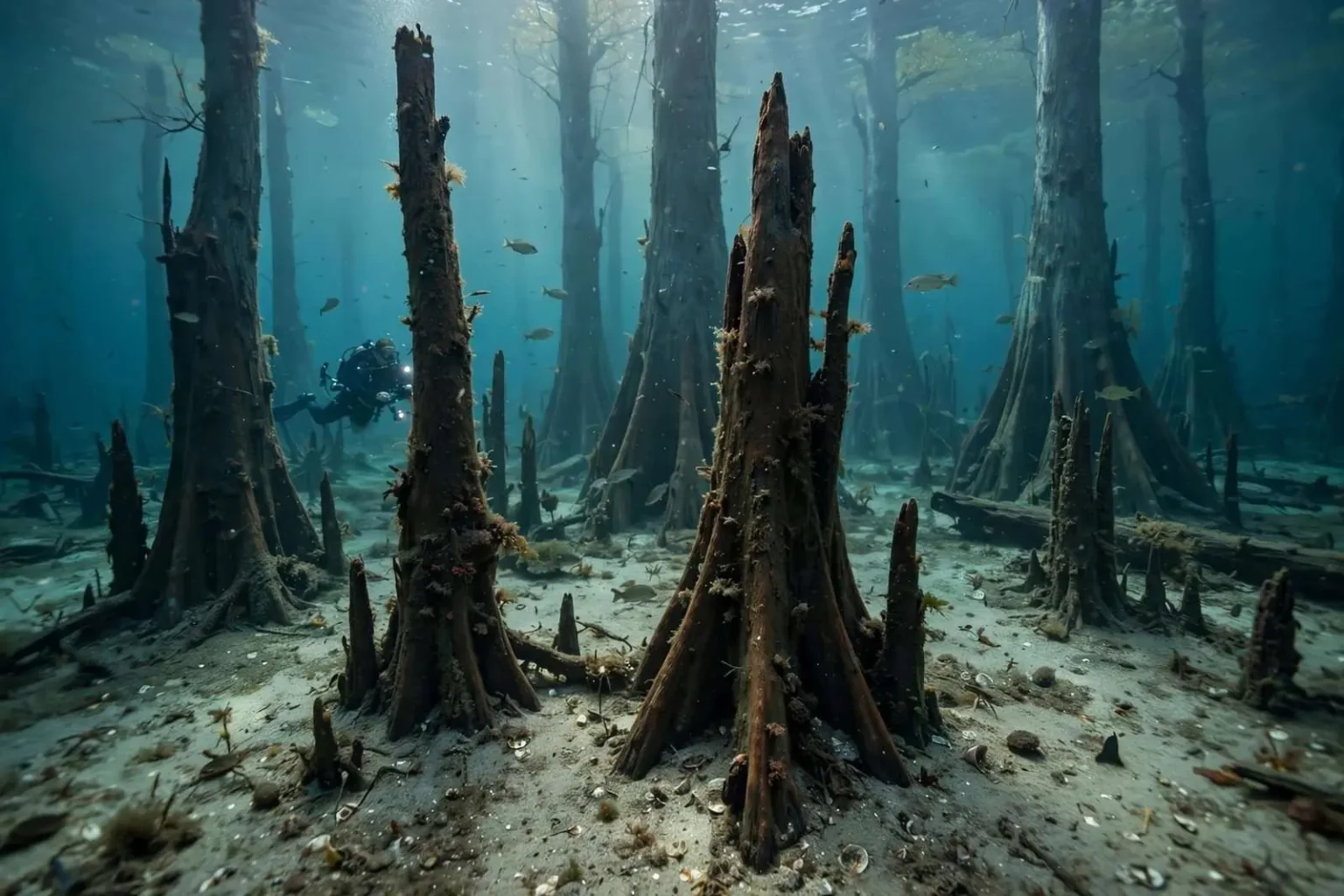
U.S. Rep. Bradley Byrne has introduced the Alabama Underwater Forest National Sanctuary and Protection Act, a measure aimed at safeguarding a remarkable ancient cypress forest discovered beneath the Gulf of Mexico south of Gulf Shores. The bill would give one of the strangest and most scientifically valuable sites on the Alabama coast the same federal protection that covers the nation’s most treasured marine environments.
The legislation would designate the site as a National Marine Sanctuary and protect the dozens of ancient cypress trees found in roughly 60 feet of water off the Alabama coast. The trees still stand where they grew, rooted in the seabed, preserved in an environment that has kept them intact long after the landscape around them vanished beneath the Gulf.
The forest was brought to light by environmental writer and filmmaker Ben Raines, whose work drew scientific, state and national attention to the site. Published reports noted that at least one company had expressed interest in harvesting some of the wood, prompting concern among conservationists. Byrne’s bill would prevent that from happening, closing the door on any commercial recovery of the timber before it starts.
Raines worked with Byrne to help draft the legislation, an unusual degree of collaboration between the man who found the forest and the congressman positioned to protect it. Byrne said the measure would protect Alabamians’ ability to fish, dive and recreate at the site while ensuring none of its invaluable artifacts can be removed or damaged.
A forest lost to rising seas
The underwater forest is a rare window into a landscape that stood along the Gulf Coast thousands of years ago, before rising seas submerged it. When the trees were alive, the shoreline sat far south of where it runs today, and a cypress swamp covered ground that is now open Gulf water. As sea levels climbed at the end of the last ice age, the Gulf swallowed the forest, and the burial that followed — sealed in sediment, deprived of oxygen — is what kept the wood from rotting away entirely.
Sites like this are exceptionally uncommon. Dead trees on the open seabed are normally consumed by marine organisms within years, but the Alabama forest’s trees have survived intact, complete enough that researchers can read annual growth rings and study the climate they record. Scientists who have examined material from the site have described it as a time capsule from an era for which the Gulf Coast has almost no other physical record.
The discovery added Alabama to a short list of places in the world where drowned ice-age landscapes remain exposed on the seafloor. For researchers, that means an opportunity to study what the Gulf Coast’s climate, vegetation and ecosystems looked like during a period of dramatic global change — a period that, in the view of many scientists, offers useful perspective on the changes underway today.
How the forest came to public attention
The site’s path to public awareness ran through the storms that regularly batter the Gulf Coast. Shifts in the seafloor and movement of sand over the site exposed portions of the forest to divers and fishermen, and word of strange stumps in sixty feet of water began circulating among those who worked the Gulf for a living before the site became widely known.
Raines, a longtime environmental journalist on the Alabama coast, pursued the site after learning of it and documented the forest through diving expeditions and reporting that eventually reached a national audience. His work made the forest a point of civic pride in coastal Alabama — and, conservationists feared, a target. The interest from at least one company in harvesting the wood raised the prospect that a site of international scientific value could be stripped for timber before researchers had a chance to study it.
That threat is what gave the sanctuary idea its urgency. In most of the Gulf, the seafloor is open to various commercial and industrial uses, and an unmarked site with no legal protection could theoretically be worked over with little to stop it. A National Marine Sanctuary designation changes that equation completely, wrapping the site in a federal framework that restricts damaging activities and provides enforcement authority.
What a National Marine Sanctuary would mean
National Marine Sanctuaries are the ocean counterpart to national parks — protected areas managed for conservation, research and public enjoyment. The program, administered federally, includes sites ranging from coral reefs in the Florida Keys to shipwreck preserves in Lake Michigan, and a designation brings with it a management plan, restrictions on removing or disturbing resources, and a permanent federal presence.
For the Alabama forest, sanctuary status would preserve the access Byrne described. Fishermen could continue to work the area as the rules allow, divers could visit a site that has few equals anywhere in the world, and scientists could pursue research without competing against commercial recovery of the wood. What no one would be allowed to do is remove or damage the trees and artifacts that make the site significant.
Byrne, who represented south Alabama’s first congressional district including the Gulf Coast, framed the bill in terms of that balance — protection for the resource, continuity for the people who use the water. The measure would keep the forest as it is: standing in the Gulf, available to Alabamians, and preserved for study rather than sold for lumber.
The forest as a scientific asset
The research value of the site is difficult to overstate. Trees from the forest can supply climate records reaching back thousands upon thousands of years, far beyond what written records or tree ring studies on land can reach for the Gulf Coast region. Each ring preserves information about the growing conditions of a single year, and a stand of ancient cypress can assemble those years into a continuous history of drought, rainfall and temperature for a stretch of time about which scientists otherwise know little.
The forest also preserves an ecosystem. Sediments around the trees hold traces of the plants and animals that lived in the swamp, giving researchers a picture of a coastal forest community that disappeared when the seas rose. Comparable sites are so rare that discoveries from the Alabama forest have drawn interest from researchers well beyond the region.
What the bill’s path forward looks like
Any bill to designate a sanctuary must move through the legislative process, and sanctuary designations are rare enough that each one draws scrutiny. Byrne’s measure would put Congress directly in the role of granting the protection, rather than leaving the decision to a lengthy administrative study process, an approach supporters have described as the fastest route to real protection for the site.
Local support on the coast has been vocal. Conservation groups, diving interests and residents of Gulf Shores and the surrounding beach communities have rallied around the forest as something genuinely special — a landmark that exists nowhere else and a potential attraction for the kind of visitors who travel to see natural wonders. Educators in Baldwin County have also pointed to the site as a teaching resource, a chance for students along the coast to study climate history from a forest they can reach by boat.
Why protection matters now
The window for protecting the forest is a practical concern. Interest in harvesting the wood is not hypothetical — published reports noted that at least one company had expressed interest in recovering some of the timber, and preserved ancient wood carries real market value to buyers who prize its age and condition. Without a legal designation, the site sits in open water with no rule preventing someone from beginning that work.
Supporters of the bill argue that once the forest is gone, it is gone in every sense. The trees cannot be regrown, the scientific record they hold cannot be reconstructed, and the public access that makes the site a coastal treasure would be reduced to a memory. That calculation — a finite, irreplaceable resource against a one-time commercial payoff — is the argument at the heart of the sanctuary push.
Byrne’s bill would settle the question permanently. By naming the site a National Marine Sanctuary, the legislation would ensure the forest remains exactly where it has stood for thousands of years: beneath the Gulf south of Gulf Shores, available to the anglers, divers and researchers of coastal Alabama, and protected against anyone who would haul its history to the surface and sell it.
For now, the forest waits — a landscape from a vanished shoreline, standing quietly in sixty feet of water, while the Congress that represents its coast decides how the next chapter of its story will be written. The bill Byrne introduced would take the question out of the hands of commercial interests altogether, and Raines, the man whose reporting put the forest on the map, remains among those working to see the protection through to the end.