
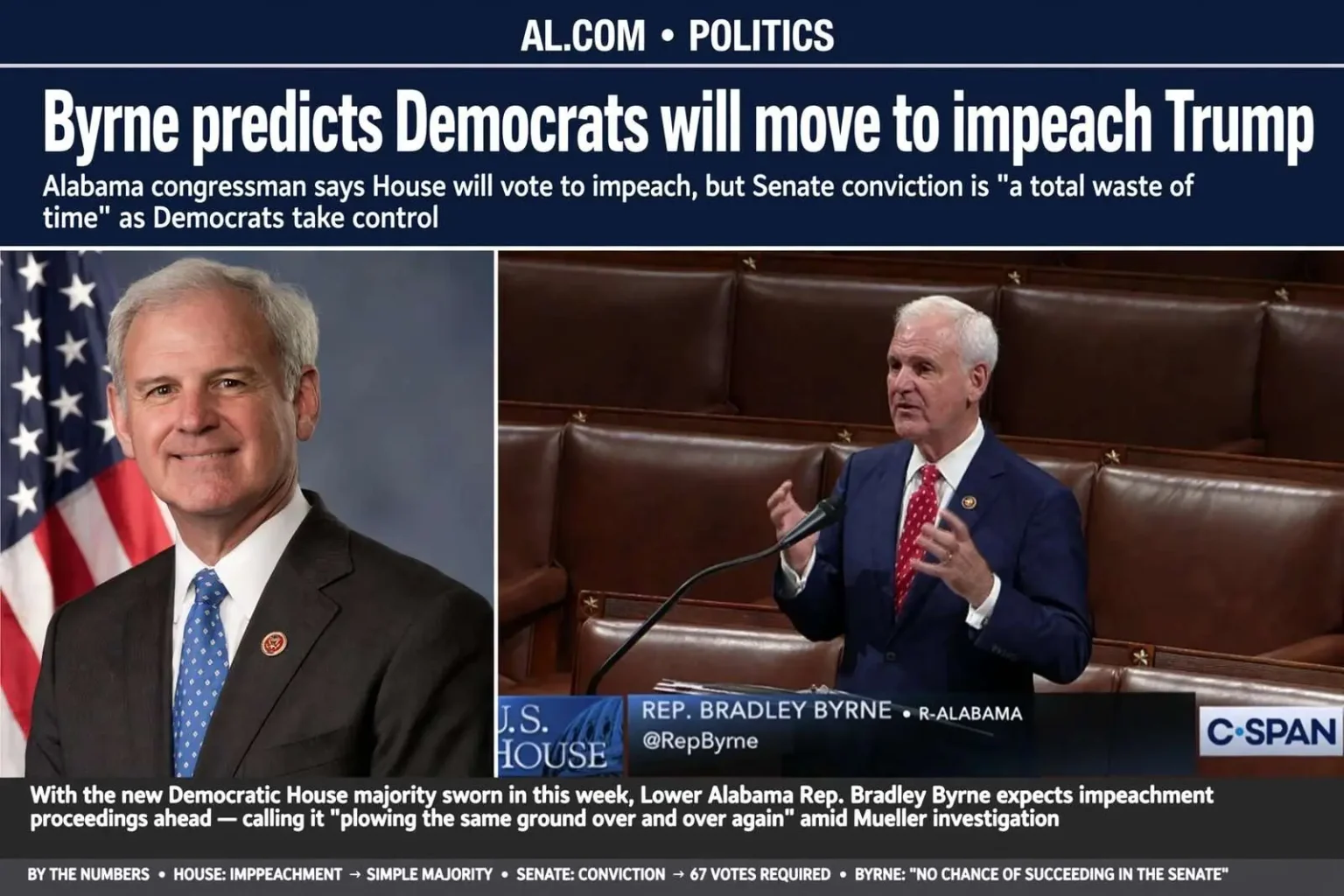
With Democrats taking control of the U.S. House of Representatives, Lower Alabama Congressman Bradley Byrne said he expects lawmakers to pursue impeachment proceedings against President Donald Trump over the next two years. The prediction, made as the new Congress prepared to take office, reflected the incoming majority’s broad investigative ambitions and the deep partisan divide that would define Washington through the rest of the president’s first term.
“I fully expect that they’ll do that,” Byrne said. “Democrats will have all sorts of their own investigations. They’ll plow the same ground over and over again.” The Fairhope Republican framed the incoming majority’s oversight plans not as a search for truth but as political repetition — a continuation of investigations begun when Republicans still controlled the chamber, now carried forward by committees with subpoena power in Democratic hands.
At the time, Special Counsel Robert Mueller had not yet released findings on the Trump campaign’s 2016 ties to Russia and whether the president obstructed justice by firing FBI Director James Comey in 2017. The special counsel’s investigation had hung over the administration for nearly two years, producing a stream of indictments and guilty pleas from figures around the campaign but no public conclusions about the president himself. Until that report landed, every investigation on Capitol Hill operated in its shadow.
The Mechanics of Impeachment
Byrne, a Republican from Fairhope, predicted the House would bring an impeachment vote and have the votes to pass it. Under the Constitution, the House holds the sole power of impeachment — a simple majority vote to bring charges, formally called articles of impeachment. A Democratic majority of the size elected in November 2018 could, in theory, pass articles without a single Republican vote, which is why Byrne treated passage as a near-certainty if the process began.
The Senate, however, is a different institution by design. “It has no chance of succeeding in the Senate,” Byrne said. “It’s a total waste of time.” Conviction and removal require a two-thirds vote of senators present, meaning roughly 67 of 100 members would have to agree — a threshold that has never been reached in American history. The Senate’s composition, with Republicans holding a majority after the 2018 elections, made the barrier steeper still, and no Democrats were predicting they could peel off the twenty or so Republican votes that would be needed.
“It’s a total waste of time,” in Byrne’s telling, referred to the political arithmetic rather than the constitutional seriousness of the process. An impeachment that passes the House but fails in the Senate leaves a president in office, an electorate inflamed and a legislative agenda frozen — the outcome Andrew Johnson faced in 1868, when the Senate fell one vote short of conviction, and again in 1999, when Bill Clinton’s acquittal came with far more than the needed minority intact.
What the Incoming Investigations Could Cover
Beyond the question of impeachment itself, Byrne anticipated a sprawling investigative apparatus. With majorities come committee chairs, and with chairs come subpoena authority over the administration’s records, finances and personnel. Oversight of the executive branch is among the House’s oldest functions, and incoming chairs across the panel structure had signaled plans to examine everything from family business entanglements to policy decisions at the departments.
Byrne’s “plow the same ground over and over again” critique captured the Republican argument about those plans: that the special counsel already occupied the most consequential investigative territory, and parallel congressional probes would duplicate his work for political advantage rather than uncover new facts. Democrats countered that Congress has independent constitutional duties — oversight is not delegation to a special counsel — and that the House could legitimately investigate matters Mueller’s mandate did not reach, including the president’s personal finances.
The clash set up the defining dynamic of the next two years: a House majority that viewed investigation as its core constitutional function, a White House that treated every subpoena as a hostile act, and a Senate that would sit as the final forum for whatever charges emerged. Between them sat the special counsel, whose report — whenever it came — would supply the factual record that either fueled or deflated the impeachment argument.
Byrne’s Position in the Landscape
Byrne represented Alabama’s 1st Congressional District, the Gulf Coast stretch that includes Mobile and Baldwin counties — one of the most reliably Republican districts in the country. His constituents had returned him to office repeatedly, and his defense of the president against impeachment threats aligned with the district’s politics. Baldwin County, his home, had become emblematic of the deep-red South Alabama that gave Trump some of his largest margins in the state, and any effort to remove the president would have been overwhelmingly unpopular among the voters he answered to.
His remarks also reflected the posture of a lawyer-lawmaker. Before entering politics, Byrne built a career in law, and his statements about impeachment consistently turned on process — the constitutional thresholds, the burden of proof, the division of power between the chambers. Arguing that House passage was likely while Senate conviction was impossible required no crystal ball, only arithmetic; he was, in effect, predicting that the next two years would produce a constitutional confrontation that resolved nothing and satisfied no one.
The Mueller Investigation’s Shadow
The special counsel’s work loomed over every prediction made in those months. Mueller’s mandate covered the 2016 election interference question and the obstruction question raised by the Comey firing, and his team had already secured convictions and plea agreements from campaign figures including the president’s former campaign chairman and former national security adviser. What remained unknown was the central question — whether the evidence connected the president himself — and both parties planned their strategies around that unresolved record.
For impeachment advocates among Democrats, the special counsel’s findings were the hoped-for trigger; for Republicans like Byrne, the same findings were the test that the House’s parallel investigations could never legitimately replace. His prediction that the House would move regardless — with or without new evidence — was the partisan mirror of the Democratic argument that no additional evidence was needed to begin examining the questions Mueller’s report might leave open.
The constitutional stakes were familiar from history. Only two presidents had ever been impeached by the House — Andrew Johnson in 1868 and Bill Clinton in 1998 — and both were acquitted by the Senate; Richard Nixon resigned before the full House could vote on his articles in 1974. Each episode followed the same pattern Byrne described: a House majority convinced of the case, a Senate that judged the same evidence differently, and a public left to sort the meaning at the ballot box. The two-thirds standard was written into the Constitution precisely to force that second chamber to be a brake, and its drafters would not have been surprised that no removal had ever succeeded.
What “Total Waste of Time” Meant Politically
Byrne’s bluntness about the exercise reflected a view shared across the Republican conference: that impeachment would function as a mobilizing grievance for the president’s supporters, would consume the legislative calendar ahead of the 2020 elections, and would end in acquittal that Democrats would regret. Opposing it, in his framing, was both a defense of the president and a judgment about what the country could absorb.
For his constituents along the Gulf Coast, the remarks offered a preview of how their representative would spend the next two years — defending the administration’s positions, contesting the House’s investigative reach and arguing that the proper verdict on the president belonged to voters rather than to Congress. The warning that Democrats would “plow the same ground over and over again” proved to be a succinct description of the oversight era that followed, in which congressional investigations, court battles over subpoenas and the special counsel’s report competed for control of the same facts.
Whatever the ultimate outcome of the process he predicted, Byrne’s analysis captured the constitutional geometry plainly: a House with the votes to impeach, a Senate far short of the votes to convict, and a president who would remain in office either way. Between those fixed points lay two years of hearings, reports and arguments — the “total waste of time” he described, or the constitutional duty Democrats saw, depending on which side of the aisle the description came from.
The View From the District
Back home along the Gulf Coast, Byrne’s prediction played to an audience that had already made up its collective mind about the president. The 1st District’s voters had delivered some of Alabama’s widest Republican margins, and town halls in Mobile and Baldwin counties during those years reflected the national polarization in miniature. Byrne’s constituents who supported the president saw the House investigations as a partisan siege; those who opposed him saw overdue accountability. A congressman’s comments on impeachment in such a district were less an attempt to persuade than a signal of alignment.
His Fairhope base gave the remarks a particular resonance. Baldwin County’s explosive growth over the previous decade — new subdivisions along the Eastern Shore, retirees drawn to the coast, a booming local economy — had made it a Republican fortress, and Byrne’s own political identity was forged there. When he warned that impeachment proceedings were coming and would fail in the Senate, he was speaking simultaneously to Washington reporters and to the voters who would judge whether he had defended their interests in the fight.
The comments also placed Byrne within his party’s broader messaging strategy. Republicans entering the minority converged on a shared frame: the incoming House majority would govern by investigation rather than legislation, and voters should judge Democrats accordingly. Byrne’s “plow the same ground” formulation was an efficient piece of that messaging — memorable, repeatable and grounded in the procedural reality that multiple committees would indeed examine overlapping questions about the administration.
Oversight, Subpoenas and the Coming Standoff
The machinery Byrne anticipated was largely structural. A House majority controls committee staffing budgets, hearing schedules and — most consequentially — subpoena enforcement. The incoming chairs had spent the minority years drafting document requests they lacked the power to compel, and they arrived in the majority with investigation plans ready to execute. The administration, for its part, prepared to contest subpoenas in court, setting up legal battles that would stretch for months over executive privilege, testimony from senior officials and access to financial records.
Those standoffs would unfold on a clock. Two-year majorities are temporary, and both sides understood that the investigative window would close at the next election. That urgency pushed committees toward aggressive timelines, and it pushed the White House toward delay as a strategy — a dynamic that has defined every congressional investigation of a modern president, and that Byrne’s prediction assumed would repeat itself here.
The special counsel’s eventual report would sit at the center of it all. When Mueller’s findings finally became public, they would supply the shared factual baseline that all the congressional investigations had been racing to match — and the fight over what to make of those findings, in hearings and in the Senate’s potential jury box, would determine whether the impeachment Byrne predicted actually arrived, and in what form. His forecast that the House would act and the Senate would not was, in the end, a statement about that constitutional design: the framers gave the two chambers different thresholds precisely so that removal would require a consensus no partisan moment easily produces.