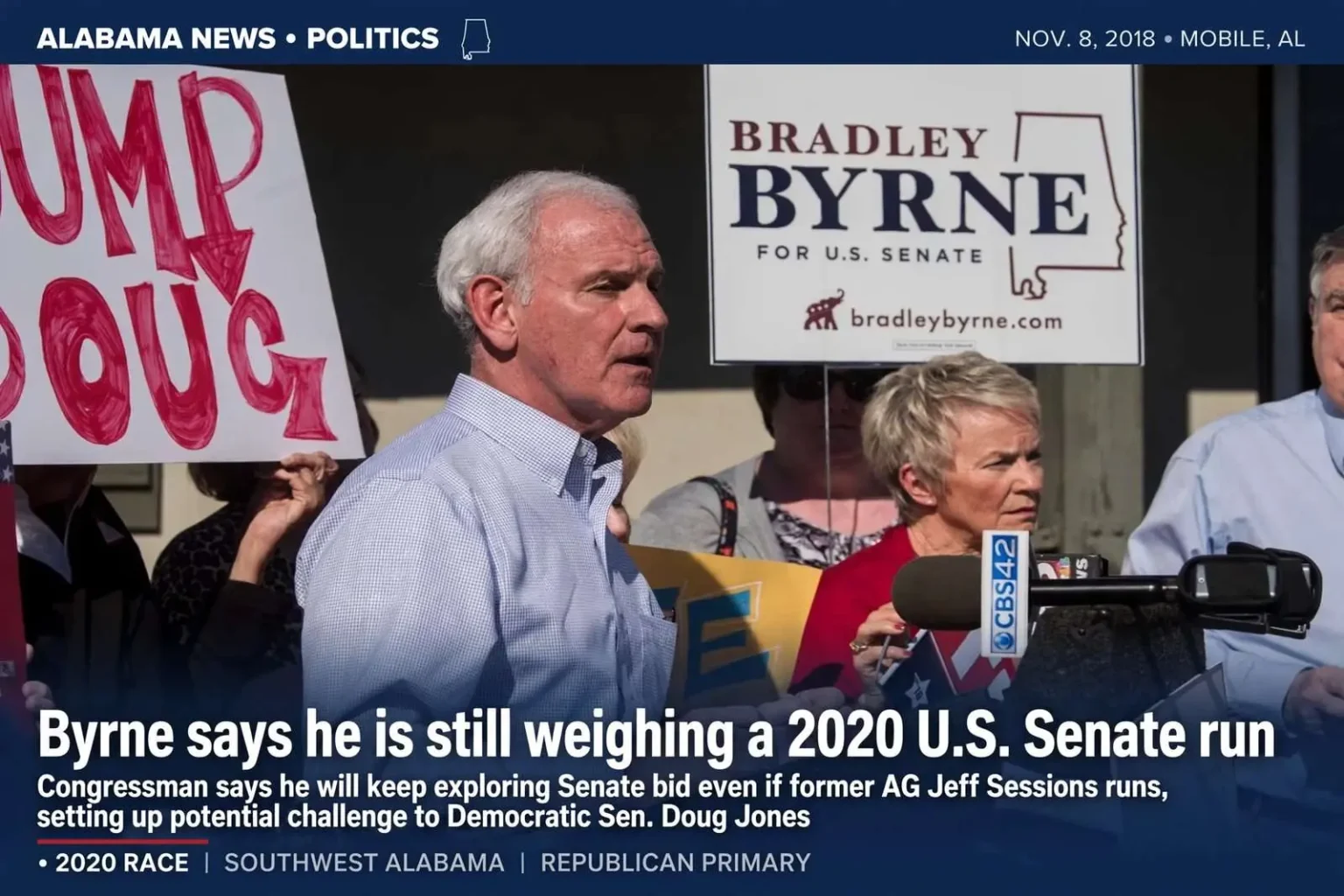
U.S. Rep. Bradley Byrne said he will continue exploring a run for the U.S. Senate in 2020, even if former Attorney General Jeff Sessions enters the race, keeping southwest Alabama’s congressman on a path toward a challenge against Democratic Sen. Doug Jones.
Byrne, who represents Alabama’s 1st Congressional District, was just re-elected to Congress but is already eying a challenge against Jones, whose seat is among the Republican Party’s top national targets in the next cycle. His comments came in the immediate aftermath of a startling development in Washington: Sessions resigned as attorney general Wednesday at President Trump’s request, ending a contentious tenure and touching off immediate speculation in Alabama about whether the state’s former senior senator would try to win back his old seat.
The speculation puts Byrne in a delicate position. Sessions remains a towering figure in Alabama Republican politics, and any primary that includes him would instantly reshape a race Byrne has spent months preparing for. But the congressman made clear that his own timetable would not bend to accommodate the former attorney general’s deliberations.
“He has some decisions to make about his life and his career,” Byrne said of Sessions. “It’s too early to say whether it’s a possibility, but it doesn’t affect what I’m doing — going around the state and talking to people about whether we should run in 2020.”
A shadow race shaped in Washington
The timing of the intrigue was no accident. Sessions’ resignation came the day after the midterm elections, in which Republicans held Alabama’s six other congressional seats and deepened their grip on state government. The instant talk of a Sessions comeback showed how closely Alabama Republicans follow developments in Washington, where a single personnel decision by the president can redraw the map of a Senate race two years before the election.
Byrne’s approach to the question has been methodical. Rather than announcing immediately, he has spent recent weeks traveling the state, testing the appetite for a campaign and building the relationships a statewide race would require. His framing — that Sessions’ potential entry is “too early to say” and “doesn’t affect what I’m doing” — is a classic exploratory stance, preserving both the option to run and the option to defer without closing either door publicly.
The maneuvering also reflects a simple electoral reality. A Republican primary in Alabama is functionally the general election in a state that last sent a Democrat to the Senate more than two decades before Jones took office, and whichever candidate emerges from that primary will start with an enormous advantage. Candidates therefore spend their energy courting primary voters, and a heavyweight entry like Sessions would force every other Republican to rethink a campaign built before he was in the field.
Sessions held the Senate seat now occupied by Jones from 1997 to 2017 before resigning to lead the Justice Department, giving up a position he had held for four terms to become one of the earliest members of Congress to endorse Trump’s campaign. His tenure as attorney general, however, was shadowed by his decision to recuse himself from the investigation into Russian interference in the 2016 election, a step that drew the president’s enduring public anger. The friction between the two men, aired repeatedly on Twitter and in interviews, culminated in the resignation request that came the day after the midterms.
Sessions’ path back to elective office would be unprecedented in one respect: few former attorneys general have sought to reclaim a Senate seat they left for a Cabinet post. But his name recognition in Alabama remains enormous, built on two decades of statewide campaigning and his tenure as the state’s attorney general in the 1990s before he entered federal office. Any primary contest involving Sessions would dominate the state’s political conversation from the day he announced.
For Byrne, the calculus involves more than one rival. Even without Sessions, a 2020 Republican field could be crowded, with other officeholders and contenders considering a race against a Democratic incumbent in a state Trump carried easily. A primary drawing candidates from across the state’s Republican spectrum would test fundraising networks, endorsements and name identification in the state’s major media markets, from Huntsville and Birmingham to Montgomery and Mobile.
Byrne suggested that geography itself could become a storyline. He described a potential all-Lower Alabama Republican primary as compelling, an acknowledgment that the race could field multiple candidates drawn from south Alabama, where the state’s Republican base is anchored in the fast-growing counties along Mobile Bay and the Florida line. Such a field would split the state’s dominant region and could give an advantage to whichever candidate consolidates support elsewhere.
Jones won the seat in a 2017 special election over Republican Roy Moore, a victory that stunned national observers and gave Democrats a foothold in one of the reddest states in the country. The race was upended by allegations against Moore, the former chief justice of the Alabama Supreme Court, and Jones squeaked through by a margin of roughly one and a half percentage points, becoming the first Democrat to hold an Alabama Senate seat since the 1990s.
The circumstances of that win define the coming contest. Jones’ seat was never expected to remain in Democratic hands for long: he was elected to serve out the remainder of Sessions’ term, and the seat returns to the ballot in 2020 for a full six-year term. Republicans nationally have made reclaiming it a priority, and the party’s history in the state suggests that a unified nominee starts as a heavy favorite, particularly in a presidential election year when turnout runs high and the top of the ticket drives enthusiasm.
For Jones, the identity of his eventual opponent matters enormously. A marquee Republican with deep statewide roots would present a different challenge than a fractured field of lesser-known candidates, and the senator’s political operation spent 2018 building an incumbent’s record on issues such as health care, criminal justice and veterans’ matters while the Republican side sorted itself out.
Byrne’s long road to statewide consideration
Byrne’s own résumé is unusually deep for a congressman of his tenure. Before arriving in Washington, he served as a member and chairman of the Mobile County school board, as a state senator representing Baldwin County, and as chancellor of Alabama’s two-year college system, where he took on the job of cleaning up a system shaken by scandal. He ran statewide once before, entering the 2010 Republican primary for governor, and won his congressional seat in a 2013 special election after Jo Bonner resigned to take a position with the University of Alabama system.
That history gives Byrne both assets and liabilities in a statewide race. His base in the 1st District, stretching from Mobile through Baldwin County and the Wiregrass, is one of the most reliably Republican regions in America, and his years in state government gave him contacts in every corner of Alabama. But rivals would note his earlier statewide campaign ended in defeat, and a primary field that includes figures with broader name recognition would test his ability to expand beyond southwest Alabama.
The congressman’s continued exploration also reflects the unusual openness of the 2020 cycle. With no incumbent Republican to displace, the nomination is an open prize, and ambitious Alabama Republicans must weigh an opportunity that will not recur: a Democratic senator in a Trump state, running for a full term at the top of the ticket. Byrne has evidently concluded that the chance justifies the travel, the fundraising and the uncertainty of waiting on Sessions’ decision.
“Let’s just wait and see what happens,” Byrne said, a summary of a race that remained, in the days after the midterms, entirely prospective, with the state’s most famous political figure unemployed, its newest senator bracing for a rematch, and a congressman from Mobile deciding whether the time had finally come for a statewide run.
Alabama’s other potential contenders were watching the same signals. In the days after Sessions’ departure from the Justice Department, Republicans across the state waited to see whether the former senator would clear the field by running or leave it open by standing aside, and several prospective candidates delayed announcements pending his decision. Byrne’s public insistence that his timeline is unaffected positions him to move regardless of what the former attorney general chooses, a useful posture in a field where hesitancy can read as weakness.
The national stakes add pressure to the Alabama calendar. Senate Republicans enter the 2020 cycle defending a narrow majority, and Alabama is one of the easiest pickups on their map; national party committees and outside groups can be expected to invest heavily in the state once a nominee emerges. For Alabama Republicans, that attention cuts both ways, bringing money and manpower while also inviting the kind of scrutiny and outside interference that reshaped the 2017 special election.
For now, the matchmakers in both parties remain busy. Byrne goes on talking to voters around the state, Sessions weighs a comeback unlike any in modern Alabama politics, and Jones builds an incumbent’s case for a seat nobody expected him to hold this long. In a state where a single Senate race can absorb years of political energy, the 2020 contest has already begun, two years before a single vote is cast.