
Byrne says impeachment should be reserved for ‘extreme cases’
Rep. Bradley Byrne, who represents Lower Alabama, said he would vote against impeaching President Trump, arguing it should be reserved for extreme cases.
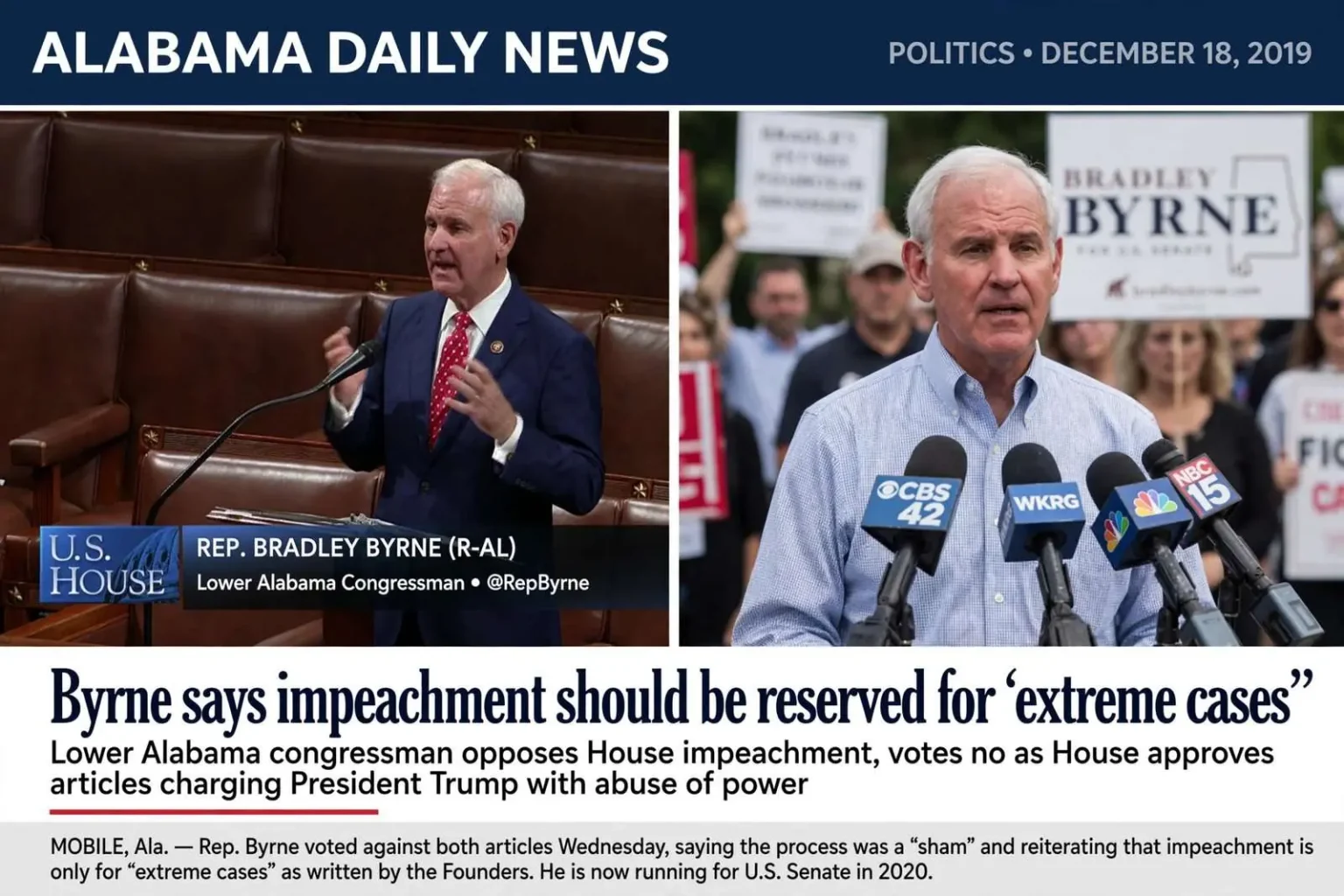
As the U.S. House of Representatives prepared to vote on impeachment, Lower Alabama Congressman Bradley Byrne said he would oppose the effort, arguing the Constitution reserves impeachment for extreme cases. “If you read what the founders said in the Constitution, they are very clear. Impeachment is only for extreme cases,” Byrne said. “It’s pretty clear to me that this is not an impeachable offense.”
President Donald Trump faced a charge of abusing his power by leveraging military aid for Ukraine to seek political information on the son of rival Joe Biden. Byrne disputed that characterization, pointing to the White House transcript of the call, which he said shows no crime. Democrats argued the transcript — in which Trump asked the Ukrainian leader “I would like you to do us a favor though” after discussing aid — is evidence of wrongdoing. Byrne said it proves nothing.
Byrne, who has represented the region in Congress since 2013, is running for U.S. Senate in 2020. His position on impeachment placed him squarely in line with most of his party’s House caucus, but it also carried particular weight at home: Alabama’s First District, which stretches from Mobile and Baldwin counties through the state’s southeastern corner, has long been among the most reliably Republican districts in the country, and Byrne’s Senate campaign gave every vote he cast in the fight an added political dimension.
The Case and the Counterargument
The dispute over the Ukraine call was at the center of the entire impeachment inquiry. House Democrats contended that conditioning security assistance on an investigation that would benefit the president politically constituted an abuse of office, and that the transcript’s “favor” language showed the purpose plainly enough. Byrne and other Republican defenders countered that the aid was ultimately released, that no quid pro quo was stated, and that reading the transcript end to end reveals a conversation about allied cooperation rather than a criminal solicitation. Those two readings of the same document became the shorthand for the whole national argument.
For constituents in south Alabama, the debate played out against familiar context. The region has deep ties to the military installations and shipbuilding industries that much of the Ukraine security aid supported, and local voters followed the question of how those funds were handled with direct, practical interest. Byrne’s office had emphasized defense priorities throughout his tenure, and the aid controversy sat at the intersection of that record and the impeachment fight.
Update: House Votes to Impeach; Byrne and Gaetz Vote No
The Democratic-controlled House went on to impeach Trump on Dec. 18, approving articles charging that he abused the power of his office and obstructed the chamber’s investigation. Byrne followed through on his stated position and voted against both articles. The December vote made Trump the third president in American history to be impeached by the House, and it split Congress along almost entirely partisan lines — a contrast with the 1998 impeachment vote, when a handful of members crossed the aisle in both directions.
Byrne described the proceedings as procedurally illegitimate, calling the articles among the most legally unsound in the chamber’s history. “From the beginning, this has been a sham and this House has been nothing but a star chamber,” he said, arguing that Republicans were denied the chance to call witnesses and that the president was denied a meaningful opportunity to mount a defense. The star-chamber reference invoked the notorious 15th- and 16th-century English court that met in secret and answered to no one — a phrase American politicians reserve for proceedings they consider fundamentally unfair.
The procedural complaint was the one Republicans pressed most consistently through the fall. Inquiry hearings held in closed session before the public phase drew particular criticism, as did the pace of the committee schedule. Democrats responded that the president’s refusal to cooperate with subpoenas for documents and testimony — which became the basis of the obstruction article itself — had limited what the investigation could accomplish. That mutual complaint became the second structural argument of the impeachment: not just what the president did, but how the House investigated it.
In a message posted after the vote, Byrne wrote: “I VOTED NO on impeachment. This was never about justice or facts,” adding that he viewed the effort as an attempt to reverse the 2016 election. The framing echoed the argument Republican members made uniformly through the week of the vote, and it anticipated the campaign language of the months ahead, when the Senate trial and the 2020 election season would run on parallel tracks. For Byrne, the two tracks converged directly: his Senate campaign would be decided the same year the Senate tried the case.
Gaetz Also Opposed Both Articles
Congressman Matt Gaetz, whose Northwest Florida district borders the Alabama coast and overlaps the region’s media market, also voted no on both articles. Gaetz’s district includes Pensacola and much of the Florida Panhandle, and his Pensacola-based coverage area shares television stations, newspapers and daily commerce with Baldwin County — which is why his votes register with Lower Alabama audiences as much as their own congressman’s do. Through the inquiry he was among the president’s most aggressive defenders on Capitol Hill.
Gaetz cast the vote as a fight over political power rather than foreign policy. “This isn’t about Ukraine. It’s about power,” he said, arguing there was no crime, victim or proof behind the charges and predicting voters would penalize Democrats in the following November’s elections. The prediction staked the party’s case to the electorate itself: that voters, not House majorities, should settle the question, a stance that mirrored the position taken by every House Republican who opposed the articles.
Both statements reflect the positions of the congressmen and their characterizations of the proceedings; House Democrats maintained the evidence gathered in their inquiry supported both articles. That gap — between lawmakers who saw a completed abuse of power and lawmakers who saw a policy dispute weaponized for political gain — was never reconciled in the House, and it carried directly into the Senate trial that followed, where two-thirds support would have been required to remove the president from office and where acquittal remained the expected outcome from the day the articles were transmitted.
What It Means for Lower Alabama
For the Gulf Coast, the vote was less about Washington theater than about representation. Byrne’s district includes the Port of Mobile, the aerospace corridor around Brookley, and the shipbuilding and defense contractors whose budgets are shaped by the same national-security debates that ran through the Ukraine controversy. His Senate campaign — for the seat the state’s voters would fill in 2020 — meant his impeachment posture would follow him onto the trail, where Alabama Republican primary voters would judge it directly.
The coast’s unique media geography amplified both votes. From Mobile to Pensacola, residents live in a shared media market split across two states and two congressional districts, so the positions of Byrne and Gaetz circulated through the same talk radio, television coverage and social feeds. When both men voted the same way on both articles, the regional message was uniform, and the post-vote statements were aimed at an audience that straddles the state line.
The Road After the House Vote
The House’s Dec. 18 vote was the constitutional midpoint of the process, not the end. The articles moved to the Senate for trial, where Chief Justice John Roberts would preside and where the chamber’s Republican majority made removal mathematically out of reach — conviction requires a two-thirds vote of senators present, a threshold no impeachment trial of a president has ever met in American history. That arithmetic shaped the House debate as well, with both parties acutely aware that the Senate outcome was effectively predetermined while the political consequences were not.
Byrne’s arguments — the founders’ standard of “extreme cases,” the fairness of the process, the claim that no crime was proven — were the arguments his party carried into the trial. Democrats’ counterarguments, anchored in the transcript’s own words, were carried by the House impeachment managers. Both sides treated the eventual Senate verdict as validation, and both understood that the final jury on the dispute would not be any chamber of Congress but the voters in November.
Whatever view one takes of the underlying charges, the episode underscored how completely impeachment has become a national fault line rather than a constitutional rarity exercised with caution. For Lower Alabama, the practical takeaway was simple: the region’s two congressional representatives on the Gulf Coast voted as a bloc against both articles, explained themselves in identical terms, and tied their case to the election that was already underway. The record of how they explained those votes — and of how their critics answered them — is now part of the district’s political history.