Cain Raisers Cut From 2024 Joe Cain Parade Lineup Over Bylaws Dispute
The Cain Raisers, founding floats of Mobile's Joe Cain Parade, are excluded from the 2024 lineup over a missing notarized affidavit after their president's.
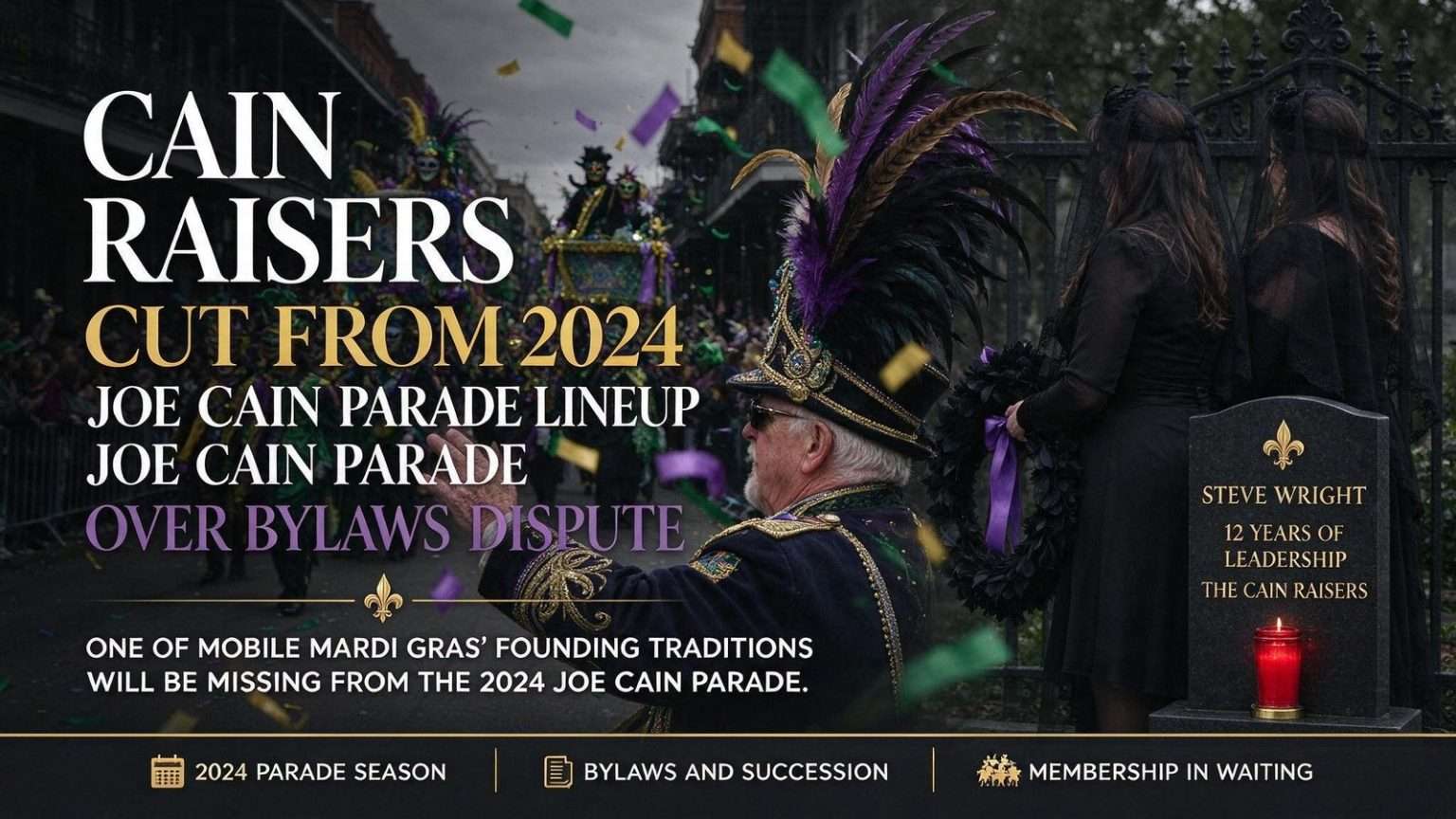
One of Mobile Mardi Gras’ founding traditions will be missing from the 2024 Joe Cain Parade, as preparations for the season get underway. The Cain Raisers — the two floats that have rolled directly behind the Joe Cain Merry Widows since the parade began more than 50 years ago — are off the lineup for the coming year. The group counts 88 riders and 50 associate members waiting their turn to ride.
“That’s crazy, isn’t it, the oldest group in the parading society being booted to the back,” Cain Raisers spokesperson Lynne Locklin-Hatch said. “We recently got unceremoniously kicked out of the parade.”
The removal closes a slot in the parade’s order that has belonged to the same organization for the better part of a century of Mobile Mardi Gras memory, and it does so over a fight that has nothing to do with floats, throws or costumes — only paperwork.
A Missing Notarization
At the heart of the dispute is paperwork that was never notarized before the Cain Raisers’ longtime president, Steve Wright, passed away in August after a battle with ALS. Wright had led the society for 12 years, and the group named a float — “the Steve” — in his honor.
In a letter sent to the Cain Raisers’ attorney, Joe Cain Parading Society president Steve Cain said Wright was aware of bylaws requiring a notarized affidavit to pass the presidency to a successor while he was still attending meetings during his illness. Because that paperwork never came in, the society says the group can no longer participate.
The dispute therefore turns on a technicality with enormous consequences: whether the Cain Raisers’ current leadership can demonstrate it was properly installed under the society’s rules. From the parading society’s standpoint, the bylaw exists precisely to prevent questions like this one — succession disputes that surface when a founding or longtime leader dies — and the lack of a notarized affidavit leaves the group’s standing in limbo.
For the Cain Raisers, the framing feels grotesquely mismatched to the moment. The group had just buried the president who led it for 12 years through a fatal illness, had named a float in his honor, and now finds itself excluded from the parade he helped lead it in — not for any failure on the parade route, but for a signature that never got notarized while he was alive.
For Locklin-Hatch, the stakes go beyond one parade season: “That’s kind of what really hurt is that this could possibly dissolve us as a group.”
What the Cain Raisers are
The Cain Raisers occupy a singular place in Mobile’s Mardi Gras calendar. They ride in the Joe Cain Parade, the Sunday-afternoon procession that caps the city’s Joe Cain Day celebration, and their two floats roll directly behind the Joe Cain Merry Widows — the black-veiled women in mourning dress who claim descent from the widows of Joe Cain himself.
The parade honors Joseph Stillwell Cain, the Mobile man credited in 1866 with reviving Mardi Gras in the city after the Civil War, when he paraded through the streets dressed as the fictional Chickasaw chief Slacabamorinico — a satirical gesture aimed at the occupying Union army. Mobile has celebrated Joe Cain Day on the Sunday before Fat Tuesday for decades, and the day’s traditions — the Merry Widows’ mournful wailing at his tomb, the parade, the gatherings in Bienville Square — form a distinct strand of the city’s Carnival season, separate from the big weekend parades downtown.
Within that tradition, the Cain Raisers’ position behind the Merry Widows has been fixed since the parade began more than 50 years ago. The group describes itself as the oldest group in the parading society’s lineup, and its 88 riders and 50 associate members represent one of the larger memberships awaiting a place in the procession.
The city’s hands-off role
The City of Mobile has no control over which groups make the parade lineup. With only 36 float slots allotted in the Joe Cain Parade, the Cain Raisers’ future participation remains uncertain.
That division of authority surprises many observers of Mardi Gras disputes. Municipal police, fire and permitting officials manage the logistics of every parade — routes, insurance, cleanup — but the composition of each procession is governed by the private parading organizations and their umbrella bodies. A city government cannot order a float back into a lineup, which is why disputes like this one play out through attorneys and bylaws rather than through City Hall.
The arithmetic of the parade sharpens the stakes. Thirty-six float slots is a fixed number, and every organization holding one defends it. When a slot is vacated — by dissolution, inactivity or, in this case, an eligibility dispute — the groups on the waiting list move up, and the group removed has no easy path back. The Cain Raisers’ roster of 88 riders and 50 associate members is therefore a constituency in waiting: members who joined, paid dues and expected their turn to ride.
A dispute over paperwork and legacy
The society’s position, as laid out in the letter to the Cain Raisers’ attorney, rests on the notarized affidavit requirement in its bylaws. Steve Cain, the parading society’s president, asserted that Steve Wright knew of the requirement while he was still well enough to attend meetings during his illness — a suggestion that the failure was neglect rather than impossibility.
The Cain Raisers’ response, through Locklin-Hatch, reframes the same facts: a dying man presiding over a 12-year tenure, a group honoring him with a float bearing his name, and an exclusion announced as the group was still mourning him. The disagreement is less about what the bylaws say than about whether applying them this way, in this circumstance, serves the organization either group claims to protect.
Legal involvement adds another layer. The letter’s address to the group’s attorney signals that the dispute has moved past negotiation between members and into a formal posture, where any path back into the 2024 lineup — or into future lineups — likely runs through documentation of the succession the affidavit was supposed to certify.
What rides on 2024
For the coming Mardi Gras season, the immediate consequence is visible on the parade route: the two floats that have rolled behind the Merry Widows for the parade’s entire history will not roll in 2024. Regular attendees will notice the gap; the floats’ absence will be the first thing many Mobilians know of a dispute that has otherwise played out in private correspondence.
The longer-term question is organizational. Locklin-Hatch’s warning that the dispute “could possibly dissolve us as a group” points to the practical reality that a parading society without a parade slot struggles to hold a membership together. Dues-paying riders who cannot ride drift away, associate members lose their reason to belong, and a tradition sustained by 88 riders and 50 associates can hollow out in a season or two.
Joe Cain Day and the parade it anchors
Understanding what the Cain Raisers stand to lose requires understanding the day itself. Joe Cain Day falls on the Sunday before Fat Tuesday, between the serious business of the weekend parades and Mardi Gras Day itself, and it celebrates the man Mobile credits with restarting Carnival after the Civil War. Cain’s 1866 procession — one man, in Chickasaw chief costume, riding a coal wagon through a defeated city — became the founding story that distinguishes Mobile’s Mardi Gras claim as the oldest in the United States.
The modern Joe Cain Day layers rituals onto that story. The Joe Cain Procession rolls through the city with its own character — satirical, scrappy, less formal than the mystic societies’ downtown parades — and the Merry Widows appear in their black mourning dress, wailing at Joe Cain’s tomb in Church Street Cemetery in the ceremony that opens the day. The crowds come out in their own costumes, and the atmosphere is deliberately looser than any other parade day on the calendar.
The Cain Raisers have been part of that pageant from the parade’s start more than five decades ago, their two floats fixed directly behind the Merry Widows in the running order — a place of honor that reflected their seniority among the parading society’s groups. Their riders and floats carry the humor and history of the day, and their absence creates a visible hole in a lineup Mobilians have watched follow the same order for generations.
Succession disputes and Carnival organizations
Disputes over leadership succession are not unique to the Cain Raisers among Carnival organizations, which is exactly why societies write notarized-affidavit requirements into their bylaws. Mardi Gras societies hold real assets — floats, dens, throws, equipment, trademarks and bank accounts — and when a longtime president dies, questions about who may act for the organization can paralyze it. The affidavit requirement is meant to force the succession question while the outgoing leader can still answer it.
The Cain Raisers’ case shows the requirement working exactly as written, and, the group would argue, exactly as it should not. The bylaw presumed a leader who could notarize the transfer; ALS gave Steve Wright a calendar he could not control. Whether the society’s rules make room for that reality — through emergency measures, waivers or membership action — is the practical question underlying the attorney-to-attorney correspondence.
Other Mobile parading organizations watching the dispute have their own succession paperwork to consider. The case functions as a citywide prompt: officers of Carnival societies checking their bylaws, confirming their own affidavits are current, and asking what would happen to their parade slots if their leadership changed suddenly in the middle of a season.
Waiting on the 2024 season
As preparations for the 2024 season proceed, the parading society will finalize its 36-float lineup without the Cain Raisers for the first time in the Joe Cain Parade’s history, and whichever organization or organizations fill the vacated positions will ride in slots the group held since the parade’s founding.
For members of the group, the path forward depends on resolving the standing question the affidavit was meant to settle. If the succession can be documented or the society relents, a return to the lineup in a future season remains possible; if it cannot, Mobile’s oldest parade tradition faces the prospect of continuing without one of its founding participants.
Either way, the dispute has already made one thing clear: in Mobile Mardi Gras, tradition is administered through bylaws, and even a group that has rolled for more than 50 years behind the Merry Widows can lose its place — at least for a season — over a missing notarized page.