
Capital murder charges filed in missing nurse Terri Sullivan case
Washington County authorities charged Samuel Sullivan and Jenny Sullivan with capital murder in the disappearance of nurse Terri Sullivan.
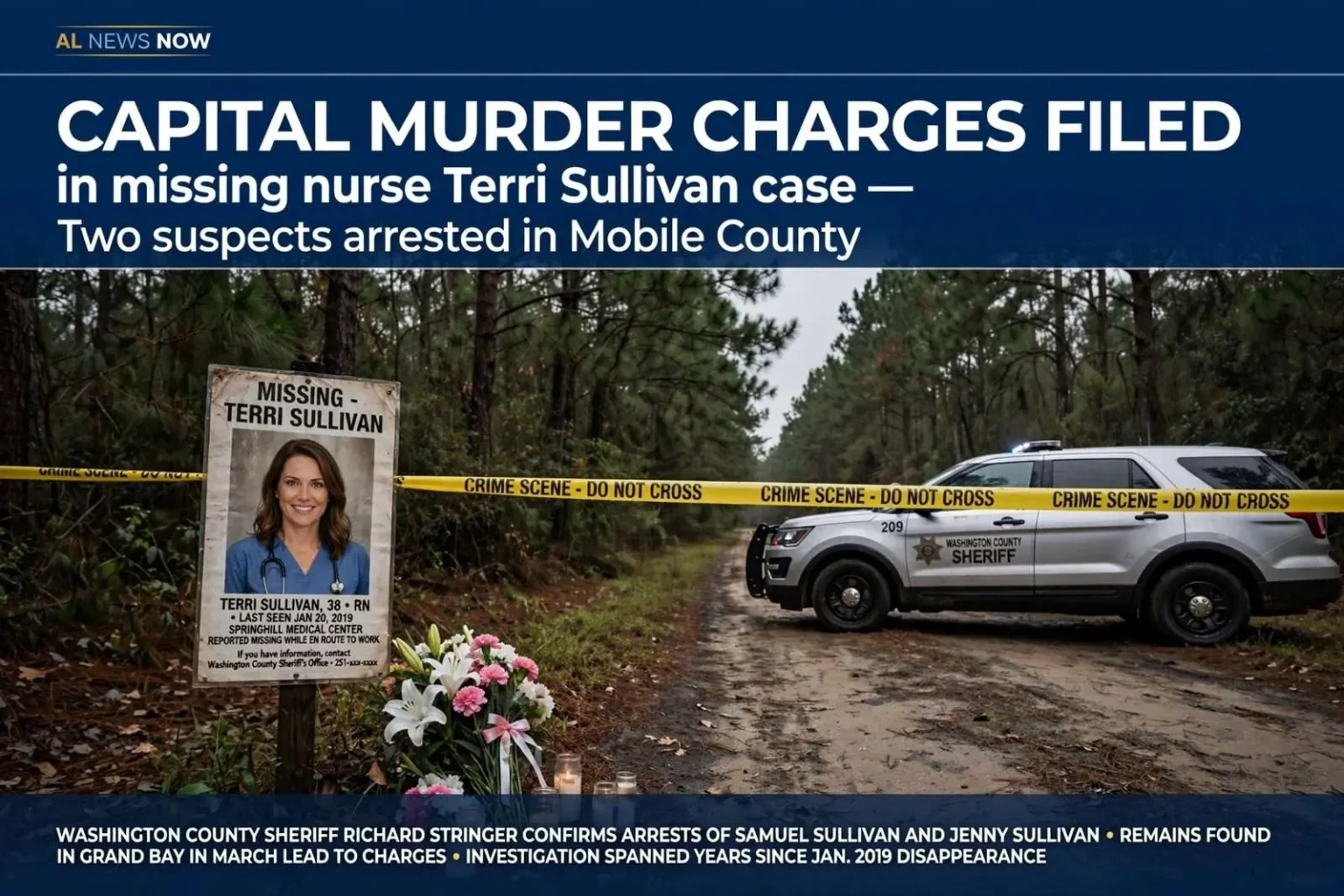
Capital murder charges have been filed against two people in the disappearance of nurse Terri Sullivan, according to Washington County Sheriff Richard Stringer.
Samuel Sullivan, Terri’s husband, and his ex-wife Jenny Sullivan were taken into custody in Mobile County. The sheriff said the arrests had been in the works for some time and that investigators had gathered the evidence they needed.
The charges mark the most serious escalation yet in a case that has stretched across years of searching, first for a missing woman and later for answers about what happened to her on the morning she vanished on her way to work.
The Disappearance
Terri Sullivan was first reported missing in January 2019. Sheriff Stringer said foul play was suspected from the beginning of the investigation, a judgment that shaped how deputies and assisting agencies approached the case from its earliest days.
Sullivan was last seen early on a Sunday morning when she left for work at Springhill Medical Center in Mobile. She never made it to the hospital. For a nurse whose routine was well known to family and coworkers, the failure to arrive was immediately alarming, and the concern only deepened as the hours passed without any word from her.
Her cell phone, a bracelet and other personal items were found on a dirt road where investigators say there were signs of a struggle. The discovery transformed the case from a missing-person inquiry into a criminal investigation, and it gave searchers a focal point for the work that followed.
Using a helicopter, an aerial search of the area where she went missing was conducted surrounding Clark Place Road in Tibbie, a small community in rural Washington County near the Mississippi line. Deputies walked and rode through timberland, fields, and vacant property in the area, and hours were spent searching property in Mobile County in connection with the disappearance as investigators followed leads across county lines.
The terrain in that part of south Alabama complicated the search. Washington County is sparsely populated, thickly wooded, and laced with dirt roads, and an aerial sweep can only do so much in country where a driveway or clearing is screened from above by pines. The ground effort continued for months as volunteers and deputies alike kept looking.
Charges Filed
Authorities said they expect the capital murder charges to follow the discovery of human remains in Grand Bay in March. The remains were found in the Grand Bay community in southwestern Mobile County, a development that shifted the case’s center of gravity from Washington County to Mobile County and gave investigators the evidence they needed to seek the more serious charges.
The two suspects were initially arrested on first-degree kidnapping counts after the remains were discovered. Prosecutors and investigators then spent time building toward the capital murder charges, which under Alabama law can apply when a killing occurs in the course of a kidnapping — a framework that matches the sequence investigators describe in the Sullivan case.
Sheriff Stringer said he spoke with Terri Sullivan’s family earlier in the day and they were relieved the arrests had been made, while still grieving. For a family that had waited years for movement in the case, the formal filing of capital charges represented both progress and a painful confirmation of what they had long feared.
A Case That Crossed County Lines
From the outset, the investigation drew on resources from multiple jurisdictions. Washington County is one of Alabama’s smallest counties by population, and its sheriff’s office routinely calls on partners — including the FBI, state investigators, and agencies in neighboring Mobile County — when a case demands manpower and expertise beyond what a small rural department can muster alone.
The geography of the case reflected that cooperation. Terri Sullivan lived and worked along a corridor that ties Washington County to Mobile: her morning commute toward Springhill Medical Center would have carried her eastward through rural stretches of two counties. Items found on a dirt road near Tibbie pointed investigators to Washington County, while the eventual discovery of remains in Grand Bay and the arrests in Mobile County placed significant parts of the case in Mobile County jurisdictions.
That split has required careful coordination between the two sheriff’s offices and prosecutors, who must sort out which charges are brought where and how the evidence gathered by each agency fits together. Capital murder prosecutions in Alabama are among the most demanding cases a district attorney’s office handles, and cases built on years-old evidence add layers of forensic and investigative work.
How Long Investigations Move From Suspicion to Charges
Cases like Sullivan’s illustrate a pattern that seasoned investigators describe often: the early hours and days of a suspicious disappearance matter enormously, but the path to charges can take years. In the Sullivan case, deputies suspected foul play from the beginning, yet building a case that prosecutors could carry to trial required gathering evidence piece by piece — items recovered from the dirt road where she was last known to be, searches of properties in two counties, interviews, and ultimately the forensic work connected to the remains found in Grand Bay.
Sheriff Stringer’s comment that the arrests had been in the works for some time reflected that reality. Investigators do not simply arrest the people they suspect; they wait until the evidence is assembled to a standard that will hold up through a capital case, where the stakes for the state are as high as they get. The decision to file capital murder charges rather than proceed on the initial kidnapping counts signals that prosecutors believe the evidence now supports the most serious charge available under Alabama law.
Capital murder in Alabama carries the state’s harshest penalties, and prosecutions under the statute involve a separate sentencing phase and heightened procedural requirements. The timeline from charges to trial in such cases is typically measured in years, with pretrial litigation over evidence and forensic findings consuming much of the interval.
The Communities Left Waiting
In Tibbie and across Washington County, the disappearance of a local nurse in January 2019 lingered in the community’s memory throughout the long investigation. Rural counties feel such losses keenly — the victim was known personally to many residents, and the search effort itself, with its helicopter flights and road-by-road sweeps, became part of local life for months. Neighbors kept watch over the Clark Place Road area, and tips continued to arrive at the sheriff’s office long after the initial searches ended.
In Grand Bay, the discovery of remains in March brought the case into another community, one that has absorbed its own share of serious crimes over the years as growth spreads along the corridor between Mobile and the Mississippi line. Residents there learned that the quiet fields and timberland around their community had become part of a capital murder investigation.
Through it all, the family’s steady presence has been a fixture of the case. Sheriff Stringer’s decision to call them before the arrests were announced reflected the relationship that develops between investigators and victims’ families over years of shared waiting. The family’s response — relief that arrests had finally been made, even as they continued to grieve — captured the ambivalence that long-delayed resolutions always carry: answers arrived, but they arrived too late to change the outcome that mattered most.
What Comes Next
With capital murder charges now filed, the case moves from the sheriff’s office to the courtroom. Prosecutors will present the evidence to a grand jury as required in felony cases, and the defendants will face arraignment on the capital counts. Given the gravity of the charges, both are expected to remain in custody without bond while the case proceeds, as Alabama law generally provides in capital matters.
The investigative file behind the charges is substantial by any measure. It includes the scene evidence from the dirt road near Tibbie — the cell phone, the bracelet, and the other personal items recovered there — along with the results of property searches in both counties, aerial survey work, and the forensic investigation tied to the remains found in Grand Bay in March. Defense attorneys will spend months reviewing that record, and challenges to specific pieces of evidence are likely as the case advances.
For the Washington County Sheriff’s Office, the arrests close an investigative chapter but open a demanding one. Sheriff Stringer has committed to seeing the case through, and his office will continue to support prosecutors as the matter moves forward. Deputies who worked the case from the first missing-person report in January 2019 through the capital murder charges filed this week have seen nearly every phase of a major criminal investigation — and, like the family they have kept informed along the way, they mark the arrests as progress rather than an ending.
Anyone with information relevant to the case can still contact the Washington County Sheriff’s Office, where investigators say the file remains open until the prosecution concludes. For a community that has waited years for answers, the capital murder charges filed this week represent the closest thing to accountability the case has yet produced — and the beginning of the legal process that will determine what ultimately comes of them.